Effective Use of the Temperaments in Education and Discipline

So far we have looked at the four-fold human being and had an introduction to the temperaments.  Today we are going to peek at HOW to use the temperaments as an ally in education and discipline.  As I have said in the first two parts to this post, this information was presented to our homeschooling group at a wonderful workshop on the temperaments given by our Waldorf Handwork teacher, Ms. Judy Forster.  She is so knowledgeable and wonderful. We are so lucky to have her as part of our group! 

So to start, a quick common question is something like this:  “Yes, I read all the descriptions of the temperaments and I still don’t know what temperament my child is.”

Yes, sometimes it is hard to tell.  It is easy to confuse the predominant temperament of a developmental stage for an individual temperament.  I have heard Waldorf teachers say typically two temperament predominate.

So, Ms. Forster gave us a tip that one place to garner an idea regarding your child’s temperament is in looking at how they approach handwork,   A choleric child will want to be done first with their handwork, and will make mistakes along the way because they are going so fast because they HAVE to be done first.  A sanguine child may have lots of holes in their loose knitting because they got distracted or were too busy talking, and are content to know that maybe the fairies will come and fix it later.  A melancholic child will take their handwork very seriously, they will be extremely detail-oriented  and will rip a piece of knitting apart for the one stitch that was off that that the handwork teacher  told them was okay to leave alone (but they can’t, so then they have to rip it all out when the teacher is not looking).  Their knitting is usually tight.  The phlegmatic child is hard to get going on anything, but once they get going, it is either hard for them to stop – they may end up knitting a rug-sized piece of something when the project was supposed to be small because they just couldn’t stop – or they may just be steady and be done first (much to the chagrin of the choleric child).   Those examples came  from Judy Forster, our wonderful and knowledgeable Handwork teacher.  Please see her Etsy shop here: http://www.etsy.com/shop/mamajudes

Here is an example from me.  I think the temperaments show in how your child deals with  social challenges.  For example, the choleric will be telling everyone what to do, what is fair and not fair, and may end up flying into a rage that they feel immensely sorry about later.  A sanguine child will know who said what and who gets along with who and will be flitting around like a butterfly and taking in everything that every person does.  A melancholic child will figure no one will like them, no one will pick them, and they think that  if they do get picked they will end up with a challenge (ie, disaster) that  no one else in the world has faced.  A phlegmatic child will spend most of the time eating and warming up and getting ready to participate, and by the time they are ready to join in, it will be time to go home.

Hope that gives you all some ideas!  Anyway, on to how to work with these temperaments most effectively!  People act as if our goal should be to eradicate the temperament that the child displays, but that is not the case.  All the temperaments have good things about them; perhaps the case is more how to balance and harmonize (which for most people will not completely happen until they are in their 30s), and also how to use the temperaments as an ally in parenting and education.

CHOLERIC:  Choleric children are actually  really fair and they have big hearts, so appealing to the choleric in that way helps. I once was friends with a very choleric little guy who would break everything.  When he came to my house, I always said something like, “You know, I love how strong you are and you are so fast!  I have this pile of ten oranges and I was wondering if you could squeeze them all by hand so we could have juice for snack.”  Worked beautifully.

When a choleric rages and breaks something, if the child is between 7 and 9, I would wait until the next day to talk to them about it.  Usually by that time they are so regretful they have punished themselves more than you ever possibly could.  The worst thing to do would be to get wrapped up in their anger personally.  You must be the wall for them to bounce off of. 

SANGUINE:  Interrupt their work and give them little tasks to do before they take off and interrupt their own work.  You are in charge of the interruption during homeschool, for example.  You need something delivered to a neighbor, you need the tomato plants watered, the dog needs something, whatever.  If you keep interrupting them, they will finally settle down to work!  Work on building up their endurance in this way – the first week interrupt their work so many times a hour and then the second week drop the number of interruptions and then keep lengthening the time that they are focused on a task.

Also, sanguine children love beauty, so be beautiful!  Put flowers in your schoolroom, wear something beautiful.  They will notice.  It will captivate them.  This is also a good way to work on this temperament if you are not naturally drawn to beauty in your daily life..say if you are predominately melancholic and pre-occupied with worry.  🙂

MELANCHOLIC:  Melancholic children have great sympathy, so appealing to what you really need and what obstacles you have yourself your day and if the child could just do “X” how helpful that would be.  I think the other place to work with melancholics is through story telling regarding perfectionism.  Donna Simmons has a good example of a story for a melancholic in her First Grade Syllabus, and there are many more examples out there.

The other key to a melancholic child is to just listen and to feel truly compassionate.  The child truly feels these things do not happen to anyone else on earth,  ever in the history of mankind…So listening, and then perhaps sharing something similar from your own childhood.  The melancholic child will be most interested in stories where the hero overcomes enormous hardship.  🙂

PHLEGMATIC:  To me, this group is the hardest.  They will sit like small little lumps for quite some time.  Our handwork teacher recommends ignoring that they are even there for a time being (which is hard without a classroom of children  to carry, I find).  Some of them will be motivated to do something if it has to be done before snack time comes.   I think rhythm is  a great help to the phlegmatic because transitions can often be hard.   When they say they are “bored”, give them full permission to be with their boredom. Encourage it.  🙂 

The other thing I learned at the temperament workshop is that Fourth  Grade, when children are ten and obviously after the nine-year-change, is when one starts to see “Extraverted” and “Introverted” categories of these temperaments….So, for example, an “introverted melancholic” may be a child to watch closely in the school years for obvious reasons. 

The other little note I thought of is that if you feel you are predominately one way or the other way, what could you do to enliven the other temperaments within you?

Many blessings,

Carrie
Secrets Of A Happy Marriage

Those of you who read this blog know how very important I think the state of your marital union is for setting the tone in your home and for the health of your children in their future relationships.  I have written quite a few blog posts on marriage, on challenges in marriage, and once a year I write on my own marriage.  Here is the post from last year, on the 21st anniversary of our first date: https://theparentingpassageway.com/2009/10/01/happy-anniversary-to-my-husband/  .  Today is our 18th year wedding anniversary and time for another post!

By the way, I am not certain I  really do have “secrets” about having a good marriage, but I think I have learned some things about marriage, at least about my own marriage,  in these eighteen years.  I am sure you all have your own thoughts on what makes a great marriage, and please feel free to share your ideas in the comment box below!

Here are a few of  our ideas for a happy marriage:

My husband says the biggest secret for him is to “take marriage seriously, but to be able to laugh at yourself and with each other.”  HUMOR and WARMTH are really big in our house from laughing in the middle of a fight to giving each other compliments to just enjoying being together and little jokes.  Humor and warmth are huge. Physical touch is definitely part of this warmth:  hand-holding, back rubs, close space, and yes, intimacy. All of these things are huge.

Faith and praying together really strengthens our marriage.  When my husband knows the children and I are praying for him when he is in a big presentation or meeting, it lifts his spirits and we all feel connected to each other and to our Creator. 

Seeing the best in each other.  We all have faults and flaws, but if we can love each other through that and make allowances for that knowing we are human, then love and forgiveness and striving for more can enter the feeling life of the home.  Respect for each other and respect for even the differences in our opinions makes life flow. 

Working together is what makes our marriage thrive; being able to solve problems together and work toward solutions together   through  good communication and  having a positive attitude (there is that humor and warmth again!).  Part of working together means surrendering the notion that you are always right, that you always know best and being able to make space for ideas that involve both of you.

We have nights were we are engrossed in reading or writing or doing our own thing, but we also  have nights where we are engrossed in being together.   Spending lots of time as a family works well for us as we enjoy being together. 

A happy marriage is the bedrock of a happy family. 

 Much love to you and yours today,

Carrie

The Four Temperaments

In Waldorf Education, the four temperaments are seen as a tool to help us understand the child as a “whole” human being.  The idea of the four temperaments was not new in Steiner’s time;  it came about during the Greek times and again during the Middle Ages (some of you may remember hearing about the four humors or the four fluids).

Roberto Trostli writes in “Rhythms of Learning”:  “Our temperament mediates between these two streams; it allows us to reconcile our hereditary characteristics with out destiny.” 

Here are a few things to be aware of with the temperaments:

  • You cannot tell what temperament your child is before the change of teeth.  You may see glimmers here and there, but things do change over the years.  So , if you have small children under the age of 7, please save this information for the future.  I would even argue you can see the temperament of your child best as they approach the nine-year change.
  • According to Steiner, each period of the lifespan has a temperament associated with it:  childhood-sanguine (most sources say sanguine, some sources say choleric; I say sanguine);  adolescents- choleric; adulthood-melancholic and old age-phlegmatic.
  • As an adult, the goal is for all your temperaments to be in harmony with none of the temperaments.  So if you see one thing predominating in  yourself, then you may have to work to cultivate the other temperaments and bring yourself into more harmony.

The workshop I attended required some artistic work and rendering of the temperaments, so know that is an option for home.  We worked with a color wheel and the temperaments and drawing.  It was very interesting, and now,  without further ado, let’s talk about each of the temperaments:

CHOLERIC: (colors:  black, reds).  Cholerics are associated with fire, summer and a predominance of “I” for an adult… (in a child, the astral body is said to predominate in this temperament).  Cholerics are people such as Napoleon (okay, he was a badly unchecked choleric), Nero, President Teddy Roosevelt, Donald Trump.   They are strong people who “DO” – the leaders of our times.  Some Waldorf teachers feel less of these cholerics are coming to us as we see less leaders and people wanting to step forth and lead during our times, as opposed to times such as World War II. 

At any rate, these fast, fiery, strong-willed and quick-tempered individuals are also very fair and associated with the mathematical process of division.  They can have great warmth and can be exceptional leaders.  They are also very hard workers and are very goal-oriented.

From a physical standpoint, cholerics can be short-statured, with shorter necks. They also  can be associated with  having health problems involving the heart.

The challenges of an individual with a choleric temperament includes being bossy or stubborn, quick-tempered and then regretful afterwards, not listening to others well.

SANGUINE:  (colors: yellows, the rainbow!)  Sanguines are associated with spring, air, sweetness, and a predominance of the astral body for the adult (for children, the etheric body predominates).  Sanguines are such people as President John F Kennedy and President Clinton.  They are full of life, they have lots of ideas, they are the social glue of a classroom,  the social  movers and the shakers  of society.  They notice everything, they respond to everything and move quickly from one thing to another. They are personable, light-hearted people. Sanguines are often associated with the mathematical process of addition.

Physically, they are often have balanced, graceful body types and are beautiful or handsome.   They can be drawn to smoking, and have health problems associated with the lungs.

The challenges of an individual with a sanguine temperament includes starting many projects but not finishing, being prone to social pressures, possibly one could see a teenager with this temperament being predominate that they would seek out inappropriate things in adolescence in order to ground them.  They can also be seen as shallow, superficial and fickle.

PHLEGMATIC:  (colors: greens and blues) Phlegmatics are associated with winter and water and a predominance of the etheric body (in children, the physical body predominates).  Phlegmatics are slow, steady people who love their physical comforts, order, repetition.  They have a hard time starting things, but once they get started, they become engaged and will stick with a project until it is completed.  They tend to be loyal, patient, dependable.  They can be deep thinkers that come up with great ideas. 

I always think of phlegmatics and digestion and inner bodily processes (due to being associated with water, like the tides going in and out and the inner rhythm of the etheric body.  Physically, there is often a softness to how a person with a predominantly phlegmatic temperament looks.  They tend toward obesity.  They can be prone to such health problems as gout and problems associated with the lymphatic system. 

The challenge of this temperament is to interest them in something besides comfort and food.   They can be rather lazy – or are they just taking it all in and thinking deeply?  Transitions can be a problem, for once they are started and caught up in something, they do not want to stop.  But most of all, the  phlegmatic individual can have a temper!  A temper that makes a choleric look like a kitten.  People who have a predominantly phlegmatic temperament are very patient indeed, but once they are angry – look out, because it all explodes.

MELANCHOLIC: (colors:  indigo, purples, violets)  Melancholics are associated with the fall and earth, along with the mathematical process of subtraction.  They have a predominant physical body, although in children one sees a predominance of the “I”.  A melancholic person is introspective, thoughtful.  They tend to be insightful people and take everything to heart and are often sad or despondent.  They can have a great capacity for sympathy and tend to be perceptive about other people’s pain.  They typically can articulate their thoughts and feelings well.

Physically, a melancholic is often tall and thin and can be prone to rheumatism and arthritis.  Due to their sensitivity, they often make good workers in the health care field.

The challenge of the melancholic is that they can become self-absorbed and feel their problems are like those that no one else in the world  has ever experienced.  They also can get lost in details and lose the big picture.  They can be prone to perfectionism.

In the next post, we will talk about some ways to work with each temperament effectively.

Many blessings,

Carrie

Parental Anger and Forgiveness of Children

This month I mentioned we are going to be looking at temperaments, love languages and nonviolent communication in an effort to be better wives, husbands, parents, friends and people.  We kicked it off with a  post on love, a post on patience, a post on changing our language and now this week we will be moving into the heart of the matter. 

So let’s dive in.  I wrote a post not too far back about “Parenting Exhaustion” that seemed to really strike a chord for this time of year, you can read it here:https://theparentingpassageway.com/2010/04/13/parenting-exhaustion/  This post today is sort of a piggyback on the “Parenting Exhaustion” post and the post about yelling in parenting available here:  https://theparentingpassageway.com/2010/04/30/yelling-in-parenting/

Sometimes mothers talk to me and  feel as if they are doing a relatively good job at controlling their actions, voice and thoughts during a time of parenting challenge, but worry that afterwards, they just don’t feel loving toward their children for several hours.   They don’t feel like taking their child somewhere, and they are still thinking about whatever happened even though the child has obviously moved on quickly and is no longer thinking about the time in the morning when they were so frustrated and screaming, or hitting their parent, etc.   Children live in the moment, more about that in a minute, but let’s start with the mothers.

Some mothers I have spoke with really do attribute these feelings to fatigue and perhaps not enough exercise or time to themselves.  I think this is a possible contributor.  It certainly is easier to let things roll off your back when you are better rested and feel positive.  Many mothers describe how hard it is even to get fifteen minutes alone.  Even if husbands have taken the baby to give the mother a break, they are sometimes walking around with the baby right in front of the mother so the minute the baby cries, it is, “Why look, he wants Mommy!”   Some mothers feel as if they are on duty all the time, or at least on call.   Some mothers want to exercise and recharge that way, but  have a really hard time leaving their children, even older children, in the child care section at a gym. And, it is easy  if it is nighttime and Daddy is home but everyone is falling apart to sort of feel as if one cannot actually leave.  So self-care does become a hard-to-fulfill priority.

Some mothers have told me they thought anger and holding on to parenting challenges was lack of self-care but then they realized that they were fairly angry all the time about many things.  They scheduled sessions with a counselor and realized they had issues coming from their childhood that needed to be addressed so they could be happier parents.  That is a possibility as well.  I don’t think there is one thing wrong with seeing a mental health care professional for a tune-up just the way you see a physician for a physical check-up.  Parenting is a big adjustment, and each stage in parenting can bring different challenges.

The books on anger that I most often recommend are “love and anger: the parental dilemma” by Nancy Samalin and “How Anger Hurts Your Kids” by McKay, et al.  For other books about  gentle discipline, please see here: https://theparentingpassageway.com/2009/11/27/favorite-books-for-gentle-discipline/

So, if we handle things well, why do we feel so badly that we don’t bounce back as quickly as our children do?   As I always say, it is one thing to read in a parenting book that a child of “X” age is likely to spit, or hit, or kick, or scream in your face, but it is a whole different ballgame when those behaviors actually happen to you!  In real life!

So, I think in some ways this boils down to how you handle forgiveness in general.  What do you do, and how do you handle forgiveness in such circumstances as when someone won’t apologize to you, if you remember some “wrong” that has been done to you, how do you handle yourself when you make a mistake?  How do YOU react if someone talks to you about something you have done that wasn’t right?  We all are human, aren’t we?

And please do know that with a very small child, a child up to the nine-year change, that child really just lives in the present moment with probably very little connection to what just happened and how you are feeling (and do remember my mantra about the verbal games young children can play about feelings and such if they have been “trained” in such ways.   See back posts about this).

I think this can also go back to the original incident.  Did you handle the parenting challenge by stuffing your feelings so far down and smiling through the whole thing?  Probably not very authentic.  Gentle discipline still means you can be authentic.  I think it is okay to say,”Mommy doesn’t like that when you do that.” It is okay to feel angry or frustrated.  What is not okay is hitting your child or screaming at your child.  Show them what to do with anger or frustration that is productive, how to handle conflict. Don’t show them the way to handle conflict is to just stuff it down so you feel sick the whole day!  Model calming down and forgiveness.

I think it is okay to say, “Would you please draw me a picture and tell me you love me?” as restitution once things have calmed down.  I think it is okay to go sit outside and say, “I am going to sit here a minute until I feel better.”  l think it is okay to assume a child must be rather tired or over-stimulated  and perhaps just need to be home instead of going out that  afternoon and to go to bed a bit earlier.  But, what doesn’t work is the guilt trip thing, the “write the lecture down and leave it under their pillow so they can read it thing”….Because if you are having a hard time moving on from some incident that happened, , some part of your own Inner Child is saying, “Wow, that child was not nice and on some level I would like to see more remorse on that child’s part!  More angst!  In fact, that child should feel terrible… treat your mother like that!  I gave birth to that child!”  So, essentially we want to see more sorrow and sadness and restitution. 

I think what happens as we parent though, is hopefully that we get better at forgiveness.  We become better at forgiving ourselves, our spouses, and yes, our children.  We start to realize that  a little self-care goes a long way, and that as mothers we can make our children  a top priority but that we also need some inner work for ourselves to make the family run better.  We can  hone our skills of compassion, of meeting our child where they are  and enjoying them.  We can choose forgiveness and essentially choose to be warm and loving and to realize a child is not going to react to things the way an adult would, which is often really what we want.  We want that small child to be able to say, “Wow, I will never do that again” and how horrible they feel..Your child in their first seven year cycle of life does  not view things the same way you do being in your thirties!

That is the hard thing about parenting, to understand and carry what children do when they are small and don’t know better and need to be guided over and over.  To understand that whilst developmental stages still need to be guided because children have to live out in the real world eventually, that most of all what they need is love and compassion and forgiveness. 

We all learn together.

Many blessings,

Carrie

Changing Our Parenting Language

There was recently an excellent conversation on Mrs. Marsha Johnson’s list (waldorfhomeeducators@yahoogroups.com) about three-year-olds and “temper tantrums”.  One of the wonderful mothers on Mrs. Johnson’s list emailed me and stated how she always felt badly about that phrase: “temper tantrum”.

I have to agree with her.  If you think carefully about it, that is a phrase that really puts a mother on one side and a child on the other side.  A “temper tantrum” really implies that the child has a bad temper, that the child should be able to control his or her emotions and that this temper tantrum is a lack of self-control or self-discipline on the part of the child.

A “temper tantrum” is a need for connection.  A time when a child is feeling so badly, so over-stimulated, is a time when a child really needs you to guide them with love.  Sometimes all you can do is to be there.  Time-out  is not an effective tool for this; it promotes separation and isolation instead of listening and being with that child when they need you most.  Please see this back post for more about dealing with challenging behaviors:  https://theparentingpassageway.com/2010/01/12/more-about-time-in-for-tinies/

So, let’s re-name temper tantrums once and for all.  I think “Connection Crisis” sums it up.  Your child needs you.

This reminds me of an article that was shared with me at a La Leche League meeting many, many years ago.  It was written by Pam Leo, author of “Connection Parenting” and appeared in the 1997 Winter edition of Empathic Parenting.  She took concepts from Faber and Mazlish’s “How To Talk So Kids Will Listen and Listen So Kids Will Talk” and modified them. 

I am going to modify what Pam wrote, so here goes:

1.  When you blame and accuse me —

  • I hear:  I’m no good, I do everything wrong
  • I feel: unloved, unlovable, incapable, worthless
  • I need: for you to listen without interrupting and judging me, to set boundaries for me if I need, but most of all to love me despite my flaws and mistakes

2.  When you call me names —

  • I hear:  I’m stupid, I’m lazy, I’m no good
  • I feel: unloved, unlovable, incapable, worthless
  • I need: encouragement

3.  When you threaten me–

  • I hear:  a person I  love is going to hurt me
  • I feel:  afraid, in danger, unsafe, terribly alone
  • I need: boundaries set and kept  in a loving way, I need to see a way to de-escalate conflicts peacefully, I need to feel your warmth and your love

4.  When you command, order or coerce me–

  • I hear:  I have no choice, I am powerless, I don’t matter
  • I feel:  unloved, unlovable, incapable and worthless
  • I need: to be able to make mistakes when the cost is small in order to learn, limits but with enough freedom that I can still grow into being myself, understanding  and love

5.  When you keep warning me —

  • I hear:  I am careless, I am stupid, I don’t think well
  • I feel:  unloved, unlovable, incapable and worthless
  • I need:  a safe way to channel my wonderful ideas, my energy

6.  When you make martyrdom statements:

  • I hear:  I am selfish, I am thoughtless, I am mean
  • I feel:  unloved, unlovable, incapable, guilty and bad
  • I need:  to see how someone asks for help when they need it, to see how someone can take care of themselves and still take care of others, how someone exercises self-control of their mouth, how someone has a positive attitude

7.  When you make comparisons:

  • I hear:  I am not good enough, everyone else is better, you don’t love me
  • I feel:  unloved, unlovable, incapable, worthless
  • I need:  you to guide me to improvement, you to show me how to solve a problem or a challenge

8.  When you are sarcastic —

  • I hear: voice words and tones that don’t match the situation
  • I feel: confused
  • I need:  your sincerity, your gentle voice and hands to guide me, to see how children of different ages are parented in different ways

9.  When you make negative prophesies–

  • I hear:  I will never do it right, I will never be enough, my life will be ruined
  • I feel:  hopeless, unloved, unlovable, incapable and worthless
  • I need: your encouragement, your guidance, your ability to let me mistakes when the cost is small, your love and compassion, your demonstration that sometimes “okay” is “good enough”

10.  When you lecture and moralize —

  • I hear:  I should be better than I am, I will never get this right
  • I feel:  unloved, unlovable, incapable, worthless. alone and isolated
  • I need:  your love, your boundaries to keep me safe, your warmth and understanding, your stories about what you were like at this age and what happened and did you ever at all feel the way I feel


Change your language and change how you feel toward your parenting

Many blessings,

Carrie

How To Plan Waldorf Homeschool Second Grade: Part Two

You can find Part One to this post here:  https://theparentingpassageway.com/2010/05/14/how-to-plan-waldorf-homeschool-second-grade-part-one/

I broke my “no-photographs” rule simply because there are not many blogs with examples of Waldorf Second Grade and I wanted to show some sample works. 


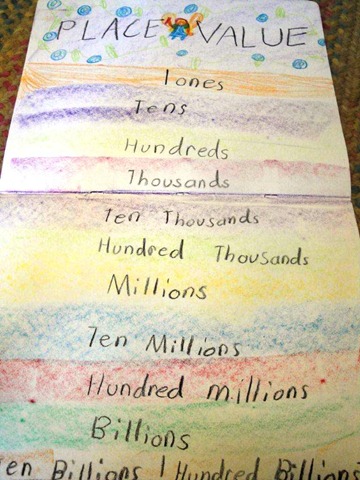
January: More poetry. Snowy Village Math from Marsha Johnson’s files and I told Russian Fairy Tales at the end of the Math lessons (also from Marsha Johnson), cooking, singing and pennywhistle – here we again went over place value, carrying and borrowing and multiplication and division


clip_image001

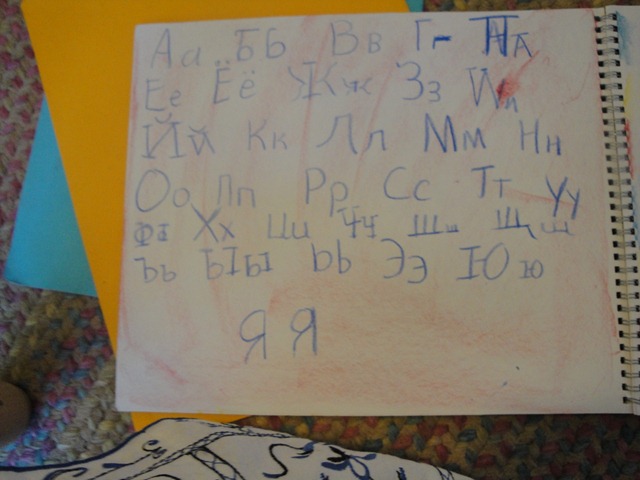
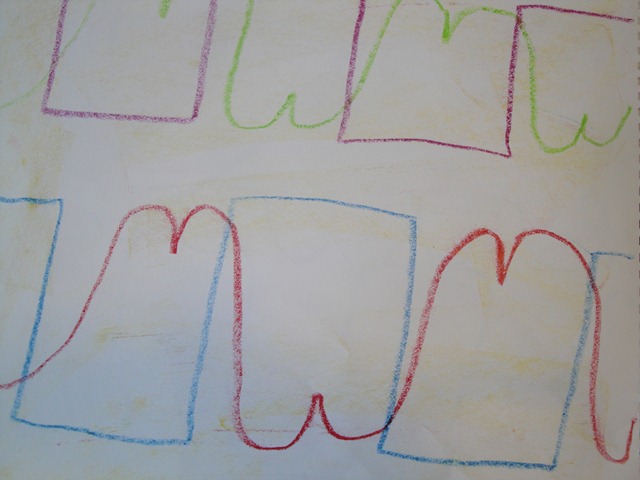
Russian alphabet to go with Russian fairy tales:

016

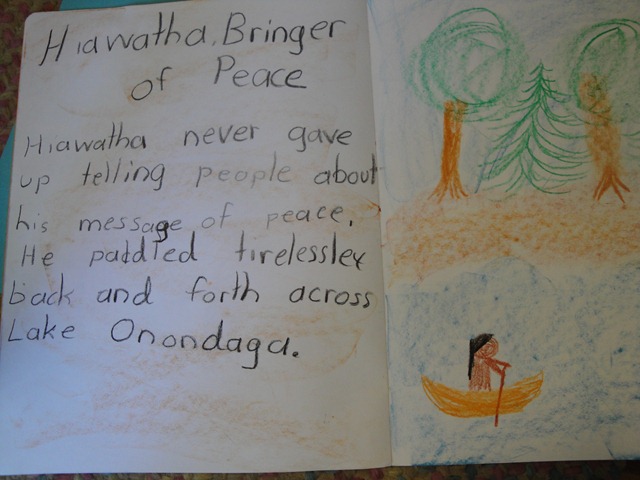
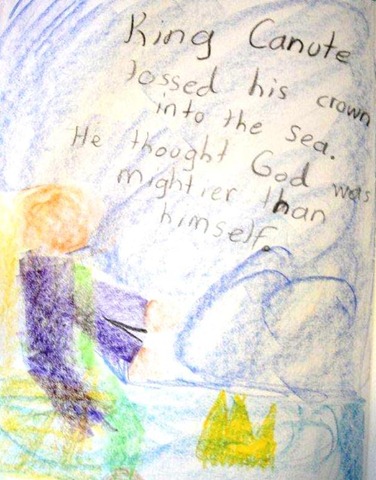
February:  Saints and Heroes from Donna Simmons and a few I picked based on Donna’s suggestions in the back of this book; special attention to word families, writing, painting and drawing –  one of these shows just a simple summary because we did a wet-on-wet painting as our artistic work for Finn MacCool.  Math rested during this month except for daily practice of math in Circle Time.

012

013

March:  Math – mixture of Melisa Nielsen’s Math Ebook and Donna Simmons’ Second Grade math; math skills as above along with money.

011

clip_image001[4]

The week around Saint Patrick’s Day we did The Leprechuan Factor Trees of Ireland from Marsha Johnson’s files, first with a lovely drawing before we made our addition  factor trees:

clip_image001[6]

And then those wild little  leprechuans traveled to the mysterious Multiplication Island where the multiplication factor trees grow; a TROPICAL island in the middle of an Irish lake..LOL.  Here is a leprechuan cobbling shoes on the back of a giraffe!

clip_image001[10]

clip_image001[8]

March was also Lent and crafts, weekly form drawing, wet on wet painting, the story of Saint Patrick.

April:  We did a block on Earth, Water, Fire and Air – I used stories from http://www.mainlesson.com , including one I found on Saint Kentigern and The Robin that involved the element of fire, lots of hands-on activities, weekly form drawing, pennywhistle and singing, math rested.


009

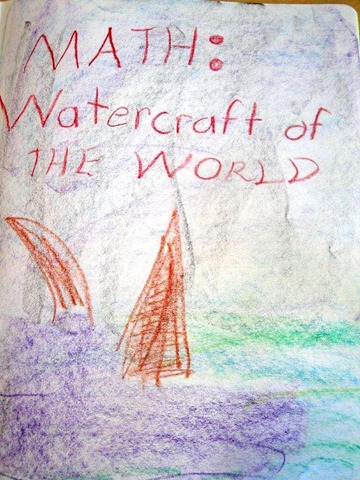
May:  Math from Marsha Johnson’s files  using “Watercraft of the World” as a theme,  more poetry and singing and pennywhistle, wet on wet painting, weekly form drawing, gardening.

004

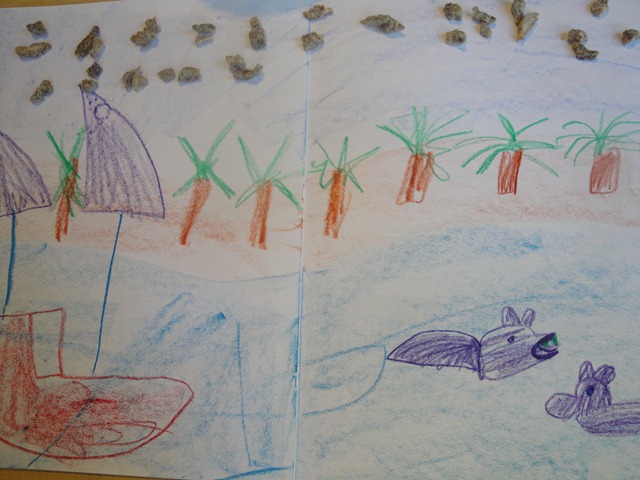
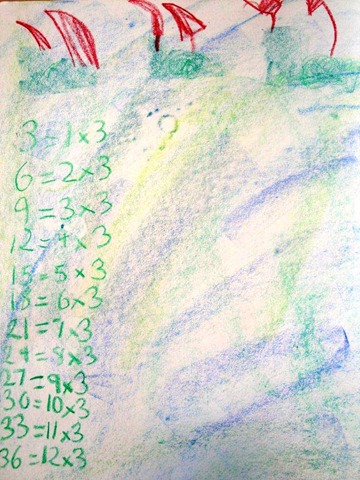
Here we counted dates and grouped them in twos and fives, and re-visited our three, four  and six times table with the help of  our hippo friends and the sails..… (these are dates along the top of this picture that we were counting –  we were working with the two-sailed lateens that sailed along the Nile River, and the dates and barley that were agricultural products in this area).  Note the hasty work in this drawing compared to the other drawings… you can really tell the difference between outlining and just building the picture up in layers with the crayon.

002

 006

June:  Saints from “Stories of the Saints” , review of work

Anyway, hope that helps provide a few resources for next year for those of you with rising second-graders.

Many blessings,

Carrie

Infusing Waldorf Elements Into Your Christian Homeschool

This is a big topic, and may take several posts.  You may need a cup of tea for the length of this post!    The question from the field is how to integrate Waldorf elements into a predominantly Christian focus in the First Grade – such as how one would teach letters through the Saints instead of through Fairy Tales.

First of all, I have to say, Steiner did not say to use the Fairy Tales to teach letters.  Fairy Tales are a mainstay in First Grade due to the archetypal images found in those tales, Dr. Steiner did say to use Fairy Tales in the first grade (age six and a half to start, please!) for reasons of history and literature, but he talked specifically about teaching letters in “Practical Advice to Teachers”, among other places and I would like to use that as a guide to looking at teaching letters today.    Let’s just use Lecture Five in this book as an example of how to look at teaching the letters.

Dr. Steiner says, “The sequence you follow is quite immaterial, and you need not proceed in alphabetical order; I will do so now merely so that you will have some sort of comprehensive record.”   Dr. Steiner discusses at length why to introduce vowels and consonants separately.

So Steiner goes on to speak about the letter “B”:  “I would now say to the children, “You know what a bath is.”  Let me here interject another point. It is very important in teaching to be cunning in a rational manner, that is, always to have something up your sleeve that can contribute unseen to the children’s education.  In this sense it is good to use the word bath for the step I am about to describe so, that while they are in school the children are reminded of a bath, of washing themselves, of cleanliness of such. It is always good to have a hidden purpose in the background, without actually mentioning it or masking it in admonishments.  It is helpful to choose examples that compel the children to think of things that compel the children to think of things that might also contribute to a moral and aesthetic attitude.”

So, that should help you all think regarding possible examples of habits or Biblical traits you would like the child to acquire that is concrete and practical for each letter of the alphabet and incorporate that.  But, the question is, can you do this in a more sideways manner than saying, “One must do this, and one mustn’t do that” ??   

Steiner actually took his “bath” example and developed it further by saying, “Then you continue, “You see, when grown-ups want to write down what a bath is they do it like this:  “bath”.  This is the picture of what you express when you say, “bath”, and mean a bath.”  Now I again let a number of the children copy this word, just copy it; whenever they are given a concept like this, it should go straight into their hands so that they take it in not just by looking but with their whole being.  Then I say, “Watch how you start to say, “bath”; let us look at the beginning of the word bath, b.”  So, this is how Steiner leapt from practical to word to writing to sound.  He then went on to give other “b’ words such as bow, band, and then bear and drawing how a bear would move into being the letter “b”.  He also choose words such as “baby” where the letter “b’ and that sound was in the middle of the word.   He says in Lecture Five, “There are educators who have pointed out that writing ought to be derived from drawing, but they proceed in a different manner from the one recommended here. Their starting point is the shape of the letters as they are today; instead of proceeding from the sign for the dancing bear to the B, they try to lead the children from drawing to writing by cutting the B into separate lines and curves: l ,  They advocate an abstract version of what we are trying to do concretely.”  

So, you could start with your idea of the letter from everyday life, from traits or habits you would like to see and then use a story for how you will draw something like looks like the letter and then you can see the letter there….You could bring in your story of a Saint – however, the way I would do it is to bring in a concrete way to really show that progression of how a letter came about:   this is what “a fish” looks like (Dr. Steiner always gave the example of a fish), this is how it looks like the letter “f”  if we draw it this way and this is the sound the letter “f” makes.  So it may not be so much the Saint starting with the letter, but an element in the story that starts with the letter.

But we are going to back up just a minute.  What other things do we need to think about to introduce writing and then reading well?

First of all, please do assess your child from the standpoint of trunk strength and also grip/hand strength.  Can your child do a wheelbarrow race without collapsing?  Can your child transfer objects with tongs into a muffin tray?  Can they sit still or are they restless and draping their arms and legs and feet around a chair to figure out where they are in space?  These are important things to address before you ever start a Language Arts Block.  Steiner also says in Lecture Five:  “We assume children have reached the point where they can master straight and curved lines with their little hands.”  So, for a yearly rhythm, please consider starting with a block of Form Drawing prior to Language Arts. 

Now we can jump back to where we were and consider the three-day rhythm as part of Waldorf Education and how sleep is a learning aid….

So, perhaps we do it something like this, this is just an example and you will think of the best way to do this with your own child and your own family!

Day One: Perhaps you could open with prayer, a psalm, singing of hymns or music specific to your religion or seasonal songs,  play a song on the recorder and include some finger plays and such for the little ones in the household.  Then perhaps we can have a Circle Time and story for the Kindergarten-aged child in the family and then have a little bathroom break and snack.  Pull out something for the Kindergarten-aged child to do, whether this is salt dough or coloring or bouncing on a mini-trampoline in the corner and then doing something quiet.  Or home school outside, so your Kindergarten-aged child can run about and you can sit with that First Grader (age six and a half and up, please!) for their Main Lesson.

So, then there may be movement to get ready to support writing – wheelbarrow races, something fine motor, something with balance and imagination.  Perhaps then whilst standing you and your child could recite some tongue twisters having to do with the upcoming letter.  Then the habit of the day like Dr. Steiner spoke of and really try to bring in those 12 senses.  “Water” makes me think of cleanliness, for example- what does a hot bath feel like versus a cold shower?  Is being clean or water mentioned anywhere in the Bible? Let’s find that.   Let’s write “water” on the board and maybe one sentence from the Bible that has “water” in it and can we find that word again?  Then you could  tell a story about a Saint that relates to water…maybe not a Saint that begins with “W” if you are doing the letter “W” but the story of St. Brendan, on his boat across the sea with the “W”aves…  This is what a wave looks like, can you find the “W” in it?  “W” sounds like this.   What other words make that sound?  Can we think of any other words where that sound is in the middle or at the end?

Let it rest – go on and do something else: tell a fariy tale before you close your Main Lesson, prayer and then  music or form drawing,  handwork and gardening and crafts or cooking in the afternoon.

Day Two:  Opening as above and then after break when it is time to start that Main Lesson, how about some movement with jump rope rhymes?  Can the child draw the letter “W” on the driveway with big chalk and walk it?  Perhaps you could write all the words that begin with “W”  that your child can think of also on the driveway.  What was that Bible verse again- could you write that down and recite it together?    Re-visit the story, and perhaps have a poem ready to recite about St. Brendan.  Perhaps build a model of a boat, or make a small wooden boat and go sail the boat on the water.  Tell a fairy tale, the same tale you told yesterday, before you close.

Perhaps on this day after the story and building a boat, you do some cooking or something else. I have to say I am against every single thing tying into the letter, because that almost turns into a unit study to me more than Waldorf, but you will have to decide what your particular child needs.  The other thing is I would save some of those, for example, “W” crafts and cooking and such for the NEXT week, when we are done with the letter “W” but then you can say, “Oh, do you remember last week when we were doing with the letter “W”, this is an example of making a (whatever, a waterfall craft, watermelon balls, etc.)

Day Three:  Opening as above,  finish up any artistic work, re-visit the day before with the words beginning with “W”, revisit the story, practice making the letter “W” and what sound the letter “W” makes and put the best examples of the letter “W” in the Main Lesson Book, draw a picture of Saint Brendan for the Main Lesson book.   In further blocks, once more letters are covered, perhaps the child could write down a very simple sentence summary that you have both orally recited and written on the blackboard.

At this point you could introduce another letter and move into a new three-day rhythm, or you could stop there and use your fourth day for something else: painting, a day to focus on your kindergartner…

I really love this quote, and it gives those of us who are teaching small first to third graders much to think about.  “The children who come to us at the of their school days, the thirteen-to-fourteen olds, are already warped by to  intellectual an education.  Too much emphasis has been laid on the intellect in the way they have been taught.  They have experienced far too little of the blessings of also having their will and feeling life developed.  Consequently, we will have to make up for lost ground in these spheres just in these last few years.  We will have to seize every opportunity to try to bring will and feeling into what is merely intellectual by taking much that the children have absorbed purely intellectually and transforming it into something that also stirs the will and the feeling.”

What part of your lesson is stirring the will and the feeling? How are you speaking to your child’s strengths, weaknesses and temperament?

Steiner closes “Practical Advice To Teachers” with four things every teacher should strive for:

1. The teacher must be a person of initiative in everything done, great and small.

2.  The teacher should be one who  is interested in the being of the whole world and of humanity.

3.  The teacher must be one who never compromises in the heart and mind with what is untrue.

4.  The teacher must never get stale or grow sour.

More to come on this topic!

Many blessings,

Carrie

Has Anyone Used This?

One of the mothers in my awesome homeschool group found this link! Check it out!  It looks like an international house exchange/rent for people within the Waldorf community:

http://waldorfhomeexchange.com/

Has anyone used this?  I would love to hear some feedback!

Blessings,

Carrie

Patience, Parenting and Verbal Spillage

Part of having a loving attitude toward our children is being PATIENT.  I have written about patience here:https://theparentingpassageway.com/2010/03/29/five-things-every-parent-needs/      and here:  https://theparentingpassageway.com/2009/10/15/the-power-of-patience-day-number-18-of-20-days-toward-being-a-more-mindful-parent/

Having patience is an important part of loving our families.  I think there are  two very concrete ways you can put patience into action in your marriage and in your parenting:

1.  Practice listening without interrupting, judging or being defensive.  How many times do we cut off our children, or our spouse when they are upset, to promote our own point of view, or our own judgment?

2.  Many women tend to “verbally spill” a cascade of words when they are upset.  It is very difficult to have self-control of one’s words, but well-worth the attempt. Can we just be silent  but warm and loving during times when the children are falling apart?  Can we just be there without verbally (please excuse the term) “throwing up” on family members with our own anger and frustration?    

I think especially in this age where people seem to say whatever they are thinking (uh, in multiple forums such as in person, in email, on Facebook, Twitter), and many times with language that is less than appropriate, it is important to show children that we can stop, we can think, we can deliberate, we can decide and then we can speak. 

Here are some other ways I am thinking about patience today:

Patience does not mean being a doormat and doing nothing, that is being the jellyfish of Barbara Coloroso’s “Kids Are Worth It!” book, right? However, patience does mean being calm enough to do the right thing!  This post talks a bit about that:  https://theparentingpassageway.com/2009/11/14/how-not-to-be-the-angry-parent/

Patience is knowing that children take time to develop, and whilst you guide the behavior during development, split-second guidance in a rough way in the heat of the moment is not modeling patience or how to deal with life’s upsets.  De-escalate the situation,  guide, go about what you need to do, but show that deliberation.

As the Internet expands, I find we take things more and more at face value in terms of “experts.”  Anyone can put a website up and say they are a parenting expert or a Waldorf expert or whatever.  Perhaps part of patience involves not jumping into believing what someone says right off the bat, about thinking about what is right for one’s own family and then being able to distill what information works best for one’s situation and beliefs.

I was thinking about patience as a part of having a relationship with friends who may not exactly share our same beliefs  but are still people we enjoy and want to spend time with.  Why should we all be the same?  Many Waldorf homeschoolers complain that they have no friends who homeschool like them, but my question is can we look beyond Waldorf to the fact that we are all homeschooling?  Can we look beyond homeschooling to see that many parents are thoughtful and caring and trying to do their best even if they choose not to homeschool? 

In the area of faith and spirituality, I know many people of one faith who have no friends of any other faith.  A faithful and spiritual life can become very insulated without that.  Do you have the patience to develop long-term friendships with people outside of your spiritual beliefs?

Do you have patience with yourself?  Do you forgive yourself for not being perfect and for not being able to do it all?  This is not an excuse for doing nothing, you know my mantra about planning, planning, planning and doing, but mothers tend to be so very hard on themselves.  I have a friend I always say to, “Isn’t it amazing when a child is going through challenging behavioral stages, we always look to ourselves and what we are doing wrong but when a child is having a smooth stage and behaving the way we would expect, we don’t look back to ourselves at all?”

Happy meditating on patience today!

Many blessings,

Carrie

Love Is A Verb

I am sure you have all heard this notion before:  that love is often more an action than a feeling.  To be loving, even to be “in love”,  we have to act loving and then the feeling of love comes.

How are you putting love into action in your home?

Love is picking up and soothing that infant for the millionth time when you really wish they would just go to sleep.

Love is being kind to your child even though they just answered you flippantly.

Love is making time to spend with your spouse at the end of a long day even though you are tired.

Love is being patient when you don’t feel like being patient, and being kind when you don’t feel like being kind.  How you do this in your home really influences the tone of your home and the behavior of the small child who not only imitates you, but looks to you to see how you react when things are not going well.

How do you react when you make a mistake?

How do you react when someone is behaving poorly?  Not doing what you want them to do?  Are you the person who escalates things or de-escalates things in stressful situations?

How do you calm things down and make things more peaceful than when you found them?

How do you leave your little corner of the world better than it was before?

It is hard work, but the wonder of it all is in the striving.  It is truly not about being perfect.  There is no perfect mother, no perfect home, no perfect road to success,  no perfect way.  There is only a loving mother, a nurturing home, a middle road, and a thoughtful way. 

Many blessings,

Carrie