Sunday Books: Completing The Circle


Back to Sunday Books!  We are in the homestretch of this book, and I am looking forward already to our next book….I just love summer reading, don’t you?


This chapter is entitled, “Paradise Lost:  The Nine Year Change.”  I know this chapter will be of interest to many of you out there who have children verging on this developmental stage!


In this chapter, Poplawski writes about how Billy Collins, a Poet Laureate of the United States, poignantly captures the essence of this age in a poem called “On Turning Ten”:
The whole idea makes me feel
like I’m coming down with something,
something worse than any stomach ache
or the headaches I get from reading in bad light—
a kind of measles of the spirit,
a mumps of the psyche,
a disfiguring chicken pox of the soul.
You tell me it is too early to be looking back,
but that is because you have forgotten
the perfect simplicity of being one
and the beautiful complexity introduced by two.
But I can lie on my bed and remember every digit.
At four I was an Arabian wizard.
I could make myself invisible
by drinking a glass of milk a certain way.
At seven I was a soldier, at nine a prince.
But now I am mostly at the window
watching the late afternoon light.
Back then it never fell so solemnly
against the side of my tree house,
and my bicycle never leaned against the garage
as it does today,
all the dark blue speed drained out of it.
This is the beginning of sadness, I say to myself,
as I walk through the universe in my sneakers.
It is time to say good-bye to my imaginary friends,
time to turn the first big number.
It seems only yesterday I used to believe
there was nothing under my skin but light.
If you cut me I would shine.
But now when I fall upon the sidewalks of life,
I skin my knees. I bleed.


Poplawski traces the stages of development that come around age two, age nine and age sixteen.  The nine year old is standing alone in a sense and realizing their separateness from their parents and the world for the first time.  Waldorf Schools address this stage by working with the very rich stories of the Hebrew people as found in the Old Testament.


Poplawski points out other challenges many nine year olds face – their early learning abilities often become challenged and the child has to try to memorize things for the first time, the child emotionally withdraws, the child needs time and space and privacy.  Children this age can feel stressed and anxious over chores, activities, homework.  Parents can help by limiting their child’s activities and making sure there is ample time to dream and just be. 


Poplawski writes about the importance of the parental role:

The nine-year-old child is yearning for autonomy, but parental warmth,
affection, and support continue to be important. Though the child can be irritable
and seems to want to push away, he still needs hugs and comforting from the
adults around him. A nine-year-old will sometimes hover near a parent wanting
and waiting for a reassuring hug, but hesitant to ask for it. A child will sometimes
be more prickly and hyper-sensitive with one parent more than the other, this
being affected by the respective temperaments of child and parents. Sometimes
one parent needs to step back and let the other be more involved with the child.
Many children have some psychosomatic symptoms around this time. Heart
palpitations, breathing problems and headaches are not unusual. Nine-year-olds
tend to be worriers and some physical symptoms may be related to that. Nightmares
—dreams of being chased or being bitten by a snake or even of being murdered—
are common and no reason for great concern. Dreams of storms and runaway
fires are also frequent.

For the nine-year-old, suddenly cut off from the world, forced to stand on her own, and beset perhaps by physical problems, anxiety is a dominant emotion.
Hence, the child depends on the structure and guidance that watchful adults can give to provide stability and a sense of security. The child needs the solid authority of teachers and a firm parental presence. Otherwise she will be overwhelmed by a sense of insecurity.
The nine-year-old likes to have rules. Adults need to be fair and consistent in enforcing them, however. Fairness is important for the nine-year-old.


Talking about life and death, the meaning and mystery of life, praying, asking about religion and prayer are all very common things in the life of a child going through this developmental change.  Children in this stage are still young, but must be recognized as the young men and women they are becoming.  How are we assisting our children in getting to an adulthood that encapsulates the ideals of duty to humanity through this stage?


Many blessings,
Carrie

Circle and Activities For St.John’s Tide


Happy Summer!  St. John’s Tide, or The Feast of The  Nativity of Saint John the Baptist as it called traditionally in the church, is almost upon us!  I have a back post about Midsummer Day/St. John’s Tide here:  https://theparentingpassageway.com/2009/06/09/midsummers-day-st-johns-tide-day/


Here are few things we are enjoying in our home as we prepare for this special day, both in church and at home.


Circle:

This is a tune from the “Summer” Wystones book:

In the Summer Garden

Where we singing go

Light is flowing

Glowing flowing while the roses grow


Then I will add this version which I made up, to the same tune:

In the Summer Garden

Where the sun’s a- glow

St. John’s coming

Making straight and narrow the paths go


A Traditional Waldorf Verse, found in many different sources:

I am the sun

And I bear with my might

The earth by day, the earth by might

I hold her fast, and my gifts I bestow

To everything on her, so that it may grow

Man and stone, flower and bee

All receive their light from me

Open thy heart like a little flower,

That with my light I may thee dower

Open thy heart, dear child, to me,

That we together one light may be.


Ring Game For The Young Child:

Sally go round the sun

Sally go round the moon

Sally go round the chimney tops

On A Sunday afternoon – whoops!

Saint John, who ate locusts and wild honey, makes me think of bees in this summertime.

Bees Verses:

Five Busy Bees

Five little busy bees on a day so sunny.

(Hold up all fingers.)

Number one said, I’d like to make some honey.

(Bend down number one.)

Number two said, Tell me where shall it be?

(Bend down second finger.)

Number three said, In the old honey-tree.

(Bend down third finger.)

Number four said, Let’s gather nectar sweet.

(Bend down fourth finger.)

Number five said, Let’s take pollen on our feet.

(Bend down thumb.)

Humming their busy little honeybee song.

Buzzzzzzzzzzzzzzzzzzzzzzz! (Fly fingers.)

From Nature Boxes for Early Childhood Educators, Debbi Williams, Story County Conservation Board


Here is the beehive, where are the bees?
     clench fist and bring out fingers quickly one by one
Hidden away were nobody sees
Watch and you will see them come out of their hives,
One, two, three, four, five,
Buzz, buzz, buzz.


One little bee blew and flew.
He met a friend, and that made two.

Two little bees, busy as could be–
Along came another and that made three.

Three little bees, wanted one more,
Found one soon and that made four.

Four little bees, going to the hive.
Spied their little brother, and that made five.

Five little bees working every hour–
Buzz away, bees, and find another flower.

And you could end with the traditional favorite:

Ring around the rosies

Pocket full of posies

Ashes, ashes, we all fall down

Cows are in the meadows

Eating buttercups

Thunder, lightning, we all stand up!


Some little activities to enjoy:

Read the story of Saint John from the Holy Bible  – such richness for all ages!

Make some small hanging suns – directions page 105  of the book “All Year Round”

Make some bees for your nature table:  http://ancienthearth2.blogspot.com/2010/07/summer-bees-needle-felting-tutorial.html  (no dry needle felting for young children, please! However,  they could paint rocks like little bees)

Wet –on-wet watercolor painting with yellow

There are stories in the back of the Summer Wynstones and also a story for older children in the back of the book, “All Year Round”. 


Many blessings on The Feast of The Nativity of Saint John the Baptist!

Blessings,
Carrie

Sunday Books On Summer Time: “Completing The Circle”


Yes, Sunday Books is apparently on “summer” time and today instead.  Summer is about relaxing, so please excuse the island time on The Parenting Passageway this week.  I hope you all are having a relaxing summer as well.


This chapter is about the esoteric view of the human being and its value in education.  Many of you who read this blog and are familiar with Waldorf Education are also familiar with how Rudolf Steiner viewed the human being in esoteric terms.   Steiner writes in many different terms for many different audiences.  He started in academic philosophy, wrote for workers and artists and for the public intellectuals, and later went on to write for a group of Theosophists who at that time of the era of  World War One in Germany were searching for spiritual renewal from the East and many of the terms Steiner used were from Ancient Hinduism in order to fit in with that audience.  He broke with this group ten years later, but the terms have remained.  (Poplawski makes a differentiation between the terms of Sanskrit and the terms Steiner used with the group of theosophists but it has been described to me in many lectures through my Foundation Studies that these are similar and used during this time period in Steiner’s writings).


(If you are Christian and having trouble with this esoteric view, all I can say is that whilst this chapter describes how Rudolf Steiner saw the body, soul and spirit of the human being using his terms, religious traditions have always discussed this.   I am Christian, and the Christian church has known and understood this for centuries.  Here is a link for my Christian readers and there are many more articles if one chooses to search:  http://en.allexperts.com/q/Eastern-Orthodox-1456/2010/12/Body-soul-spirit.htm. This is how, based upon my religious tradition, I work with my own children in my own homeschool – I consider the body, the physiological processes that make up the body and then  the soul with its parts of the  inner eye (the nous) and its passions (the “irrational part”).


So Steiner saw the human being as a physical body that is shared with also the mineral kingdom,  an etheric body of life forces that also are akin with the plant kingdom with its physical form and life forces, the astral body which we share with an animal kingdom where the animals also have a physical body with life forces but also passions, desires, will, consciousness. Lastly, the human being as an “I” is seen as Steiner by our spiritual self, which is a source of discernment, insight and conscience.  Poplawski points out that varying religious traditions talk about what happens to the “I” after death. 


Poplawski moves on to talk about the development of the human being in seven year cycles.  The infant is born with a body, the life forces, the soul and the spirit, but these unfold according to developmental stages.  The physical body develops slowly, the life forces of an infant are intertwined with those of its mother.  As these life forces become more independent from the mother, then the child becomes ready to develop memory and thinking at this time, which is why in Waldorf Education academics formally begin in the grades.  (Although I would also add this makes sense according to childhood development according to other schools of thought in education and psychology as well). 


Poplawski points out that the intertwining in the first period of the life forces is primarily dependent upon the mother but that during the second seven year cycle, the forces there are shaped by the emotional and moral life of the community around the child.  Poplawski also points out that this is the time to think still about protection of the child from harsh realities of adult life. 


Poplawski points out that the third seven year cycle is the realm of adolescence and that many children are being rushed into this cycle even though they are younger.  As the mother of an almost twelve year old, this particularly resonates with me.  Poplawski writes:


Between ages seven and fourteen, the child should be allowed to mature and develop at an unpressured pace, particularly in his feeling life. For this the child needs to be protected, held, and directed by his parents and teachers in their roles as loving but firm authority figures. The child will then feel safe to experiment in a playful and innocent fashion, instead of being thrust too early into the more complex and confusing realm of grownup love and hate, the extremes of agony and ecstasy and trauma. Media and commercialism are the most common culprits in stealing the innocence of children in stable families. In broken families, the
children are afflicted as well by parental tensions and conflicts. Too early an exposure to these influences and experiences can desensitize the child and maim his or her later ability to tackle the complex issues of human relationships with equanimity and common sense.
With the onset of adolescence, the feeling nature is released from the physical and etheric bodies and gradually becomes able to deal with the challenges of a more complicated emotional and social life. Parents and other adults around the child need to slowly relinquish the often uncomfortable role of authority figure that they have played. Virtually all traditional cultures have recognized the spiritual reality of the maturation of the child’s astral body and have marked this in “coming
of age” ceremonies. While these have largely disappeared in our culture, the Jewish bar mitzvah and Hispanic “sweet sixteen” celebrations are remnants of this tradition. Not until age twenty-one, though, is the individual fully accepted as an adult.

(Carrie’s note:  I think Poplawski is referring to the tradition of the Quinceneara in many Hispanic families and cultures, which is at age fifteen, not sixteen!)

We help the child develop through a steady rhythm, through being warm and loving, through consistent mealtimes and bedtimes, through protection from adult stresses and by providing a life that is simple.  The adult must work on themselves so they are not providing emotional outbursts in front of the children.  (Hard work!!)  A wholesome and whole foods diet is also important.  Clear and firm boundaries on behavior is also seen as extremely important in Waldorf parenting and education.  Boundaries are needed for a child to grow in a healthy way.  This can be very difficult for parents in this day and age who do not have a clear relationship to authority themselves.


For the older child, it is the unfolding soul that needs protecting. A child of
ten, or even of thirteen, is not ready to deal with the world of “drugs, sex, and rock and roll,” though in many instances this world may have already been thrust upon her. The attention and vigilance required of parents to create this protection for children and early teenage children is great and also time-consuming. Parents must stand not only as role models but as authority figures in providing guidance to their children. Being an authority figure does not mean being authoritarian.
Parents need to stay interested in what their children are interested in and maintain an active dialogue with them and their friends. But parents need to recognize that their primary role is not to be their child’s buddy, but rather to be a source of higher judgment that sets reasonable standards of behavior and follows through to see that they are observed.


We want to promote that which is true and good in the life of the grades aged child, and to protect children before the age of 14 from entering adolescence too soon.  Being in nature, cultivating a relationship to the arts and handwork and music is important.  Sports that are intensive can be more of a drain than a help. Chores and doing work for others, and being part of helping in a community is also extremely important.  Older children need the experience of caring for the poor, the aged, the young, the disabled and the ill.


Finally, each family needs a clear set of behavioral and moral standards that are made explicit, that are taught to the children, and that are modeled by the adults. Manners, civility, consideration of others, truthfulness and honesty, the treatment of all family members, friends, acquaintances, and strangers with respect, and speech that is civil and free of profanity are all part of this. There is a coarsening today in speech, behavior, and morals that can be redeemed only by conscious
and concerted efforts within each family.
Religious instruction and practice can also be important for a child, even if the parents themselves are not motivated in this direction.

Poplawski talks about how the adolescence needs space, and one or two wholesome activities to do…but how not to overdo activities.  The adolescent also needs even more time from parents to be at hand and vigilant as he or she explores the world. 


This all can sound demanding and perhaps can induce guilt in some parents, but Poplawski writes:


Fortunately, raising a child is not an exact science. There is a built-in forgiveness
factor and hence some room for flexibility. Make more time for your children,
especially as they grow older. Take frequent looks at your family and its life together.
Ask whether you meet your own standards of civility, of morals, of spirituality.
Finally, protect your children from losing their childhood prematurely—neither
you nor they will regret it.


This is a lot of food for thought, and I would encourage you to read this chapter for yourself and see what resonates with you.  This is available as a free ebook at the Waldorf Library on-line.


Blessings,
Carrie

And The Winner Is….


Kathleen H. is the proud winner of the Meadowsweet Naturals giveaway!


Many blessings,
Carrie

Giveaway From Meadowsweet Naturals! Enter to Win!


Pamela over at Meadowsweet Naturals is giving the readers of The Parenting Passageway a sweet giveaway!  This giveway includes:

  • One set of 3 primary block crayons
  • One 12 ct set of Lyra Laquered Color Giants (or 12 ct of the lyra short ferby pencils-can be your choice depending on age of  your children)
  • One block of Stockmar Modelling beeswax
  • Two main lesson books (size to be determined with Pamela after you win!)


TO WIN!  Like Meadowsweet Naturals’ Facebook page here: 

https://www.facebook.com/MeadowsweetNaturals


and leave a comment in the comment box saying you did this (if you don’t have a Facebook account, leave a comment to be entered to win anyway), along with your favorite tip for fall planning and be part of our random drawing to win!  There is also a  20 percent off sale  valid through the end of June on all orders over $50.00. No coupon code needed.


For those of you who don’t know about Meadowsweet Naturals, Meadowsweet Naturals is a family operated on -line shop serving the needs of families worldwide. They offer  an ever- increasing selection of Waldorf inspired products, including art and handwork supplies, homeschooling products,books,  and music items.  Their hallmark is to offer  personal, caring service and love transforming our customers into friends.

Pamela is the owner of Meadowsweet Naturals. Pamela writes:

I’m Pamela, a passionate, lifelong student of holistic healing and mother of eight, naturally raised, home educated children. My passion for natural healing began in my teen years and continues to the present, as I study nutrition, herbology, homeopathy, aromatherapy, relationship dynamics, and how all of these relate to our overall health.
In a thriving marriage of 29 years, I love supporting people in creating healthy, radiant relationships through nutrition and joyful living. I’ve had my share of health challenges to work through and know how challenging it can be to run a family, household, and business, and to keep it all thriving while not losing oneself in the process. Fortunately, I have also learned ways to make it all come together and I love sharing those ideas. I have a special interest in raw food and vegan lifestyles, food addictions, blood sugar balancing, and creating vibrant family relationships
In addition to working with Dr Ritamarie Lascalzo, I am also a graduate of the Institute of Integrative Nutrition, a Dr Sears Certified Nutrition Coach. I hold various certifications from American College of Healthcare Sciences, and am also a certified raw food chef and a Karen Knowler certified Raw Teacher Trainer. Additionally, I am also certified by Renee Trudaeu, as a Personal Renewal Group Facilitator.
I live with my family on our organic farm in New York State, where we operate an online business for families called Meadowsweet Naturals.
When not doing the work that I love, my favorite place is being at the ocean with my family.
I can be reached at www.MeadowsweetNaturals.com and www.YourRadiantPath.com

Can’t wait to see who wins!

Love,
Carrie

Fourth Grade Handwork


I was going to post pictures of fifth grade handwork projects, and realized suddenly I had never posted the fourth grade projects!  Our homeschool group has been exceedingly lucky to have trained Waldorf handwork teacher working with us.  She really knows the Waldorf curriculum inside out, and has taught  many of the children for years, so can really  invent projects for them that are stunningly beautiful and fulfilling to the children.


So here are the fourth grade projects in all their glory:

The first project, which was actually done in between third and fourth grade,  was a bear that had a pattern of essentially knitting an entire row, then knitting half a row, purling a stitch and then completing the row.  He came out like this:

WP_20130613_002


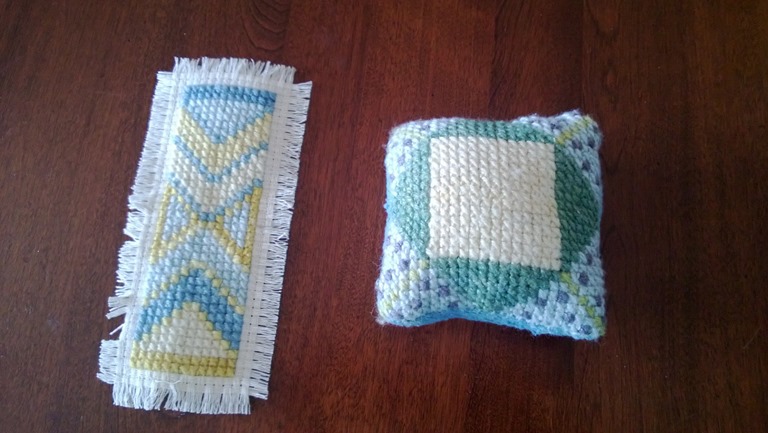
Fourth grade is a time of cross stitching.  The designs for these projects were done by my fourth grader, including choosing the colors and such.  The pin cushion has leather backing so the pins will not stick through!


WP_20130613_006


The last project of fourth grade was a hedgehog that was knit but the face was done in the round.  This was a preparation for knitting in the round. 


WP_20130613_008


Blessings,

Carrie

Third Grade: Wool Pictures


WP_20130606_007


This time of year for me is not only for planning on paper for our fall homeschooling, but also time for de-cluttering, re-arranging the school room, and crafting some beautiful things to inspire us through the grades.  This fall, I will be teaching third and sixth grade with a cute little three year old in tow.


I wanted to make something to hang on the wall that represented Third Grade for our schoolroom and the picture of Moses and the burning bush was foremost in my mind.  There are images of this scene on the Internet and in iconography and I looked at many images before I decided upon an idea to use to paint with wool.


Making wool pictures is an easy project – all you need is plant-dyed wool felt for your background, plant-dyed wool roving, an iron and ironing board, and your imagination.  I order my plant dyed materials here: http://www.etsy.com/shop/mamajudes#   I don’t believe synthetically dyed materials will work  for this project.


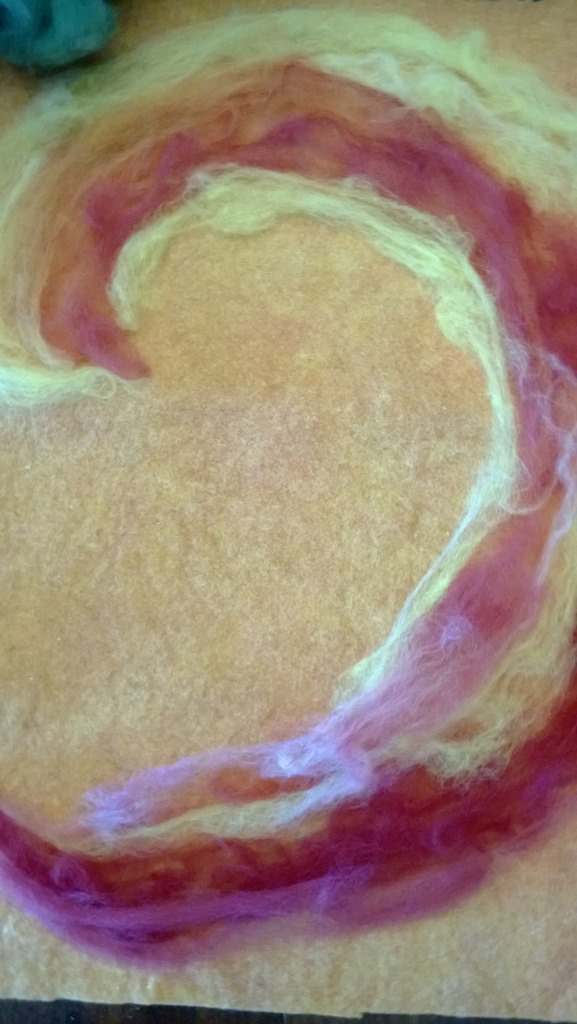
Start with a background felt of your color choice.  Take the wool roving and tease it apart with your fingers.   Start to layer it in very thin layers into the shape that you want by taking small amounts of the fiber,  holding one end in place and stretching the fiber apart.  Pat everything down.  I suggest ironing the background with long periods of holding the iron and then layering in more fibers and the details that are more in the foreground.  The wool roving will then stick to the wool felt and you will have a beautiful, dreamy picture.


Here is a picture of this process; layering the background first:


WP_20130606_003


I pressed this with the iron, and then added in the bush with its green leaves.  Then I layered in special red wool roving into fire on the tips of the leaves and pressed that.  The figure of Moses came last.


These pictures are easy to do and so full of possibilities!


Many blessings,

Carrie

Simplicity Monday: The Nitty Gritty


I think in  life sometimes we just need to get down to the nitty gritty of parenting and childhood development.  It makes life so much simpler to know the things that are most important to your family, because then you can see what makes sense to do within your days, weeks and months.  Does your use of time match up with what you really think is important?


For example, if simplicity is important to you, but you are running your children somewhere every day, does that reflect your priorities?


If you think religion is important, or spiritual inner development is important to you, but you don’t spend any time in activities that reflect that, then does that reflect your priorities?


Too often we start out the school year very strong, and things sort of peter out by the end of the school year.  What a perfect time of year this is to look and evaluate where your family is, and where you would like to be.


We enjoy having a Family Mission Statement.  This is not everyone’s cup of tea, but it can be helpful in looking at priorities, and making sure everyone is on the same page.  Here is a link to a back post on this:  https://theparentingpassageway.com/2009/05/08/creating-a-family-mission-statement/  Our Family Mission Statement involves kindness, integrity, positive attitude, patience, and adventure.  Yours will be different, but I think it is worthy project to undertake.


I would love to hear what you are revitalizing in your family life this time of year!

Much love,
Carrie

Summer Rhythm


Happy Summer to all!  It is summer here in the United States, although some parts of the U.S. are having colder than usual weather, to be sure!


One thing in summer is to enjoy the expansive space and time of the endless days of heat, warmth and sunlight and a time of rest from academic work and a rhythm better suited to colder days.  However, I also receive many letters from readers asking about a rhythm to the days, about what to do with sibling bickering, should they continue doing circle time with smaller children…what  to do, what to do.


I used to not plan for summer at all and was content to let the endless days of swimming here in the Deep South unfold.  However, the older my children have gotten, and the more children we have had, it was clear some bit of rhythm was being craved by all.  Having a simple framework for when at home in the summer can be a big help towards staving off any summer bickering and a relief to children to know they have long stretches of time to play, but also special things to do, even at home that makes special summer memories.


For my youngest little three year old, I am thinking of having a small circle time of songs and fingerplays and footplays three days a week, along with a story this month.  We have been doing the story of Goldilocks and the Three Bears for almost a month now, which is  still well-loved and enjoyed, so that will be the story I will continue.  My older children enjoy time for crafting, preparing for festivals, painting and baking, and all of us enjoy time to be with friends.  I look at what days we will be home and what days we will be out. I also look at what days we will swim, what days we will be with friends and are there any days of the week in which we may just be home (no swimming and no friends to play with but just a good ole’ family day).  I also use this summer time for things I mentioned a few posts back on a Simplicity Monday – decluttering, planning for fall homeschooling, and regular cleaning and cooking.


We have had an expansive time of summer so far with travel and horse camp, so this coming week will be a week to settle into summer and being home.   A sweet summer circle and story, crafting, Father’s Day preparations, and baking, along with lots of swimming and being with friends, should round out the week nicely.


If you are interested in ideas for summer, here are a few back posts that you may find enjoyable:

https://theparentingpassageway.com/2011/06/09/guest-post-creating-a-magical-summer/

https://theparentingpassageway.com/2011/05/24/summer-stories-and-summer-nature-table/

https://theparentingpassageway.com/2010/07/21/summertime-bickering/

And the famous July Doldrums!  https://theparentingpassageway.com/2009/07/31/down-and-out-the-july-doldrums/  and here:  https://theparentingpassageway.com/2010/07/05/the-july-doldrums-again/


Can’t wait to hear all of your wonderful ideas and plans for summer! 

Love,

Carrie

Fifth Grade Greek Mythology and Ancient History


WP_20130524_008

Greek mythology is a wonderful block.  These stories have lent so many expressions into Western Culture and much like expressions from the Bible, a student will be at a disadvantage to not know these stories, to be familiar with these expressions, and to later understand Greek civilization and how that has impacted our own history in the United States.


You can see the resources we used in my previous post regarding Ancient Mythology and Civilizations.  Our projects this block included a lot of drawing, including a large picture of Artemis as chosen by my daughter as her favorite to draw, modeling of columns and vases in clay (see the Christopherus Fifth Grade syllabus), drawing of columns, freehand map drawing, learning the Greek alphabet and writing a few simple phrases, and memory and recitation of poetry. 


We started in the land of mythology with the book of Greek Myths from D’Aulaires’ Book of Greek Myths and then leading into the wonderful stories of Perseus, Heracles, and Theseus.  Here is a scene my fifth grader drew from the story of Perseus:


WP_20130606_009


I used Dorothy Harrer’s “Chapters In Ancient History” as an aid in contrasting life in Sparta and Athens, talking about the landscape of Greece, the school boy in Athens, and many of the biographical sketches.


We finished with the history of Ancient Greece, and Charles Kovacs’ “Ancient Greece”, did an excellent job in terms of making Greek History and Alexander the Great accessible, understandable and memorable.  I cried at the end of telling the story of the Battle Of Marathon.


One note about Ancient Greek History: many Waldorf homeschoolers put this off until sixth grade. My fifth grader was eleven for the entire school year, and close to turning twelve by the end of the school year, so I chose to go ahead and include it, but if you have a younger fifth grader you might want to place this in sixth grade.


More next time,

Carrie