A Quick Note About Waldorf Grade Two

Hi all,

I have been thinking about those of you planning your Waldorf homeschooling Grade Two experience.  I have been speaking with several mothers locally and via email.

One thing that has come to  my mind is that whilst the theme of Waldorf Grade Two is this notion of the duality of man (as shown in the lesser traits in some of the animal fables and the higher traits shown in those other-worldly Saint stories) , sometimes it is easy for the year to feel a bit disjointed. 

One thing that I think will assist you is to think of what you would like to predominate in your Second Grade experience – folk tales?  American tall tales? Saint/hero tales? Fables?  and build the majority of your blocks around that.

Thoughts from anyone out there planning Grade Two?

Many blessings,

Carrie

A Little Linky Love and Previews!

Thank you to  my top 11 referrers for the past 30 days (uh, why top 11?  I don’t know – just to be quirky I guess!)

www.daguanyan.5d6d.com (This looks like this is in Chinese!  Hello over there! 🙂  I have not Google translated you, so I have no idea what you are discussing, LOL but welcome and hello!)

www.catherine-et-les-fees.blogspot.com (Hello Canada!)

www.untroddenpaths.blogspot.com

www.fabiolaperezsitko.blogspot.com

www.eileenspace.blogspot.com

www.blumieboys.blogspot.com

www.blumieboys.blogspot.com

www.hiddendell.blogspot.com

www.inspire.com   — preemie discussion group (Hi there, fellow mothers of preemies!  Yes, I think I have mentioned here before that I was born prematurely, my professional background was 12 years in NICU work as a developmental/feeding therapist and one of my children was also born premature!  Hello there!)

www.everyday-beautiful.blogspot.com

www.womanwifemomma.blogspot.com

So, this past month we covered A LOT of ground from boys to temperaments to “Discipline Without Distress” to parenting plans to the foundational years of ages 9-12, to planning for homeschool.  Hard to top!

For July, we will be finishing up that very last chapter in “Discipline Without Distress”, starting “Hold On To Your Kids”, and taking a month-long focus on marriage- what makes a good marriage, what can be done to strengthen marriages, communication in marriage and more!  I hope you will enjoy it.

Also looking for continued feedback as to what you would like to see in this space!

Live big and love your children,

Carrie

Individual Assessment for Homeschooling Success!

I hope you are well on your way with home school planning for fall; I have planned about six weeks’ worth of lessons so far myself. 

One thing that does not always get mentioned among the Waldorf forums and websites is this notion of INDIVIDUAL ASSESSMENT.  Very often we know WHAT to teach (ie, Norse Myths in the Fourth Grade, Modern History in the Eighth Grade); hopefully we have the pieces to know HOW to teach (through movement, through whole to parts, through oral to written to reading, through a rhythm that includes sleep). Maybe we even know WHY we teach what we teach – based upon the development of the human being.

But we still need the piece of individual assessment in order to plan for the school year.  And who knows your child better than yourself?

Here are some areas I might consider for the Kindergarten-aged child (those aged 5 and 6):

  • Physical Appearance (this often provides insight into the speed of incarnation into the physical body – ie, tall and thin?  how do they walk and move?  loss of teeth yet?)
  • Gross Motor Skills/Fine Motor Skills
  • Reaction of Child to Rhythm
  • Imagination/Creative Play
  • Artistic Abilities/Handwork
  • General Personality (adaptability, perseverance, inquisitive or not, how do they do with other adults, how do they do with children, etc)
  • Spirituality (does the child show reverence? when? how?)
  • Health (how many times sick this past year? with what?)
  • Academic Areas (are they able to catch onto oral rhymes that you are doing?  how do they order things outside and inside?  do they understand sequencing of a story?  attention span? etc.)
  • Practical Life Skills

You may also want to assess yourself:

  • What qualities do I need to work on bringing to my family through my modeling?  Where did I succeed as a homeschooling parent this past year?  Where were my weaknesses?
  • How did I arrange our days at home and our days out?  How was the flow on the days we were home?
  • How did I cultivate protection and development of the 12 senses for my small child, both in physical and emotional ways?
  • What was my inner work? How did I do this?  What did I learn from it?
  • What do I need to read over the Summer to prepare for the upcoming year?
  • What skills do I really need to learn in order to help my children?


For older children in the grades, I might consider all of the above plus some of the following areas:

  • Very specific academic and artistic skills for goals for the school year
  • Areas of challenge within the personality/temperament areas that need harmonizing and balancing during the school year (this could be done through your selection of stories, your own modeling, setting up situations or opportunities for this to occur)
  • Do I have a theme for the year or a quality for the year that I want to work with and run as a theme through my year? 

And finally,

  • As a family, what do we need to have more of?  to see more of?
  • What are our challenges as a family?
  • What do I need to do artistically or through my inner work?
  • What do I need to be successful as a homeschooling mother?


Just a few ideas to get you started, please do feel free to share some of your planning tips below!

Blessings,

Carrie

The Cardinal Rules Of Waldorf Education

Mrs. Marsha Johnson posted this on her Yahoo!Group and I thought is was well-worth sharing as mothers start to plan for homeschooling for the fall.

These are the wise words of Mrs. Johnson:

Cardinal Rules of Waldorf Education

1. Work with the WHOLE CHILD
2. Always begin from the child’s point of view, i.e., do not tell space stories to 4 year olds who have no concept of space, etc. but do tell nature stories about animals s/he sees on a regular basis. Think LOCALLY and expand gradually.
3. Use imitation in birth to 7, imagination in 7 to 14, and inspiration in 14 to 21.
4. Be creative and artistic in your lessons. Avoid abstract concepts, try to find hands on interesting ideas to present your material. 
5. Include movement in nearly every activity, recognize and use in-breathing and out-breathing rhythms to the day
6. Remember Head (morning), heart (rhythmic activities middle of the day) and hands (afternoon activities).
7. Set a home rhythm, get rid of excess material goods, and insist on regular rising and resting times, ensure the children have 11-12 hours of sleep per night and eat as close to Mother Nature fresh as possible!
8. Rid your home of televisions, video poisons, and insist on outdoor play, go camping, hiking, food gathering, and exploring. 
9. Pray before meals and before bed, find a spiritual path and STICK TO IT. Celebrate regular festivals
10. Develop a social network of like minded families anf gather regularly to share, support, care, and enjoy one another. Invest in these lifelong friendships.
11. Care for yourself, pursue a daily lesson for YOU, and invest time in educating yourself and enhancing your skills/abilities/ capacities.
12. Use heart seeing, heart thinking, and heart visioning. Show a warm interest in every single encounter on the physical plane, whether with a weed, a person, a pet, a sunset, or ? Empathize with the Other and teach your young to do so, too.
These are my TWELVE CARDINAL RULES OF HEALTHY WALDORF PARENTING AND LIVING…..
Love, Mrs Marsha

To join Mrs. Johnson’s Yahoo!Group, please join here waldorfhomeeducators@yahoogroups.com

Many blessings,

Carrie

Another Word on First Grade Readiness

This article is by Donna Simmons and can be found on Donna Simmons’ Christopherus Blog.  Please see Donna’s blog for more wonderful articles about topics near and dear to your heart as a parent here: http://www.christopherushomeschool.org/home.html  
Here is a link for this special article:   http://christopherushomeschool.typepad.com/blog/2010/06/musings-on-school-readiness-and-older-children.html  

This article addresses not only the six-year-old year but other transition years/grades for older children.  This article is really wonderful, and I encourage you to read it.

For the Early Years section of this article,  I especially and wholly agree with the idea that we are starting children much too early in Waldorf Kindergarten at school.   At home,  we have the opportunity to make the “Waldorf Kindergarten” years the “five-year-old year”  (ie, starting at  the ages of four and a half/five years old) and  the “six-year-old year” (ie, starting at five and a half/six years of age) with first grade starting at six and a half or seven years of age based upon your individual assessment of your child.  I have posts on this blog about the one and two –year- old in the Waldorf Home, the three and four- year -old in the Waldorf Home, and many articles about the six-year-old kindergarten year.  My perspective on the five and six-year old years will be forthcoming.

For those of you with older children, I encourage you to read this article as Donna shares candidly about her high school experiences from her perspective as a Waldorf Educator, now a high school teacher, and as a parent.

I hope you find this article as wonderful as I did…  Donna Simmons has many wise word regarding children and their needs.  Thank you Donna!

Many blessings,

Carrie

The Foundation Years of Ages 9-12: Decreasing High-Risk Behavior in Teens

Many of you have been following along chapter by chapter the wonderful book,  “Discipline Without Distress:  135 Tools for raising caring, responsible children WITHOUT time-out, spanking, punishment, or bribery” by Judy Arnall.

The last chapter we reviewed was the chapter regarding the teenaged years.  There were some very sobering facts in there, such as suicide is one of the top three causes of death in teens, that the average marijuana use in the US is age 14, that many children have tried alcohol by age 12.  This really has hit home  for me personally as I know three mothers  who have really struggled with their teens in the areas of addiction issues and sexual promiscuity.  One of the teens recently overdosed, was the victim of a crime,  and lost his life.  This is a heart-breaking tragedy and I have felt so sad about this.  As parents we always wonder what we could have done differently in a situation like this, and my heart hurts for this family.

Judy Arnall, in this chapter about teens, goes through some of the things parents of teenagers need (for our teenagers to respect themselves and others, to have their teenagers feel successful in their relationships, school, work and community).  She lists some of the reasons that teenagers try high-risk behaviors such as curiosity, unhealthy self-esteem and want to feel good about themselves, lack of coping skills to deal with their problems and needing to escape, not understanding that they can say “no” to a sense of obligation or pressure from peers or  partners, needing to feel grown-up, needing to rebel, needing to fit in and win approval of peers, needing to escape uncomfortable feelings, feeling invincible and not understanding the risks/benefits/ consequences, not being able to communicate their needs to their family.

I would add a few things to this list:  besides curiosity,I think  boredom coupled with  a lack of guidance by caring adults to channel this boredom or curiosity into healthy things, and also I think there is a   lack of something bigger than themselves to worry about.  I think this is extremely important.

I was talking to a dear friend about this chapter and she was saying one thing that really helped her in her teenaged years was that she was very into horses and horseback riding and that she had a horse who depended upon her every day to take of it.   That is something bigger than yourself.

I talked  about this book regarding  rites of passage  ( https://theparentingpassageway.com/2009/06/30/rite-of-passage-parenting-four-essential-experiences-to-equip-your-kids-for-life-heading-up-to-the-nine-year-change-and-beyond/), and part of the book asks essentially “what does your child do around the house that you could not be without if they were not there?”  There it is again:  what is your child involved in that is bigger than himself or herself?  How is your child tied to you, your family, your community?

If the average age of marijuana use is 14, and the average child has tried drinking before age 12, I believe the foundation for decreasing high-risk teenage behaviors HAS to start around that nine-year change (and before, of course.  Attachment and security and so many things are laid during that first seven year cycle)  But in many ways, I think because that nine-year change is a watershed where your child starts to feel separate from others, separate from you and the family, different, is noticing things about how different families and people do different things,  now is the time to start.

I have an almost nine-year old, and I am trying to formulate some thoughts in my head as to how to create responsibility for my child that is bigger than her, how to keep time together,how to keep  communication open, and how to best answer her questions about life.    I am thinking hard.  I have four years until the teenaged years, and this time is precious to me.  Is it to you?

It is NOT enough to just talk about drugs and alcohol and sex.  Yes, those conversations have to be there and they have to keep going throughout these years.  But, there has to be ACTION.   How will you help your child/teen structure their time, their environment, so these behaviors are less likely to occur?  What are the top three things in your house that your child KNOWS is not negotiable?  What freedoms can you give, but also what RESPONSBILITIES go with these freedoms?  WHAT does your child have to look up to , to participate in, to take care of, that is bigger than himself or herself? 

What community OUTSIDE the family is your child involved in and accepted in – is it one that you have helped create or one that just happened along the way?  I am sure both can be okay, but it is important to know what is going on in that community.  For example, how well do you know your child’s friends?  Judy Arnall brings up the point of creating a “secondary community” away from the school environment if your child is in school – through church or other religious outlets, through Girl Scouts or Boy Scouts, through volunteering .   There HAS to be something bigger than themselves for these children.

Would love to hear your thoughts!

Many blessings,

Carrie

How I Adapted “Along The Alphabet Path”

So I wrote a bit about the use of  saints to teach letters in a Waldorf-style for mothers who had asked this question about how to work in Waldorf elements of teaching with a predominantly Roman Catholic/Orthodox focus.  

Now I would like to share a bit about what personally I did when my oldest was in first grade.  Perhaps it will spark some ideas for you and your summer planning!

My oldest was a fluent reader prior to when she turned seven and started first grade.  And by fluent I mean she could read whatever she wanted, so beyond Frog and Toad and all that…People freak out about a situation like this frequently on Waldorf boards and forums, because they don’t realize that the content of Waldorf first grade so speaks to the soul of a seven-year old and the academic skill level can be adjusted up or down.  Also, early readers frequently need the balancing and harmonizing Waldorf first grade provides. 

At that time, I really liked the  “Along The Alphabet Path” that Elizabeth Foss created (see link at end of this post).  I loved Saints, I loved the flower fairies,  but I also liked that archetypal imagery of the fairy tales.  What was a homeschooling mother to do?

Create her own story, of course, in a three day rhythm. 

Here are examples from my story (PS, the Saint book I used was the original one Elizabeth used before she switched to a different Saints book.  I used  “Letters From Heaven: An Illuminated Alphabet” by Susan Kelly vonMedicus.  There are essentially poems to go with each Saint for each letter of the alphabet). 

The Beginning: (we started with Circle Time and alliterative verses for the letters A and B)

“Once upon a time there was a little girl named Lily who lived with her mother and father and her little sister Tess in a far away Kingdom. Today, Lily was very excited – Lily had turned 7 just a few weeks earlier, and in her family, once you were 7 you started training in order to be able to wear a crown…You see, Lily’s mother and father were the Queen and King, and Lily was a princess. But there was no crown to be worn until one was seven.

The King and Queen called Lily into their chambers and told her, “You are now 7, which is a very important age. You will be the Keeper of Knowledge and you will be learning all kinds of things to help you be a kind, compassionate Princess for all the people in our land.

We have a special task for you to complete before you can be crowned. You will travel with the wisest woman in our land to meet 26 of our most loyal fairy subjects. You will learn much about our world and we are proud of you as you undertake this task. We wish you much luck.” And they kissed her.

Lily could hardly believe her ears! What an adventure to be had! 7 is such an exciting age, she thought, and she wanted to be the very best princess she could be and learn a lot. She looked up with her eyes full of wonder and who should she find standing there but Queen Bluebell, the Queen of all the fairies.

“It is time, my dear, to come with me to start your very special task,” Queen Bluebell said. Lily’s eyes shone and then she grew sad. “I will miss my little sister so much,” said Lily to her mother and father and Queen Bluebell.

Queen Bluebell smiled, “And she shall miss you. Please go say goodbye to your little sister and then we shall start our journey.”

Lily ran outside to give her little sister Tess a big hug. She loved Tess so much. Tess looked up at Lily and said, “Take this, and if ever you are scared or lonely, look at this and think of me.” She pressed a tiny sack that fit inside her hand into Lily’s hand. “I shall be happy to see you return once your journey is over, and see you crowned as a princess!”

And so Queen Bluebell and Lily started off on a pathway that went through the Palace Gardens — there were many beautiful flowers there. Lily wondered if that was where they were stopping, but Queen Bluebell continued on, toward a large meadow in front of the woods that surrounded the castle…

“Princess Lily, I would like you to meet a friend of mine – This is the Bugle Flower Fairy.” And there, standing before Lily and Queen Bluebell was a small clump of herbs with purple flowers growing in the shade.

“Umm, excuse me, Queen Bluebell? I do not see a friend anywhere,’” whispered Lily politely. Suddenly, up from the clump of purple flowers rose a tiny purple fairy, a boy with a small purple bugle tucked into his waistcoat.

“Queen Bluebell and Princess Lily,” said the boy, bowing. “Let me be the first to welcome you to your journey. May luck and peace be with you.” Lily fingered the small sack Tess had given to her.

“And every good journey should have a song and story to begin by. “ and he settled himself on the ground cross legged and began to sing the song that all Bugle Flower Fairies sing :(This is from the Flower Fairy Alphabet Book, this is not original by me!):

“At the edge of the woodland

Where good fairies dwell,

Stands, on the look-out

A brave sentinel.

At the call of his bugle

Out the elves run,

Ready for anything,

Danger, or fun,

Hunting, or warfare,

By moonshine or sun.

With bluebells and campions

The woodlands are gay,

Where bronzy-leaved Bugle

Keeps watch night and day. (A Flower Fairy Alphabet, page 165)

And then he said, “Now you shall have your story as well!”

“Once upon a time (Tell story of Snow White and Rose)

** So, there were other things on “DAY ONE” to do in school, but that was essentially the Main Lesson Story.

DAY TWO:

Re-visit  Snow white and Rose Red with child helping tell it in parts, dress up and dramatize it.  Practice writing “B”s in words – BEAR, BED, BET, BEAT, BABY etc.  on chalkboard.   Draw a picture of a bear and the “B” hidden within the shape of the Bear. 

Write a simple sentence on the board such as “The bear was brown.’” and such and have child copy.   A poem about a bear  to orally recite would be nice here as well.  (TYPICALLY, we would only do artistic work here and do a summary of the story or saint for the third day, but I feel it can be a bit different whilst learning letters).  🙂

We baked because it was baking day for my kindergartener and  we made B’s with  the dough

DAY THREE:

Recite poem from yesterday, go over b words and read sentences with “B”.  Re tell Snow White and Rose Red  with silk marionettes

Skip the first two pages of the Main Lesson book and on the second page of two page spread, design border with bugle flowers.  On a golden path with stars between the letters, practice writing a line of big B and little friend b’s , think of words from yesterday and add new words that begin with “b” and write on blackboard or sheet of paper.

(Further along in grade, this would be time to draw the picture and if you have an already fluent reader and writer, the child could already be writing short summaries.  You are the teacher, you assess and decide and execute your plan for that particular child.)

Wed – toward end of lesson:  new story – Have ANGEL puppet ready!!

The fairy was very proud of himself for being the first loyal subject to tell a story to the Queen and the Princess. He was puffed up with pride! He put his bugle to his lips, but as he went to blow, suddenly a great light illuminated the area and an Angel, a messenger from God appeared. The Bugle Fairy bowed so low that the point of pointed hat touched the ground. 

“AAAH,” said Lily, who was amazed at the sight of the angel. The light was brilliant and wonderful.

The angle unrolled a scroll and from the scroll he read,  “There has been a heavenly decree that Princess Lily shall hear the story of Saint Brendan for the letter “B”

(Story of Saint Brendan) Use drawing of Saint Brendan with a B for the sail.  There is also a verse that goes with this story from “Letters From Heaven”, recite together and can be left on the board to look at next week and perhaps write in Poetry Main Lesson Book. 

When the Angel was finished with the story, he pulled a beautiful Apple Blossom from his robe and handed it to Lily. It had a golden stem! Lily was again amazed and said “AAAHHH.” Then the angel was gone.

Lily wiped a tear away from her eye. “Those are wonderful stories! Especially Snow-white and rose-red, who were never to be parted…and the Bravery of Saint Brendan! How I wish to be brave as well!” Lily had a lump in her throat as she missed her sister, but as she looked down she saw a bugle-flower in her hand and brightened.

“I will collect a whole bouquet of flowers for my sister” Queen Bluebell patted her on the arm. “I feel amazed at all I have seen! An angel of God!” (Have paper flower with gold chenille stem ready to press in main lesson book)

And she and Queen Bluebell went a little further on…

In Main Lesson book, on first two skipped pages, draw picture of an Angel with Big A and little friend a in one corner and on opposite page, write a sentence to caption the angel picture….. think of A words, write on board, think of sentences with a, such as:  Lily was amazed to see an angel.

Look at b spread on next two pages and be excited and proud. 

**Carrie’s note:  Okay, so there were other things for school on this day, but that was much of the main  lesson story.  

I know a bit more about the three-day rhythm now, and I am not certain this is the best way to divide this up, but it gives you an idea of how to start and create something for your own family.  I have another child coming up to first grade not this coming fall,but next fall, and I am planning on writing her her own story – probably something involving animals and Saints and the fairy tales, unless she falls in love with flower fairies by then..:)

Also, this probably would be WAY too much for many children,  too many tangents of flower fairies and saints and fairy tales, but for a quiet-already-reading- at a high level little girl, it was well-received, and well-loved.  🙂

Don’t you all want to know what happened, and how it ended? LOL. 

Thank you to Elizabeth Foss, whose “Along the Alphabet Path” became an inspiration for me to write my own.  Please visit Elizabeth here: http://elizabethfoss.com/ and see her other Learning Ideas at Serendipity.  Readers looking for a direct link to The Alphabet Path, can find it here: http://ebeth.typepad.com/serendipity/along-the-alphabet-path-1.html

Many blessings,

Carrie

Effective Use of the Temperaments in Education and Discipline

So far we have looked at the four-fold human being and had an introduction to the temperaments.  Today we are going to peek at HOW to use the temperaments as an ally in education and discipline.  As I have said in the first two parts to this post, this information was presented to our homeschooling group at a wonderful workshop on the temperaments given by our Waldorf Handwork teacher, Ms. Judy Forster.  She is so knowledgeable and wonderful. We are so lucky to have her as part of our group! 

So to start, a quick common question is something like this:  “Yes, I read all the descriptions of the temperaments and I still don’t know what temperament my child is.”

Yes, sometimes it is hard to tell.  It is easy to confuse the predominant temperament of a developmental stage for an individual temperament.  I have heard Waldorf teachers say typically two temperament predominate.

So, Ms. Forster gave us a tip that one place to garner an idea regarding your child’s temperament is in looking at how they approach handwork,   A choleric child will want to be done first with their handwork, and will make mistakes along the way because they are going so fast because they HAVE to be done first.  A sanguine child may have lots of holes in their loose knitting because they got distracted or were too busy talking, and are content to know that maybe the fairies will come and fix it later.  A melancholic child will take their handwork very seriously, they will be extremely detail-oriented  and will rip a piece of knitting apart for the one stitch that was off that that the handwork teacher  told them was okay to leave alone (but they can’t, so then they have to rip it all out when the teacher is not looking).  Their knitting is usually tight.  The phlegmatic child is hard to get going on anything, but once they get going, it is either hard for them to stop – they may end up knitting a rug-sized piece of something when the project was supposed to be small because they just couldn’t stop – or they may just be steady and be done first (much to the chagrin of the choleric child).   Those examples came  from Judy Forster, our wonderful and knowledgeable Handwork teacher.  Please see her Etsy shop here: http://www.etsy.com/shop/mamajudes

Here is an example from me.  I think the temperaments show in how your child deals with  social challenges.  For example, the choleric will be telling everyone what to do, what is fair and not fair, and may end up flying into a rage that they feel immensely sorry about later.  A sanguine child will know who said what and who gets along with who and will be flitting around like a butterfly and taking in everything that every person does.  A melancholic child will figure no one will like them, no one will pick them, and they think that  if they do get picked they will end up with a challenge (ie, disaster) that  no one else in the world has faced.  A phlegmatic child will spend most of the time eating and warming up and getting ready to participate, and by the time they are ready to join in, it will be time to go home.

Hope that gives you all some ideas!  Anyway, on to how to work with these temperaments most effectively!  People act as if our goal should be to eradicate the temperament that the child displays, but that is not the case.  All the temperaments have good things about them; perhaps the case is more how to balance and harmonize (which for most people will not completely happen until they are in their 30s), and also how to use the temperaments as an ally in parenting and education.

CHOLERIC:  Choleric children are actually  really fair and they have big hearts, so appealing to the choleric in that way helps. I once was friends with a very choleric little guy who would break everything.  When he came to my house, I always said something like, “You know, I love how strong you are and you are so fast!  I have this pile of ten oranges and I was wondering if you could squeeze them all by hand so we could have juice for snack.”  Worked beautifully.

When a choleric rages and breaks something, if the child is between 7 and 9, I would wait until the next day to talk to them about it.  Usually by that time they are so regretful they have punished themselves more than you ever possibly could.  The worst thing to do would be to get wrapped up in their anger personally.  You must be the wall for them to bounce off of. 

SANGUINE:  Interrupt their work and give them little tasks to do before they take off and interrupt their own work.  You are in charge of the interruption during homeschool, for example.  You need something delivered to a neighbor, you need the tomato plants watered, the dog needs something, whatever.  If you keep interrupting them, they will finally settle down to work!  Work on building up their endurance in this way – the first week interrupt their work so many times a hour and then the second week drop the number of interruptions and then keep lengthening the time that they are focused on a task.

Also, sanguine children love beauty, so be beautiful!  Put flowers in your schoolroom, wear something beautiful.  They will notice.  It will captivate them.  This is also a good way to work on this temperament if you are not naturally drawn to beauty in your daily life..say if you are predominately melancholic and pre-occupied with worry.  🙂

MELANCHOLIC:  Melancholic children have great sympathy, so appealing to what you really need and what obstacles you have yourself your day and if the child could just do “X” how helpful that would be.  I think the other place to work with melancholics is through story telling regarding perfectionism.  Donna Simmons has a good example of a story for a melancholic in her First Grade Syllabus, and there are many more examples out there.

The other key to a melancholic child is to just listen and to feel truly compassionate.  The child truly feels these things do not happen to anyone else on earth,  ever in the history of mankind…So listening, and then perhaps sharing something similar from your own childhood.  The melancholic child will be most interested in stories where the hero overcomes enormous hardship.  🙂

PHLEGMATIC:  To me, this group is the hardest.  They will sit like small little lumps for quite some time.  Our handwork teacher recommends ignoring that they are even there for a time being (which is hard without a classroom of children  to carry, I find).  Some of them will be motivated to do something if it has to be done before snack time comes.   I think rhythm is  a great help to the phlegmatic because transitions can often be hard.   When they say they are “bored”, give them full permission to be with their boredom. Encourage it.  🙂 

The other thing I learned at the temperament workshop is that Fourth  Grade, when children are ten and obviously after the nine-year-change, is when one starts to see “Extraverted” and “Introverted” categories of these temperaments….So, for example, an “introverted melancholic” may be a child to watch closely in the school years for obvious reasons. 

The other little note I thought of is that if you feel you are predominately one way or the other way, what could you do to enliven the other temperaments within you?

Many blessings,

Carrie

How To Plan Waldorf Homeschool Second Grade: Part Two

You can find Part One to this post here:  https://theparentingpassageway.com/2010/05/14/how-to-plan-waldorf-homeschool-second-grade-part-one/

I broke my “no-photographs” rule simply because there are not many blogs with examples of Waldorf Second Grade and I wanted to show some sample works. 


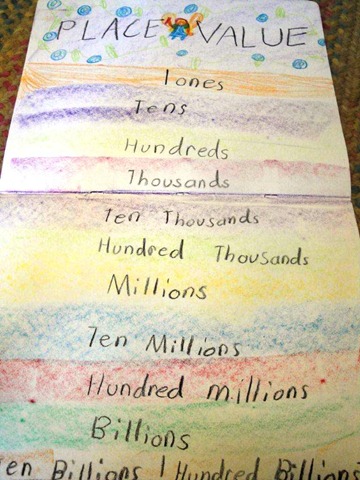
January: More poetry. Snowy Village Math from Marsha Johnson’s files and I told Russian Fairy Tales at the end of the Math lessons (also from Marsha Johnson), cooking, singing and pennywhistle – here we again went over place value, carrying and borrowing and multiplication and division


clip_image001

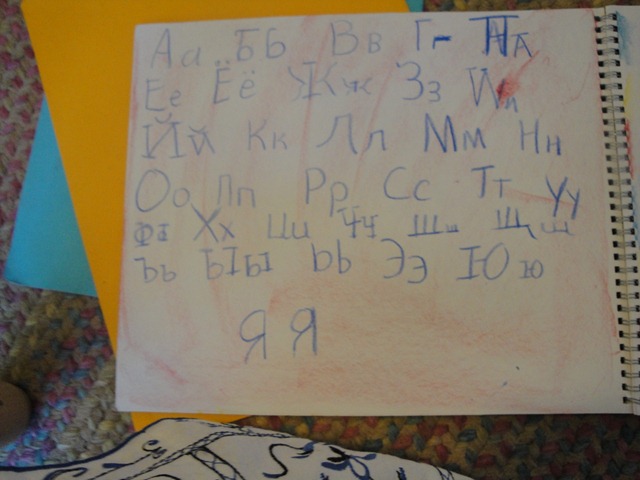
Russian alphabet to go with Russian fairy tales:

016

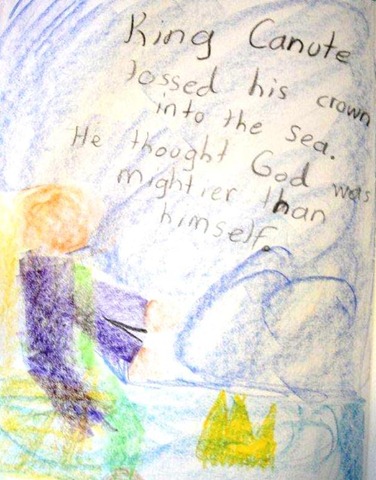
February:  Saints and Heroes from Donna Simmons and a few I picked based on Donna’s suggestions in the back of this book; special attention to word families, writing, painting and drawing –  one of these shows just a simple summary because we did a wet-on-wet painting as our artistic work for Finn MacCool.  Math rested during this month except for daily practice of math in Circle Time.

012

013

March:  Math – mixture of Melisa Nielsen’s Math Ebook and Donna Simmons’ Second Grade math; math skills as above along with money.

011

clip_image001[4]

The week around Saint Patrick’s Day we did The Leprechuan Factor Trees of Ireland from Marsha Johnson’s files, first with a lovely drawing before we made our addition  factor trees:

clip_image001[6]

And then those wild little  leprechuans traveled to the mysterious Multiplication Island where the multiplication factor trees grow; a TROPICAL island in the middle of an Irish lake..LOL.  Here is a leprechuan cobbling shoes on the back of a giraffe!

clip_image001[10]

clip_image001[8]

March was also Lent and crafts, weekly form drawing, wet on wet painting, the story of Saint Patrick.

April:  We did a block on Earth, Water, Fire and Air – I used stories from http://www.mainlesson.com , including one I found on Saint Kentigern and The Robin that involved the element of fire, lots of hands-on activities, weekly form drawing, pennywhistle and singing, math rested.


009

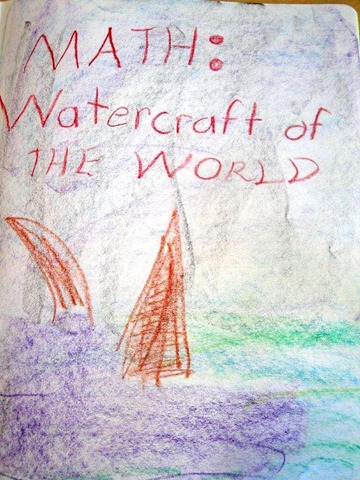
May:  Math from Marsha Johnson’s files  using “Watercraft of the World” as a theme,  more poetry and singing and pennywhistle, wet on wet painting, weekly form drawing, gardening.

004

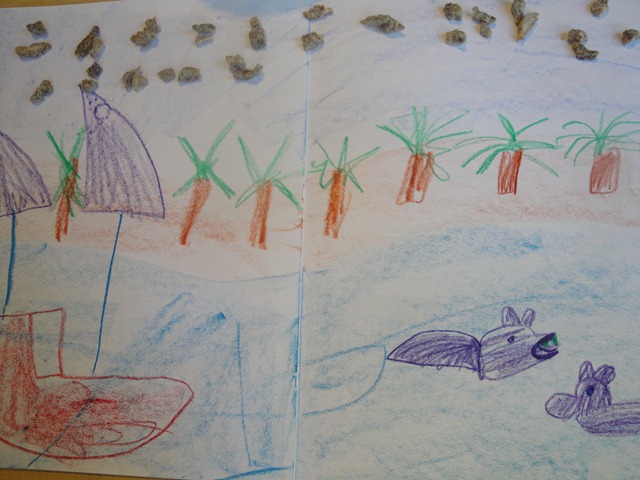
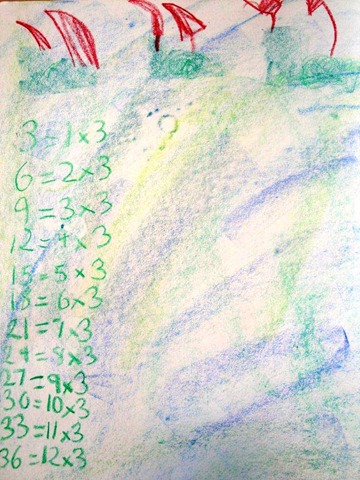
Here we counted dates and grouped them in twos and fives, and re-visited our three, four  and six times table with the help of  our hippo friends and the sails..… (these are dates along the top of this picture that we were counting –  we were working with the two-sailed lateens that sailed along the Nile River, and the dates and barley that were agricultural products in this area).  Note the hasty work in this drawing compared to the other drawings… you can really tell the difference between outlining and just building the picture up in layers with the crayon.

002

 006

June:  Saints from “Stories of the Saints” , review of work

Anyway, hope that helps provide a few resources for next year for those of you with rising second-graders.

Many blessings,

Carrie

Infusing Waldorf Elements Into Your Christian Homeschool

This is a big topic, and may take several posts.  You may need a cup of tea for the length of this post!    The question from the field is how to integrate Waldorf elements into a predominantly Christian focus in the First Grade – such as how one would teach letters through the Saints instead of through Fairy Tales.

First of all, I have to say, Steiner did not say to use the Fairy Tales to teach letters.  Fairy Tales are a mainstay in First Grade due to the archetypal images found in those tales, Dr. Steiner did say to use Fairy Tales in the first grade (age six and a half to start, please!) for reasons of history and literature, but he talked specifically about teaching letters in “Practical Advice to Teachers”, among other places and I would like to use that as a guide to looking at teaching letters today.    Let’s just use Lecture Five in this book as an example of how to look at teaching the letters.

Dr. Steiner says, “The sequence you follow is quite immaterial, and you need not proceed in alphabetical order; I will do so now merely so that you will have some sort of comprehensive record.”   Dr. Steiner discusses at length why to introduce vowels and consonants separately.

So Steiner goes on to speak about the letter “B”:  “I would now say to the children, “You know what a bath is.”  Let me here interject another point. It is very important in teaching to be cunning in a rational manner, that is, always to have something up your sleeve that can contribute unseen to the children’s education.  In this sense it is good to use the word bath for the step I am about to describe so, that while they are in school the children are reminded of a bath, of washing themselves, of cleanliness of such. It is always good to have a hidden purpose in the background, without actually mentioning it or masking it in admonishments.  It is helpful to choose examples that compel the children to think of things that compel the children to think of things that might also contribute to a moral and aesthetic attitude.”

So, that should help you all think regarding possible examples of habits or Biblical traits you would like the child to acquire that is concrete and practical for each letter of the alphabet and incorporate that.  But, the question is, can you do this in a more sideways manner than saying, “One must do this, and one mustn’t do that” ??   

Steiner actually took his “bath” example and developed it further by saying, “Then you continue, “You see, when grown-ups want to write down what a bath is they do it like this:  “bath”.  This is the picture of what you express when you say, “bath”, and mean a bath.”  Now I again let a number of the children copy this word, just copy it; whenever they are given a concept like this, it should go straight into their hands so that they take it in not just by looking but with their whole being.  Then I say, “Watch how you start to say, “bath”; let us look at the beginning of the word bath, b.”  So, this is how Steiner leapt from practical to word to writing to sound.  He then went on to give other “b’ words such as bow, band, and then bear and drawing how a bear would move into being the letter “b”.  He also choose words such as “baby” where the letter “b’ and that sound was in the middle of the word.   He says in Lecture Five, “There are educators who have pointed out that writing ought to be derived from drawing, but they proceed in a different manner from the one recommended here. Their starting point is the shape of the letters as they are today; instead of proceeding from the sign for the dancing bear to the B, they try to lead the children from drawing to writing by cutting the B into separate lines and curves: l ,  They advocate an abstract version of what we are trying to do concretely.”  

So, you could start with your idea of the letter from everyday life, from traits or habits you would like to see and then use a story for how you will draw something like looks like the letter and then you can see the letter there….You could bring in your story of a Saint – however, the way I would do it is to bring in a concrete way to really show that progression of how a letter came about:   this is what “a fish” looks like (Dr. Steiner always gave the example of a fish), this is how it looks like the letter “f”  if we draw it this way and this is the sound the letter “f” makes.  So it may not be so much the Saint starting with the letter, but an element in the story that starts with the letter.

But we are going to back up just a minute.  What other things do we need to think about to introduce writing and then reading well?

First of all, please do assess your child from the standpoint of trunk strength and also grip/hand strength.  Can your child do a wheelbarrow race without collapsing?  Can your child transfer objects with tongs into a muffin tray?  Can they sit still or are they restless and draping their arms and legs and feet around a chair to figure out where they are in space?  These are important things to address before you ever start a Language Arts Block.  Steiner also says in Lecture Five:  “We assume children have reached the point where they can master straight and curved lines with their little hands.”  So, for a yearly rhythm, please consider starting with a block of Form Drawing prior to Language Arts. 

Now we can jump back to where we were and consider the three-day rhythm as part of Waldorf Education and how sleep is a learning aid….

So, perhaps we do it something like this, this is just an example and you will think of the best way to do this with your own child and your own family!

Day One: Perhaps you could open with prayer, a psalm, singing of hymns or music specific to your religion or seasonal songs,  play a song on the recorder and include some finger plays and such for the little ones in the household.  Then perhaps we can have a Circle Time and story for the Kindergarten-aged child in the family and then have a little bathroom break and snack.  Pull out something for the Kindergarten-aged child to do, whether this is salt dough or coloring or bouncing on a mini-trampoline in the corner and then doing something quiet.  Or home school outside, so your Kindergarten-aged child can run about and you can sit with that First Grader (age six and a half and up, please!) for their Main Lesson.

So, then there may be movement to get ready to support writing – wheelbarrow races, something fine motor, something with balance and imagination.  Perhaps then whilst standing you and your child could recite some tongue twisters having to do with the upcoming letter.  Then the habit of the day like Dr. Steiner spoke of and really try to bring in those 12 senses.  “Water” makes me think of cleanliness, for example- what does a hot bath feel like versus a cold shower?  Is being clean or water mentioned anywhere in the Bible? Let’s find that.   Let’s write “water” on the board and maybe one sentence from the Bible that has “water” in it and can we find that word again?  Then you could  tell a story about a Saint that relates to water…maybe not a Saint that begins with “W” if you are doing the letter “W” but the story of St. Brendan, on his boat across the sea with the “W”aves…  This is what a wave looks like, can you find the “W” in it?  “W” sounds like this.   What other words make that sound?  Can we think of any other words where that sound is in the middle or at the end?

Let it rest – go on and do something else: tell a fariy tale before you close your Main Lesson, prayer and then  music or form drawing,  handwork and gardening and crafts or cooking in the afternoon.

Day Two:  Opening as above and then after break when it is time to start that Main Lesson, how about some movement with jump rope rhymes?  Can the child draw the letter “W” on the driveway with big chalk and walk it?  Perhaps you could write all the words that begin with “W”  that your child can think of also on the driveway.  What was that Bible verse again- could you write that down and recite it together?    Re-visit the story, and perhaps have a poem ready to recite about St. Brendan.  Perhaps build a model of a boat, or make a small wooden boat and go sail the boat on the water.  Tell a fairy tale, the same tale you told yesterday, before you close.

Perhaps on this day after the story and building a boat, you do some cooking or something else. I have to say I am against every single thing tying into the letter, because that almost turns into a unit study to me more than Waldorf, but you will have to decide what your particular child needs.  The other thing is I would save some of those, for example, “W” crafts and cooking and such for the NEXT week, when we are done with the letter “W” but then you can say, “Oh, do you remember last week when we were doing with the letter “W”, this is an example of making a (whatever, a waterfall craft, watermelon balls, etc.)

Day Three:  Opening as above,  finish up any artistic work, re-visit the day before with the words beginning with “W”, revisit the story, practice making the letter “W” and what sound the letter “W” makes and put the best examples of the letter “W” in the Main Lesson Book, draw a picture of Saint Brendan for the Main Lesson book.   In further blocks, once more letters are covered, perhaps the child could write down a very simple sentence summary that you have both orally recited and written on the blackboard.

At this point you could introduce another letter and move into a new three-day rhythm, or you could stop there and use your fourth day for something else: painting, a day to focus on your kindergartner…

I really love this quote, and it gives those of us who are teaching small first to third graders much to think about.  “The children who come to us at the of their school days, the thirteen-to-fourteen olds, are already warped by to  intellectual an education.  Too much emphasis has been laid on the intellect in the way they have been taught.  They have experienced far too little of the blessings of also having their will and feeling life developed.  Consequently, we will have to make up for lost ground in these spheres just in these last few years.  We will have to seize every opportunity to try to bring will and feeling into what is merely intellectual by taking much that the children have absorbed purely intellectually and transforming it into something that also stirs the will and the feeling.”

What part of your lesson is stirring the will and the feeling? How are you speaking to your child’s strengths, weaknesses and temperament?

Steiner closes “Practical Advice To Teachers” with four things every teacher should strive for:

1. The teacher must be a person of initiative in everything done, great and small.

2.  The teacher should be one who  is interested in the being of the whole world and of humanity.

3.  The teacher must be one who never compromises in the heart and mind with what is untrue.

4.  The teacher must never get stale or grow sour.

More to come on this topic!

Many blessings,

Carrie