At The End Of The Teaching Day…

Did I put as much movement as possible into my Main Lesson?

Did I stir a feeling in my child through the pictures, stories and images I presented?

Did my child put forth effort and work, thereby developing his or her own will?

Did we have fun?  Did we laugh?  Did I hug my child and love them?

Did I teach my child something new?  New can also be nuances on an existing subject or theme…

Did I use sleep as an aid to my teaching?  Did I keep reviewing what my child needs to review?  One time is not enough!

Did my children and I do something practical for the nurturing care of our home?

Many blessings,
Carrie

The Essential Soul Tasks Of The Early Years

Dearest Friends,

During my time of moving houses, I have had several very important issues swirling about in my head with no opportunity to write them down until tonight.  So, you will be seeing some deeply thought and deeply held posts coming from The Parenting Passageway over the next several days.

One thing that I was thinking about fervently was the essential soul tasks of the small child.  If you have been a long-time reader of this blog, I hope over the years I have convinced you of the utmost importance of the physical development of the small child through time and space outside.  We think of a very tiny child of ages birth through three as struggling through space over time to achieve being upright, then progressing to speech and from speech flowing into thought.  During the Early Years, we also develop our  twelve senses, and I often think of such things as the awareness of our bodies (what is us?  what is others?).  This is done through work and also through imaginative play.

But on the soul level, there is a very important task for this age, which is relating to others, and how the child finds their place within a group.  The small child’s experiences with trust of others, belonging with others, finding safety and acceptance of others and within others is all part of this experience.  So is the reverence that we often cannot fully see until we stand present with another.  I have had the wonderful experience of my almost three year old and his very best friend on earth whom I shall call Little Friend.  He and Little Friend adore each other; they run to see each other in the utter thrill that only two best friends can share and laugh in joy.  They chase “moonbears” (their code name for grasshoppers) through the grass, wonder at each spider web and bug, and show such deep reverence and awe at each step of Creation.  It is amazing to watch and it has shown me the deep ability of the small child to love outside of his own immediate family.  For some of you, this is a moment of “Duh!” and for some of you this is a moment of thoughtfulness.  If you can think back to your smallest days, where did you feel safe?  Where did you feel loved?  Where did you feel you belong?  Where were you part of a community?  Did you feel accepted and loved or on the outside?  Why?  How would you answer these questions about your own children?

I have received three separate emails this week asking about five or five and a half year olds and finding the balance of being home and the need for friends (or not).  I think many homeschoolers would say there is no need for interaction outside the family per se; especially perhaps for those with larger families.  But for those with smaller families or children who are close to age six with only a baby perhaps to “play” with, the question remains…  And then people tell me they have tried to look for community and nothing that resonates with them is available, so what do they do?  Do they do classes?  How do they meet people?  Is playing with a friend once a month or once every few months enough? Continue reading

The Secret to Homeschooling Children In Multiple Grades


I will never forget one of the stories of my husband’s great-grandparents. They were celebrating their seventy-fifth wedding anniversary and people at church asked great-grandma to stand up and say a few words about having a successful marriage.  She stood up, and probably to the chagrin of most of the people there wanting inspirational words, said, “Well, it hasn’t been easy!” and sat back down again.


I feel a little like this when readers ask me about homeschooling children in multiple grades, especially in the land of Waldorf Education, where things are often  so….teacher intensive…..


It just isn’t always easy.  (I know, not what you want to hear! )


Oh, sure, people can give you tips.  I have given out “tips” before, especially in this post:  https://theparentingpassageway.com/2011/04/17/crafting-a-homeschool-rhythm-to-work-with-multiple-grades-and-ages/  and in this post:  https://theparentingpassageway.com/2011/04/14/homeschooling-children-in-multiple-grades/  and here:  https://theparentingpassageway.com/2009/05/05/homeschooling-multiple-children-with-waldorf/


This is the thing with “tips”:  they are things that may work for one particular family, and that family is not your family..  So tips may be helpful, but they also may not resonate with you.  It may not work for your family.  You are the only one on this crazy homeschooling adventure that can figure out what works for you and your family!  You are the expert! 


Make a plan, keep it loose with plenty of time and space (yes, those of you who read this blog know I love those two words in relation to development and also in relation to homeschooling)…It is hard to know with different children what they will  blow through quickly and what will take more time, especially the older they get. For example, there is a much wider range in abilities in reading, writing and math in second through fourth grades than probably at any other time, I think, which can make it harder to plan the first time through those grades… Every child is different, and you are homeschooling to meet your children’s needs…so you tailor around that, not some blog you read where everything looks perfect!


Because there is no perfect way to Waldorf homeschool, and you find differences of opinion even amongst Waldorf homeschoolers.  And there is no life that is so calm and peaceful that it never influences how you feel in the moment about homeschooling…     Today I had a child who needed to get stitches out and whilst I was on the phone with the doctor regarding that, toddler man fell and knocked both front teeth which were now bleeding all over and we needed groceries and one child needed to be somewhere.  (So, theoretically, if I  could teleport, I could have gotten to all four places at once, but since I don’t have a nifty Dr. Who telephone booth, I couldn’t).   I say this to point out that sometimes it is not homeschooling itself that is stressful, especially since all of this happened during the afternoon,  but just the crazy of life that swirls around and that sometimes penetrates into making us feel like life would be easier if we were not homeschooling multiple children!  (Or just that life would be easier if we were sitting on a beach somewhere drinking something fruity with a little umbrella in it! Ha!)


But  that my friends, is the secret to thriving with homeschooling:  embrace the chaos.  Can you roll up and down on the roller coaster and smile? Can you keep your footing and calm amidst the wild ride?


Because if you have multiple children, multiple main lessons, along with younger children,  it will be a juggle.  And the juggle may extend down to the children: my children often alternate distracting or playing with a toddler whilst I work with one of them; (unless he is nursing or otherwise enthralled near us); there really isn’t all this time and space to just hang out that other homeschooling families often seem to have.  But this season is short, and in a few months it will be something different!  This I know for sure:  things change!


So, on my good days , I like to think homeschooling with multiple children teaches flexibility and resiliency.  Oh yes, we have rhythm for creating good health for the future adult (but remember that  it is the rhythm that works for us and no one else!), but we have the flexibility and resiliency that comes with having multiple children of different ages and in different seven year cycles.  We also have great time learning all the time, not just in “main lesson” because there are so many opportunities for learning with different temperaments and personalities and ages within the family. 


And on my bad days, it just looks a lot like crazy.  Smile


But the one thing that carries me through, and the one thing that I think you really do NEED as the secret to homeschooling multiple children is a strong spiritual footing.  If your inner work, your walk with your Creator is off, than all the days start to look like crazy instead of the beautiful blessings that God provided. 


Start your day with prayer, with silence to hear the voice of the Spirit, weave your religion into your schooling and your life…and then just  roll with it.  Crazy, chaos or not!


Blessings and love,
Carrie

A Little Taste of The First Day of Fifth and Second Grade

WP_000110Folks all over have been posting about their first day of school.  As usual, I am late to the party. We started school three weeks ago in an effort to have some time off around the date we move into our new home.  Here in the Deep South, school tends to start in August, sometimes as early as the first of August, so we were in the company of many children we knew who had already been going to school for weeks!

Our first day of Fifth and Second grade was welcomed by the children, and the older girls insisted upon wearing matching outfits as their “uniform.”  We took a picture of the all the children by the front door.  Usually Daddy takes the children out for breakfast on the first day, but this year he was traveling, so we decided to jump in anyway.
I always start with a bit of review from the previous year, (or  begin with something that we didn’t finish!  LOL).  And I usually start with form drawing.  So, this year my second grader began with running forms.  Some of you may be familiar with a story by Donna Simmons in the Christopherus Form Drawing book that incorporates quite a few running forms for first grade (http://www.christopherushomeschool.com/Form-Drawing-For-Beginners-p/chr0007.htm), and I decided to start there since we didn’t use that particular story last year.

My second grader can have some challenges with spatial relationships, so we warmed up with quite a few exercises where I peeked at overall body dominance and hand-eye tracking, hand-eye-foot tracking and then moved into practicing these forms with chalk on the driveway, walking the forms with our eye on a fixed point facing various directions, drawing the forms on each other’s back and guessing what they were, drawing them in the air, drawing them on the blackboard and scrap paper and then finally placing them in our main lesson book.  We also began a review of math – numbers and counting, skip counting, Roman Numerals, all four math processes.  After running forms, we moved into the mirrored forms typical of second grade with some Trickster Tales from the Cherokee, found in this book: http://www.amazon.com/How-Rabbit-Tricked-Otter-Trickster/dp/0930407601/ref=sr_1_1?ie=UTF8&qid=1346611672&sr=8-1&keywords=cherokee+trickster+tales

Our fifth grader started with some geometric forms found in the Christopherus Fourth and Fifth Grade syllabi ( http://www.christopherushomeschool.com/Fifth-Grade-Package-p/CHR1005.htm).   One of the first forms we tackled was the (not-so-simple) circle.  I garnered some grand inspiration from the book, “A Beginner’s Guide to Constructing The Universe” (http://www.amazon.com/Beginners-Guide-Constructing-Universe-Mathematical/dp/0060926716/ref=sr_1_1?ie=UTF8&qid=1346458910&sr=8-1&keywords=beginner%27s+guide+to+constructing+the+universe).

We started with a quote by Ralph Waldo Emerson found in the above book:   “The eye is the first circle/The horizon which it found is the second/And throughout nature this primary figure is repeated without end.”  So we looked at each other’s eyes, and we looked at the horizon.  What circular things did we see in each other and in the cosmos?

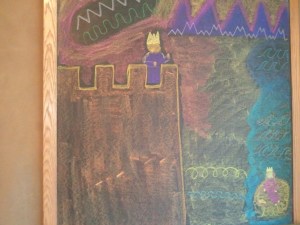
We read the book, “North Star:  St. Herman of Alaska”, as a read aloud for all of us, and looked carefully at the picture of the Northern Lights, such a circular pattern in the painting in the book, and such a grand representation of the cosmos.  We liked it so much we got out our paints and painted it.

Here is the book’s picture of the Northern Lights, and here is what we painted below.

We then looked back at the sky, and wondered at this idea that if we took the trajectories of the planets around the sun, the moon around the planets, the galaxies itself and tracked that around a fixed point, it would also look rather circular..There is a good picture in the “A Beginner’s Guide to Constructing the Universe” book…So we painted this (blue watercolor paint over the trajectories done in yellow beeswax crayon):

We dropped rocks into water to look for the dispersion of energy, which to our eye can look like a circle, and talked about other things we could find in nature that is circular.

All shapes are possible within the circle, and one person that came to mind was the great artist Giotto.  I pulled out this book and we looked at Giotto’s famous frescoes and then I told this story:

A long time ago in the country of Italy, a little boy was born to one of the village blacksmiths. As he grew it was apparent he had a certain light about him. He observed everything in great detail, and had such merry eyes and inquisitive countenance that made everyone in the village love him. His name was Giotto, and he helped his family by watching the sheep of the family amongst the rolling hills of the Italian countryside.

One thing Giotto loved to do was draw and paint the things he observed. He was a keen observer, and he could draw things in such a lifelike manner that it would make all the villagers stop and admire his talent. One day, the greatest Florentine painter Cimabue discovered Giotto drawing pictures of his sheep on a rock. They were so real, they looked like they could wander off the rock and start grazing right then and there! Cimabue was astounded, and asked Giotto’s father if he could take Giotto on as his apprentice.

Giotto went on to do such marvelous work and he kept his funny sense of humor and merriness. Once when Cimabue was absent from his workshop, Giotto painted such a lifelike fly on a painting that Cimabue was working on! When Cimabue returned to his workshop to pick up his paintbrush again, he saw the fly and kept trying to brush it off! Giotto broke into laughter and the two had a merry chuckle over the painted fly that was so lifelike Cimabue was convinced it was real!

As time went on, Giotto painted beautiful frescoes on the walls of many chapels throughout Italy and became known as the most important Italian painter of the 1300’s. But yet, when Pope Benedictus the XII contacted him and asked him to send a painting representative of his skill in order to come to Rome and paint for the Roman Catholic Church, Giotto only drew a beautiful and simple circle and sent that back by messenger to the Pope.

Why would the greatest artist in Italy do that?

So we talked about that, about what that perfect “O” really symbolized to mathematicians, artists and theologians alike – the prefectness of the circle, how all shapes can be accommodated within the circle, how the circle became the symbol of heaven and paradise.  We worked with drawing round circles freehand.  Ours were not nearly as perfect as Giotto’s!  After this, and over the next few weeks, we moved into other geometric shapes – the triangle, the quadrangle family- and then into lines, points, and rays.

And we off to the races in fifth and second grade!  We have since move into a block on Botany for our fifth grader and a Saints and Heroes block for our second grader, which I hope I get a chance to write about soon.

If you have posted your first day of school on your blog, I would love to read it.  Please leave a link below.  If you don’t have a blog but would like to share your first day with my readers, please leave a comment in the comment box!

Many blessings on a new school year,

Carrie

Our Homeschooling Group Never Makes Those Lists……

(This group has since closed.  There are a number of inclusive homeschooling groups in our state to check out, and a Waldorf-inspired group as well.  Many blessings!)

Oh, you all know the lists I am talking about:  those ones on the big Yahoo! Groups where Waldorf homeschoolers write in and ask about, “Where is there a vibrant Waldorf homeschooling community?”  It always seemed to be answered by some destination in the Northeast or the Pacific Northwest.

I understand.  I mean really, the Deep South is not exactly considered progressive in many respects.  People from the West tend to be shocked by the lack of mandatory recycling when they move here.    It is extremely hot and humid so the air just plain upsets people from other parts of the non-humid country, and I remember being floored by the size of the insects when I moved here twenty years ago.  In fact, I distinctly remember thinking they surely were bigger than my dog.

But there good things too:  decent economic opportunity, a fairly low cost of living, a good stock of older homes and new construction, a good amount of hiking and biking and canoeing, great local farmers, lots of things to do, there are La Leche League, Attachment Parenting and Holistic Mom’s Groups here….And here, in the metro Atlanta area, we also have a very vibrant Waldorf homeschooling community.  It is a close-knit and loving group of really wonderful and wise women; we have supported each other through this journey and have a great love for  each other’s families.  People who move here from other parts of the country notice that and are really impressed with the intimacy, openness and friendliness of our homeschool community!  Always gratifying!

I have written in the past about how our group as grown from mainly meeting just for festivals and mainly kindergarten-type activities to now a full compliment of things for children ages birth through grade six.  This year, for example, we have field trips for each grade, seasonal activities like berry picking and apple picking, festivals with complete puppet shows, weekly co-op days with such things as handwork, German, woodworking and an Early Years group, park and swim days, a new annual trip to the beach to end the school year,  and lots of opportunities for adult learning where each month has a focus on some aspect of Waldorf education with adult classes and roundtables to learn more, adult classes, and a large curriculum fair that last year attracted folks from five neighboring states… We do work hard to reduce, reuse and recycle as a group…Most of our members are into natural foods and natural living.  We even hold classes on such things as how to make your own cultured vegetables.

We strive hard as a group  to provide the right thing at the right time, in accordance to what is traditionally done at a Waldorf School, to our children.  Sometimes we have bumps in the road as we grow…this year we have 46 children in co-op classes alone….  Growing a group can have its own aches and pains,and to address that we recently formed a Pedagogical Committee for our group that is comprised of committee heads and others to help discern the spiritual direction for our group.

We all live very spread out and are committed to driving to support each other and to make events.   If you want your children involved in a like-minded community, sometimes you have to work for it.   This can be challenging for folks who don’t want to leave their neighborhood, so that is always something we ask members to consider:  the balance of their own family life and the benefits of a like-minded community.    The location of things rotate, which sometimes works out well for some people on one side of town,and not so well for others.  Traffic can be not great, just like in any other metro area…

But overall, the ride is a good one.  So I wonder if Atlanta will ever start to show up on those lists?

Blessings,
Carrie

Foreign Languages In Your Homeschool


I have written about foreign languages in the Waldorf-inspired homeschool before here:  https://theparentingpassageway.com/2009/02/17/teaching-a-foreign-language-in-waldorf-homeschool/  and here:  https://theparentingpassageway.com/2009/12/24/learning-a-foreign-language-in-your-waldorf-homeschool/


As mentioned in these posts, most Waldorf Schools teach two languages from Kindergarten onwards and these two languages are typically ones that are from different poles: A Romance language and a language of Germanic or Slavik origin, for example.  In my own homeschool, we are learning Spanish and German.  My oldest daughter has plans to branch out into Russian.  You could bring in whatever language you have knowledge of, or of whatever languages you have in your surrounding area.  It is important to consider what languages are being spoken in your own geographic location, because tapes, recordings and such as not the approach in a Waldorf School, but immersion through a native speaker is the norm.  And the approach of the language is not just to learn the language, but to celebrate and immerse oneself in another culture.  For example, a Waldorf School Spanish teacher may come to school in native dress and do cooking and dance and festival celebrations along with the beginnings of the basic themes in Spanish for the early grades.


Some of my favorite resources for small children in Spanish, available through Amazon, are posted on the Facebook page of The Parenting Passageway here:  http://www.facebook.com/#!/TheParentingPassageway.  Another book I use frequently is “Senderos”, available through Rudolf Steiner College Bookstore: http://www.steinercollege.edu/store/product.php?productid=16373&cat=0&page=1  What I find especially helpful in this book is the list of books and stories by grade in the back of the book and the examples of how to teach for each grade.  It has extensive Spanish in it, so if you cannot read Spanish, this book may not be as helpful as you would like. (I see that it ends up on the used Waldorf book lists a lot and I think it might be because either folks don’t know what to do with it or maybe they think it provides comprehensive lessons, which it does not.  This might be one to try to look at ahead of time before you buy if you have other Waldorf homeschoolers in your area).    Many of the books suggested by grade in “Senderos”,  I have found used on Amazon, and they provide a great springboard for Spanish studies, especially for my fifth grader who is working at a middle school level in Spanish.


I found German to be harder, simply because I don’t know any German (!!), but I was fortunate to find a Saturday German School in our area and also a very dear friend who is a native speaker from Austria who became the tutor for our children.  This year my youngest will also be taking German in the classes for our homeschooling group, which is a group that seeks to unite homeschooling parents in our area who try to educate according to the tenets set forth by Rudolf Steiner in education.  (And PS, we have a smashing, busy, full homeschooling group – why is it that Atlanta never comes up on those lists of where to move when folks ask this question on the big national Waldorf Yahoo Groups?  Atlanta and the surrounding metro areas is not a bad place to live!  But I digress…guess that is a post for another time!)


I have had folks writing to me and asking for resources, preferably books with rhymes and songs that may also have a CD so they can learn the song themselves to teach their children….So, I am asking all my readers:  What languages are you teaching?  What resources do you use?  How do you bring in native culture – dress, festivals, dances, games – into your homeschool?    I have readers especially searching for resources in Russian and Chinese that could be tailored to Waldorf methodology.  If you know of any of these resources, please leave a comment in the comment box.


My readers are a big and diverse bunch, so I would love to hear from you in the comment box!


Many blessings,
Carrie

Fall Stories For Puppets!


For those of you looking for ideas for Autumn puppetry, here are some wonderful links to check out:  


Here is a sweet look at puppets to go with the story “The Star Apple”:  http://webloomhere.blogspot.com/2012/07/the-star-apple-puppet-play-story.html


Here is a puppet making tutorial for Jeremy Mouse and Tiptoes Lightly:  http://joygrows.wordpress.com/2012/07/12/tiptoes-and-jeremy-mouse-marionette-puppet-tutorials/


And a sweet Autumn story from 2009 that deserves a closer look:  http://domesticallyblissed.blogspot.com/2009/08/autumn-story.html


More about making marionettes: http://teachinghandwork.blogspot.com/2008/08/6th-grade-or-kindergarten-teacher.html


You can see a list of my favorite Autumn tales by age for children under the age of 7 here:  https://theparentingpassageway.com/2009/09/03/favorite-fall-tales-for-waldorf-kindergarten/ and some ideas for Autumn in the Kindergarten:  https://theparentingpassageway.com/2010/08/20/some-quick-autumn-ideas-for-waldorf-homeschool-kindergarten/


Many blessings as you bring sweet Autumn dreams to your wee little ones,

Carrie

Guest Post: Botany In The Waldorf-Inspired Homeschool

Our guest blogger today is the wonderful, wise and inspiring Lauri Bolland.  She lives in Pennsylvania with her husband, Eric, and their three always-homeschooled Waldorfy children who are now 22, 18 & 14. Their youngest, Gracie, recently published her first book, which grew out of their Seventh Grade Creative Writing Main Lesson Block. Gracie can be found on Lulu here:

http://www.lulu.com/spotlight/AmazingGrace

I asked Lauri to share some words regarding the “botany” block of fifth grade, and this is what she wrote:  Continue reading

Guest Post: Using “A Donsy of Gnomes” In First Grade Homeschooling

My original post on the book “A Donsy of Gnomes” stirred quite a bit of interest!  You can read the original post here: https://theparentingpassageway.com/2012/07/09/a-donsy-of-gnomes-7-gentle-gnome-stories/ .  One of my wonderful readers wrote in with her story of how she used “A Donsy of Gnomes” in her daughter’s first grade experience.  Thank you to my reader Kristen from Vermont for sharing with all of The Parenting Passageway’s readers!

Here is what Kristen wrote, and I hope it will spark some creative ideas for your own homeschooling experience:

At the end of my daughter’s first  grade year, I decided to incorporate Sieglinde De Francesca’s sweet book of gnome stories into our Nature Block.“How to Create a Spring Nature Block for Grades  1-3”.  I loved her ideas but being the busy mama that I am with a small farm  to ‘manage’ and two  young girls under my constant care, I couldn’t possibly figure out how to find time to write my own stories.  Here in northern Vermont, we have seven to eight months of winter and relative ‘rest time’ but once it warms up, we are like crazed squirrels running here and there trying to fit everything in before it snows again!  I learned an important lesson this first year of homeschooling:  don’t leave any planning for spring undone before spring arrives.   You will never find the time once it’s warm enough to venture outside again and enjoy longer stretches of fresh air and the warmth of the sun.

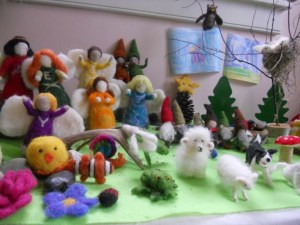
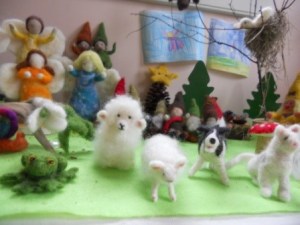
So, I cheated.  I’ve been telling Sieglinde’s stories all year, with needle felted characters for each story, and my daughters have enjoyed them immensely.  (In fact, when I told the last story of the book, which occurs in late spring, my girls cried and I had to reassure them that they’d hear the stories all over again beginning in late summer!)  My plan was to tell the last two stories over the course of a month and tweak each story just a wee bit, adding bits of natural history here and there.  For instance, when I was in graduate school studying forest ecology, I loved reading about microhabitats and the ‘pillows and cradles’ you often see on the forest floor in mature stands.  Why not have the gnomes enjoy a rollicking time running up and down that lumpy ground, just for fun?  I also love wildflowers, especially the ephemeral ones in spring that look really groovy, like Jack-in-the-pulpit.  So why not have a gnome take shelter beneath a Jack-in-the-pulpit “roof” during a quick rain shower?   And, since I’m a bit obsessed with birds, why not have the gnomes comment on some of the bird songs as they scampered through the woods during the story?

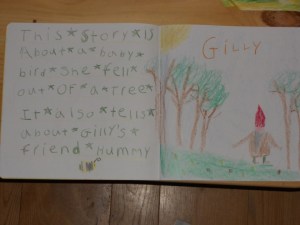
The rhythm of our weeks was simple and was basically the same as telling the fairy tales, except that we incorporated nature walks into our afternoons to look for pillows and cradles and Jack-in-the-pulpits and notice what birds were singing their springtime songs.   We kept a nature journal which included a picture of the story and a short summary.

I also drew my own picture for story and hung them below our blackboard.  On these, I wrote words that my daughter could learn to write in her MLB and then practice reading.  We also incorporated a game in Peggy Kaye’s wonderful book “Games For Reading”.  It involved writing a short sentence related to the story, cutting up the sentence into pieces so that the words or phrases were separated, and asking my daughter to put the pieces back together in the right order to make a logical sentence.

She had already seen most words on my drawing and written many of them in her main lesson book so this was not as difficult a task as I thought it might be.  She is having a hard time learning to read and is not the type of kid who will sit down and try to figure it out herself.  A late bloomer, perhaps, but a child who loves to hear and retell stories!

Overall, I think this block was a stunning success and for weeks afterward my girls played with the needle felted gnomes (and other animal characters from the stories that I needle felted).    They both attended a garden camp this summer and during one of their walks in the forest  they gleefully showed their friends how much fun it is to run up the pillows and down the cradles in the forest, just like little gnomes do!

Many blessings, and much love,

Carrie

Last Minute Homeschool Planning


In my neck of the woods, many of my homeschooling friends are planning to start school in the next few weeks.  The Deep South runs on a bit of a different time table than much of the country, who traditionally starts school after Labor Day.


Some mothers are still searching for curriculum to buy, or are realizing that there really is not a lot of money to buy curricula.  Others are wondering how to put it all together.


I always start with a calendar of the year, an idea of when we want breaks and a general idea of starting and ending and then decide what block I would like to do when.  I tend to stick to form drawing and math blocks that are shorter than language arts or history blocks.


Think about your child’s interests in planning blocks.  A Waldorf homeschool is not a Waldorf School. Sarah Baldwin, owner of Bella Luna Toys, wrote a lovely post about this very topic from her own experience here:  http://simplehomeschool.net/waldorf-homeschooling-learning-to-let-go/  If you know the curriculum and child development along with your child’s interests, you really can’t go wrong.  Bring things in at the right time, but look and observe your child – not only what they like, but what they really need to be balanced and to grow up healthy and strong and capable. 


Once you have an idea of your blocks, you can move into what your weekly rhythm looks like and your daily rhythm.  I shared a number of homeschooling forms that I used to plan my school year this year:  http://simplehomeschool.net/waldorf-homeschooling-learning-to-let-go/  and here:  https://theparentingpassageway.com/2012/06/16/get-your-planning-on-a-daily-homeschool-form-you-can-use/


Start plugging things in to your form – what verses will you use for your child to recite?  Can you get a poem related to your subject from the library?  What will you use as the basis for your block – fables, stories from history, etc?  Can you get these from the library or can you afford to order something you would like to have on your book shelf?


Where is the rhythm of using sleep as an aid?  Where is the movement, the arts (see this post to remind yourself: https://theparentingpassageway.com/2011/12/21/more-about-the-artistic-pillars-of-waldorf-education-a-virtual-tea/) , and the academic piece?  Where is the practice for the academic pieces:  your  daily math practice and your reading aloud or having your child read to you? I find most families do put these things in daily and do not let them go with no practice for a whole block…Again, this is the reality of how families do things, not some dogmatic way of approaching things.


And finally, where is the FUN?  Festival preparation, field trips, going out with your homeschool group, family outings or whole mornings or afternoons at the park or on a hike?  Get your fun going on so you won’t be burned out by the holidays!


Happy planning!