Parenting and Homeschooling The Only Child

You might wonder what I could possibly say about the only child as I am raising three children, not an only child.  And if you have read this blog for any length of time you probably know I think the ideal number of children (at least for myself :)) would be four or five children.

However, I myself am an only child so I feel I can speak from my own experience on this subject!    I have also worked with many families who have only children, and all of these families  have had almost the exact same concerns regarding their child’s “only child status”:  are they getting enough time with other children their own age?  Are we doing enough to prepare this child to interact with their peers?  Less frequently parents with an only child have asked me if they were “spoiling” this child?  Will this child be prepared for life on their own or will they expect everything to go their own way?

First of all, I have to say that most  of the only children I meet are really sensitive, talented children.  Most of them are very attuned to adults and adult body language and how adults think and do things.  Most of them seem to have very high vocabulary levels.  Many of them are relaxed children who enjoy life.  Some of them do seem anxious socially and have problems in this regard, but so do many children who come from families with multiple children.

I feel the question of  “socializing” an only child to peers of the same age is often not an issue at all.  I think it is important to the only child to be viewed as the same as other children in  terms that the family as the basic unit of socialization is “enough”.  There can be many opportunities within one’s own family for the only child. 

In my own childhood, I had a large family where I was raised by and lived with  my grandparents and my great-grandmother, my father and my uncle and my other set of grandparents were frequently around  (and did I mention all my grandmothers’ brothers and sisters who showed up for a month at a time?  My family was big into “Surprise!  Here we are!  We are staying for a month!”)  I also had many cousins I was close to and stayed with for periods of time who treated me like a little sister.  🙂  Part of my family were in business together, so that added yet another dimension of “togetherness” to the equation. 

Possibly what is more of an issue is in socializing an only child to peers who are NOT of the same age as the child.  The only child often seems to relate well to a child who is older, perhaps because that older child is viewed as closer to an adult, but may have trouble accepting the noise, attention span, and  immature behavior of a younger child.  They may not understand how to play with and include a younger child the way an older child from a family with multiple children does.    Again, this is just my experience in working with only children, and it may not be typical of your experience at all.  🙂

Another area that I think *could*, (but again may not be in your case), pose challenges is that of a mother homeschooling an only daughter.  I don’t think this is such a challenge in the younger years, but I do think sometimes mothers and daughters can really get into each other’s “stuff” the older a child is.

One area I think all parents in general need to be aware of is what is appropriate for the child developmentally and how to parent the ever-changing stages of childhood.  I have seen only children in the early grades who were treated as much younger and less capable of doing things than they really were, and this may be because there was no smaller sibling around to gently remind the parents what small really looks like. 🙂  Conversely, perhaps that only child seems so mature and adult-oriented that we forget that child really is still very young.  To me, if you can figure out how to parent the only child, you can homeschool the only child!  The parenting is the harder part!

There are things about having siblings that just can never be replicated for the only child, and I am not so sure that should be a goal.  The only child is having an experience that is different than a household full of children, but there is value in the experience the only child is having as well.  Why should we try to make the only child’s experience into something else?

If you are a mindful enough parent to be considering these issues, then I am sure all will be well.  🙂

I would love to hear your thoughts, challenges  and successes on the subject.

Blessings,

Carrie

Surviving Bedrest and Being Homebound With Medically Fragile Children

Hi all,

I had a wonderful comment on one of my other posts regarding what I would recommend for parents who have medical challenges or for parents of micro-preemies who with the flu session and Winter need to stay home for several Winter seasons in a row.

It really is challenging to get a good mindset about it all.   One important thing I would like to say right off the bat is that this is a time to shore up your own inner work, your own prayer and meditation life, your own personal development.  These situations can really push one to grow.

 I was on bedrest with my second child, and it was one of the most challenging experiences of my whole life (because as many of you know I am a rather busy little soul).  However, I think I would handle it much, much better today. There is a really good thread here over at the Berkeley Parents Network  regarding bedrest, does it really work and is it worth it, how to handle it, etc:   http://parents.berkeley.edu/advice/pregnancy/bedrest.html

There is an organization devoted to mothers experiencing bedrest and high-risk, complicated pregnancies here: http://www.sidelines.org/

I think one of the main things with bedrest is to have people available to talk to who can understand your feelings.  If you are on bedrest with an older child, I think it can quickly dissolve into the fact that you cannot mother your older child the way you want, and you feel as if you are failing the baby inside of you as well.  If you have multiple older children, it also the sheer logistics of caring for everyone, being stretched as a couple, perhaps having family members come and stay for weeks on end (which can be challenging).  There is a lot to think about and plan, so I highly suggest those above links.

As far as being homebound with children who are medically fragile for the Winter, I do understand how hard this can be for parents!  It seems especially difficult  when one has  to do this for the second Winter season in a row after having some freedom in  the Spring and Summer.  For many parents, it was hard enough to slow down for the first Winter season! 

I would invite you, though, to close your eyes and imagine your little micro-preemie or medically fragile child as healthy and whole due to staying home.  Imagine them thriving due to a healthy rhythm, lots of rest and sleep and time to just be. 

That being said, here are a few suggestions:

  • Every family dealing with a second season of isolation due to RSV season has their own way of doing things – some allow family members to visit, some have their child avoid contact with children who are in day care, some avoid indoor places and only go to outdoor places.   Some are on complete and utter “lock-down” at home.   I think it is very important to dialogue with your health care team as to what is right for your individual child and to decide as a family how you will handle this.  I think it also helps to know how many cases of RSV are out there in your own state, you can check here:  http://www.cdc.gov/surveillance/nrevss/rsv/state.html
  • Try to have a rhythm of when you might bundle up and go outside if that is a possibility, even if it is just to walk around your own yard, when to do finger plays, when to do some work around the house, rest and sleep times, bodily care.  This post may actually assist you:  https://theparentingpassageway.com/2010/01/06/waldorf-in-the-home-with-the-one-and-two-year-old/  Rhythm is especially important for children who were premature as this helps the child’s sense of balance in life and flexibility.
  • The entire focus of the day should not be hovering over your small child anxiously….the focus should be in creating a warm, peaceful, home with peaceful mother hen energy where you as the parent are setting the tone of your home.  You have important work to do in your home that your child can help with and imitate.  You have more to do than just sitting there looking at your child.  This will help their development more than anything!
  • Think about how to nourish the caregiver.  When can Mommy go out on her own to run errands?  How about something you enjoy doing that you could do at night once your wee one is asleep? 
  • Do you have the support of your local place of worship?  Do they know what you are experiencing?  Can they be of support to you? 
  • Do you have anyone locally you can get support from either in-person or on the phone?  I have heard of some parents of micro-preemies meeting up on meetup.com or the like…perhaps over the Winter, one could not meet in person but one could keep in touch and support each other over the phone.
  • Who else could help with  running errands for you or could you order things on-line?  What is your plan if you have a traveling spouse or your child does actually get sick?  Do you have some meals frozen?
  • What can you do to experience nature indoors if you cannot go out?  Can you set up bird feeders, can you have a fish tank, can you start a potted herb garden or plant bulbs?
  • Depending upon the age of your child, can you have lots of holiday craft supplies on hand?  Music and songs to sing and learn? 
  • What about the child’s gross motor abilities?  Can you have an under the bed box full of sand and sand toys and put a tarp under it?  Water play?  Can you hang a swing somewhere? 

These are just a few suggestions, take what resonates with you.  Also, if you are a mother who has survived bedrest or staying in a season, please leave your ideas and suggestions for other mothers below.  You could be a real blessing to someone today!

Love your children and live big,

Carrie

A Waldorf View of Martinmas

(Updated with working links 11/2014).  The time of Martinmas (November 11)  is upon us again!  This is one of my favorite times of the year; I wrote about some of my thoughts regarding Martinmas  last year here :https://theparentingpassageway.com/2009/10/29/martinmas-in-the-waldorf-home/

Martinmas marks the burial of St Martin of Tours (316-397 AD).    St. Martin may be well-known for his compassionate gesture of sharing his cloak with a beggar.  This charitable gesture is at the heart of this festival for many Waldorf schools, who hold coat drives and other charitable drives around this festival.

This festival is the middle point between Michaelmas and Christmas; the light of Martinmas fortifies our souls for the dark winter and prepares us for the birth of Christ.  One symbol of this is working with light from lanterns in the traditional Lantern Walk.

Regarding Lantern Walks, the authors of the book “All Year Round” write:  “The traditional way of celebrating Martinmas is with lantern walks or processions, accompanied by singing.  St. Martin recognized the divine spark in the poor man of Amiens, and gave it the protection of his own cloak.  When we make a paper lantern, we, too, may feel that we are giving protection to our own little “flame” that was beginning to shine at Michaelmas, so that we may carry it safely through the dark world.  It may only be a small and fragile light- but every light brings relief to the darkness.”

As a parent, it is important for you to penetrate a festival or holiday and discover what it means to you.  You can then bring that to your small child, and your older children, in a physical way.  If you would like to know more about a Waldorf School perspective regarding St. Martin, one can read this article from the Gateways Journal for Waldorf Early Years teachers:  http://www.waldorflibrary.org/Journal_Articles/GW57martin.pdf.  Here is some information about St. Martin from a Roman Catholic website:  http://www.catholic.org/saints/saint.php?saint_id=81.

We usually host a Lantern Walk every year within our homeschooling group; this year my children walked with their German school but we were sadly not able to make our homeschooling group’s walk.  However, as a special treat, this weekend we are attending a Lantern Walk held by one of the German churches in our area that will include not only the walk but St. Martin on his horse!  This should be lots of fun.

Below find some links for ideas for your own Martinmas celebration.

Specific Resources:

If you would like to know more about a Waldorf School perspective regarding St. Martin, one can read this article from the Gateways Journal for Waldorf Early Years teachers:” http://www.waldorflibrary.org/images/stories/Journal_Articles/GW57martin.pdf

“Lantern Walk Story:” http://www.waldorflibrary.org/images/stories/Journal_Articles/GW3808.pdf

“A Waldorf Early Years Teacher’s Experience with a Lantern Walk: Here is one Waldorf teacher’s experience with a Martinmas Lantern Walk here:” http://www.waldorflibrary.org/images/stories/Journal_Articles/GW53gallardo.pdf

And another story:  http://herbnites.tripod.com/waldorfinspiredschool/id15.html

Examples of Different Kinds of Lanterns to Make:  (German website, but good pictures):  http://www.kikisweb.de/spezial/stmartin/Laternen/laternen.htm

Lantern Walk Songs:  http://astorytellingofcrows.blogspot.com/search/label/lantern%20walk%20songs

Many blessings,

Carrie

Back To Basics: Community!

In life there are always polarities and then A Middle Way. 

My dear long-time reader Elizabeth urged me to write a post to balance out and harmonize a post I wrote regarding staying at home (https://theparentingpassageway.com/2010/11/06/back-to-basics-staying-at-home-and-loving-it/).  Thank you, dear friend!  You see, she has been reading  my blog for a very long time and she knows a few things about me, and has probably read some of my past posts I have written about the importance of COMMUNITY.

She knows that whilst I was an only child, I lived with an extended family that worked together in a family business.  I had lots of cousins and aunts and uncles, many of whom came and stayed for extended periods of time. I had a group of maybe ten children in my neighborhood as well to play with.  Right now, as an adult,  I am very outgoing and have a very  large community of friends – through our homeschooling group, through church, through my neighborhood, through helping mothers with breastfeeding and homeschooling.  My children are involved in things at home and in our neighborhood and yes, also have a few activities.  

I love people, and I  certainly never mean to say we don’t ever go out!

However, you have to understand another perspective from which  I am writing from.  I  live in a very big, very bustling city where parents really do drag their children around way too much, the commute times to get to things are long, the needs of small children are generally not respected and very tiny children are enrolled in classes, lessons, mother’s morning outs, etc. etc, etc.  Separation and learning skills are pushed incessantly. I see mothers who are consistently stressed and harried and just generally not having any fun at all on their parenting journey.

I also see small children under the age of seven whose senses are being bombarded, children who are being treated as miniature adults and are the worse for it.  And many times the implications of this treatment during the Early Years doesn’t fully appear until the child is the age of the grades or even the teenaged years.

So, maybe you are in the opposite situation that I am, living in this large urban area…Maybe you live somewhere rural, somewhere where you are unsupported.   Maybe you don’t have a car for any of the days of the week and you need one to get out in your community.  So you mainly stay home.

Part of that is necessity for where some mothers are…And I absolutely believe that the family is the unit of socialization for the small child.  But hopefully that consists of more people than just one mother.  If you do not have family near-by, have you discovered any friends who can become like family?  If you can only get out once a week, can part of that be to go and get involved in a place of worship and build a community through that?  Can your one errand day also involve a picnic with another family?  Can you let go enough of your grades age child to arrange for them to spend time with other people, other adults besides you,that would also nurture them and be positive for them?  I think this is an important question.

I also encourage mothers to form support networks for themselves, to rely on more than just themselves from sun-up to sun-down to take care of their children.  I have encouraged you all to have mothering mentors,and  to reach out to other mothers yourself.    Maybe you have some beautiful friends or neighbors who can be part of your family.  I know my own personal “family” extends way beyond just blood relatives!

I especially think this is IMPORTANT FOR THE GRADES CHILD.  The grades child really needs to be part of a community.  The six and  half year old or seven year old does need friends, the world does need to open up a bit.  When I hear about nine or ten year olds and up who have no friends, this makes me feel  sad.  They should, hopefully, have some friends by this age!  In nine years or so, they will be out on their own, no longer in your house, and they will need to be able to navigate the social world by themselves, without you.  Let them develop their skills in discerning good friends, deal with friends who don’t want to play what they want to, all of those childhood things we all go through.  This is their social work, and it is important.  I don’t believe that this has to happen at age three or four but it does become important as children mature and grow. 

It is always important to PARENT WITH A PLAN.  What does your child need right now?  What needs to be balanced and harmonized?  Does this need to happen now, can it wait, what is child doing developmentally and is this something that needs to be worked with deeply or something that needs to be guided but  will pass?  What does the family need as a whole?  Your needs as an adult count as well….

Here are some back posts on community, and I hope you find them helpful:

A few notes on the importance of a spiritual/religious community:  https://theparentingpassageway.com/2010/06/07/a-summer-parenting-project-for-you/

9-12 year olds and community:  https://theparentingpassageway.com/2010/06/06/the-foundation-years-of-ages-9-12-decreasing-high-risk-behavior-in-teens/

Another post about this debate of protection and community:  https://theparentingpassageway.com/2009/09/09/more-about-social-experiences-for-the-four-year-old/

Are we making this too hard?  Are these things mutually exclusive?  https://theparentingpassageway.com/2009/06/19/the-simplicity-of-parenting/

Protection of the twelve senses is so important (Waldorf readers will understand that which I am referring to!), but one of those twelve senses is the Sense of Balance.  Simplicity and rhythm are wonderful, but so is warmth and fellowship.  Fellowship can carry things that are so difficult to carry alone.  I do not want people to mistake simplicity for emotional distancing.  Life, and living with people, can be messy.  So be it!  The pros far outweigh living life isolated and alone, I think.

This is a hot topic and one that is so important to figure out where you and your family stand – be mindful and create what works for your family!  Let the comments begin, LOL.

Have fun creating a family culture that extends outside the walls of your home,

Carrie

Back to Basics: Work Hard On Your Marriage

(This is a note:  Feel free to change the language in this post to match what works for you – partner for spouse, partnership or relationship for marriage.   Onward and upwards now!)

We are still continuing on our “Back to Basics” posts.  I really wanted to include one on the challenge and importance of nurturing your marriage, because family stability is so important for children.

How do you hold onto your spouse and marriage in the midst of raising small children?  It can be really difficult, because as many of you know,  time is little, many times there can be small children waking at all various times and in your bed, and “going out” can be challenging as well.

I see many attachment-minded mothers (and fathers) who seem to replace the intimacy of their marriage with a relationship to their children.  Whilst I love the connection to children, a child is not your spouse. A child is not there to fulfill your adult needs.   A child will be grown up and gone, and you and your partner will be looking at each other across the kitchen table wondering what you all have in common with each other.  Many of you have read my back posts on marriage and know the wise saying of my own friend who talks about preparing for the day the children will be gone from the home starting today.

Here are some of my ideas for building up a marriage during this season of raising children:

I am waiting to hear your ideas in the comment box below!

Many blessings,

Carrie

The One-Year -Old

Right now, I have the great and distinct privilege of closely watching some one to eighteen -month old children grow and develop and change.  I love watching what interests them! 

Have you ever noticed that the one-year old likes to:

  • Eat and drop things over the edge of their chair, feed the dog, and drop the food down their shirt or put it in their hair.
  • Move furniture around
  • Take things in and out of something or open and shut something.
  • Shriek loudly.
  • Wiggle out of your arms and move!
  • Watch what you are doing and imitate the motion of it
  • Use different objects to imitate the gesture of  things (ie,  use a kitchen spatula or a spoon for the gesture of  combing their hair)
  • Be outside to feel the grass, the dirt, the leaves…..and to try to eat it all
  • Be sung to and have fingerplays and rhymes bouncing on your knee
  • Laugh
  • Play peek-a-boo
  • Be held and kissed
  • Catch your eye when they are doing something and smile
  • Empty out a bookshelf or drawer of kitchen supplies
  • Roll a ball back and forth with someone
  • Give you things and take them back
  • Wave bye-bye
  • Make piles of mulch or leaves
  • Ride in a sling
  • Pull the cords out of things – look carefully around your house!
  • Go for walks
  • Talk! Coo! Communicate!

Have you ever noticed that a one to eighteen month old:

  • Is more likely to have erratic napping?
  • May wake up during the night due to teething or other developmental milestones?
  • May have an increase in appetite for solid foods  (or may not!)
  • Will still nurse a lot!
  • Can often have cold hands and feet – keep checking their levels of warmth

Just a few thoughts and observations.

Many blessings,

Carrie

Back To Basics: Staying At Home and Loving It!

Many mothers struggle with certain areas of cultivating a peaceful family life.  Typically these areas are housecleaning and home maintenance, gentle discipline, and creating a rhythm for their family.  Many mothers tell me that they start off well, and then they stop, and then they start and then they stop.

I have a solution for you in these areas, although it is not a very popular one these days:  stay home!  You need an unhurried pace in which to parent small children, and you also need time to work on yourself and your own development as a part.

Staying at home gives you the time to focus on the things that matter:  connecting with your spouse and children without rushing around stressed; giving your children the healthy foundation of rhythm; and providing you enough time to be home to actually cook nourishing meals and clean your home and take care of your garden.

I wrote a post in May of 2010 that in part read:

I invite you to breathe and ask yourself this question:  How often am I going out of my home?

  • Is it every day and you have children under the age of seven?
  • Is your home and your homeschooling and your parenting where you would like it to be?
  • Could your time of lessons or classes or activities for your small  children be better spent elsewhere at this point?

I understand if you are suffering from depression and really need that social connection and support of other mothers.  I really do understand if you are extremely outgoing like me and just get filled up by being with other mothers and other people…I really do understand!    I wrote a post about Social Isolation for Stay-At-Home mothers here:  https://theparentingpassageway.com/2010/02/24/social-isolation-for-stay-at-home-mothers/

But there has to be a balance, and if you are going out every day and if your under-seven child is involved in a plethora of activities, I just gently am nudging you to explore this.  Boundaries are important, and showing and modeling for your child how to set boundaries and maintain them is REALLY important as they grow up into a world that will most likely have even more blurred lines between personal and professional lives due to increased technology.

I invite you to try to discern what really are  the most essential things in your life, and how the time you spend reflects what is most meaningful to you.  I am working on this right now, and it really is challenging me!

Particularly for the parents of very small under-aged five children, it is easy to get caught up in lessons, classes, and other things.  The ages under five (and under seven and yes, even under age nine!), to me, is an excellent place to experience an  unhurried concept of  time.   They will never have these days again!   There will be so many other years for classes, for lessons and for other activities and for rushing about on a schedule (which is different than the flowing rhythm of being at home).”

Some mothers tell me it is so difficult to stay at home for them.  One post I wrote on this subject that was insanely popular was this one, take a look and refresh your memory:  https://theparentingpassageway.com/2010/05/09/how-can-i-love-staying-at-home-with-my-children/  and this one:  https://theparentingpassageway.com/2009/04/15/but-when-i-stay-homeeverything-falls-apart/

Are you worried about your child and their level of socialization?  In general, for children under the age of 7, I feel less is more.  I wrote about that here:  https://theparentingpassageway.com/2009/09/07/social-experiences-for-a-four-year-old/

Look into your heart and see what is right for your family at this time, in this day.  Your rhythm will change as your children grow, but being home is so important.  You can develop your own will to do this (see here for help: https://theparentingpassageway.com/2010/04/30/the-adult-will-and-how-to-develop-it/)

Many blessings,

Carrie

Back to Basics: Rhythm

And you thought we were done with “Back to Basics”!  No, I still have a few more musings on this subject. Today I am thinking about rhythm and about how to develop rhythms that work for the whole family.

Crafting your day, your week and your year has distinct advantages for your family life:

· Gives children a sense of security

· Rhythm can calm a high-needs, anxious, nervous or difficult child

· Children can see the tasks of daily life as process from beginning to end

· Once children have external rhythms, they then develop internal rhythms for eating, sleeping

· Helps the child focus their energy on play and growth and balance as opposed to wondering when the next snack time will be or when bedtime is

· Rhythm helps maintain a person or child’s strength for daily tasks

· Connects a child to nature

· Provides a structure for a child that is neither boring nor over-stimulating; provides a balance

· A True Help in Loving Guidance – because children are so centered in their physical bodies and in imitation, rhythm becomes a real help in avoiding arguments

· Helps children become helpers in the home and in life by building in times for setting up and cleaning up activities within the rhythm; this helps calm nervous and difficult children

· Rhythm helps the adults of the family build up their own self-discipline so we can model this to our children

· A rhythm helps a child feel certain that their needs will be met

· A rhythm is a vital piece in establishing for young children that there is a time for all things

· Rhythm helps parents not only with self-discipline but with enabling the energy of the house to flow smoothly and to support the needs of everyone in the entire family, not just one child or the children

· A disorganized life is not truly free!

Sometimes mothers will tell me that rhythm in the home is near-impossible for them to develop because they lack rhythm, they did not have a rhythmical home life growing up,their children are very irregular and arrhythmical….I say these are the sorts of adults and children who NEED rhythm the most.  However, it is a place that requires development of our own will-forces to execute, to get back on that band-wagon when we fall off.  I wrote a post about developing the adult will here:  https://theparentingpassageway.com/2010/04/30/the-adult-will-and-how-to-develop-it/  We can only give our children the gift of inner discipline when we ourselves can model inner discipline in some area!  I have a post about instilling inner discipline in children here:  https://theparentingpassageway.com/2010/04/20/how-do-i-instill-inner-discipline-in-my-child/

Here are some open-ended questions regarding rhythm:

  • Do you have rhythms set around mealtimes and rest and bed times?
  • What is your rhythm for  your own inner work, your own work you may do for pay, and other roles you may play besides Wife and Mother?
  • What kind of rhythm do you have for spending time with your partner? 
  • Do you have a general rhythm for taking care of your own health?
  • What is your rhythm for homeschooling?
  • What is the rhythm for balancing being home and being outside of your home?  Are you always going, going, going?  Do you find it difficult to say no to outside things?
  • Do you have seasonal rhythms?  What festivals speak to you –why and why not?

Hope that helps you meditate on this important subject,

Carrie

The Schoolroom

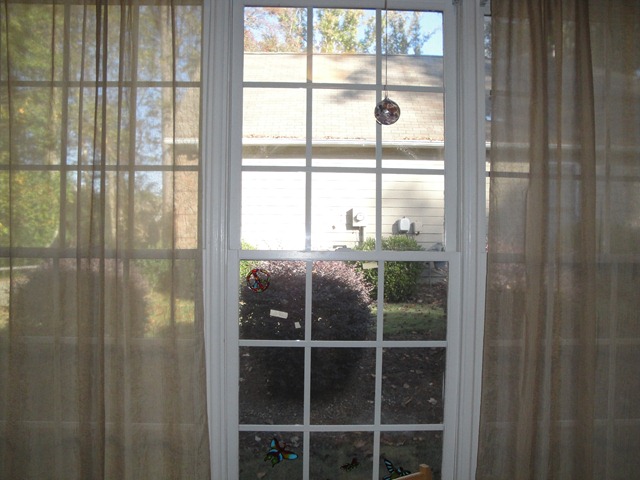
Ah, I am breaking the “no-picture” rule on my blog today to show you my schoolroom.  I do this to show you that I have a very small school room and to demonstrate that the goal truly  is NOT to re-create a Waldorf School in your home!  Sarah Baldwin over at Bella Luna Toys has a great post on that here: http://blog.bellalunatoys.com/2010/waldorf-homeschooling-letting-go-of-perfect.html

Your schoolroom is still part of your home!  My schoolroom is in the room that is supposed to be a small dining room.  I feel blessed because many homeschoolers do not have a dedicated homeschooling space, and I truly enjoy mine.

Facing the South:

 DSC00773

Just a small view of outside with sheers and a suncatcher.    Next to the window, also on the South wall:

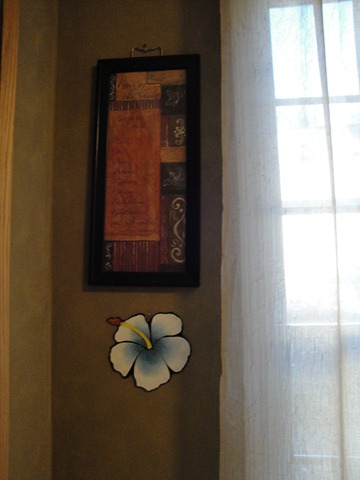
DSC00774

Crucian glass and a plaque about “The Fruit of the Spirit.”

I don’t know why, but I have no picture of the East wall.  It has a very large blackboard that you can see in the Old Testament block post, and a homeschooling cabinet.  Cabinets are very important.  I have a cabinet that was made for scrapbooking, so it has tons of pockets and places to stash all the art supplies associated with Waldorf.  It was a gift for my 40th birthday, and I am grateful for it every day.

The North wall has a doorway and a large two sided-chalkboard slid next to the cabinet.  Then we come to the  West wall:

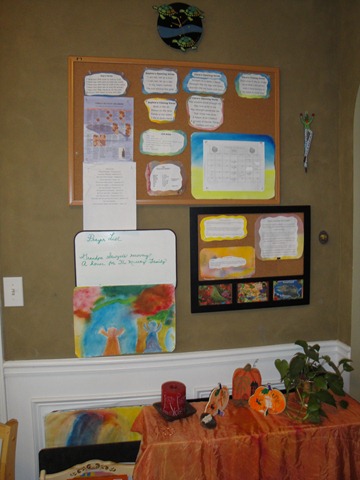
DSC00769

Bulletin boards are not especially Waldorf-y but I have to have one.  It has all our prayers for the day, our white little prayer board, more Crucian glass.  The silks are covering a bookcase.  There are painting boards and lap-sized chalkboards slid behind the bookcase.  Foreign language materials are in a little painted wooden holder next to the bookcase.  Then there is a doorway to the kitchen and this little bookcase and Nature Table in the corner:

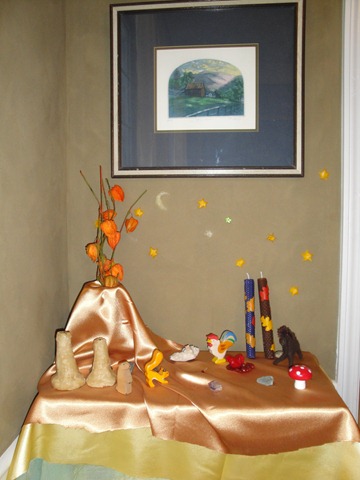
DSC00772

My Nature Table is very simple as you can see.  I realize I did not take a picture of our kidney-shaped table and chairs.  We also have a braided rug to warm the room.

One thing I would like to get is a mobile of some sort to hang from the ceiling.  A school room is a wonderful thing, and its organization is often a work in progress.  We also homeschool in the kitchen and garden a lot, and many times I will move the large two-sided chalkboard out into the dining room to work on it.  Right now I have three chalkboards and would like to get one more for next year when I have a first and fourth grader together.

Thanks for looking!

Many blessings,

Carrie

The Frail Child

I have recently  been observing many children and they seem so frail.  They are not only frail physically, with spindly arms and legs (and no, I don’t want them to be fat!) but no hint or curve of any muscle mass.   They don’t seem to be able to carry anything for themselves.  They  appear to  have low endurance for running and playing and tend to pick sedentary things to do.

Many times, they also seem frail emotionally, falling apart at the least hint of anything not going the way they think it should.  Now, this absolutely can be “normal” for small children under the age of 9 who are going through stages of  developmental disequilibrium.  I think of children as having an excess of emotion when they are under the age of nine.  So, it is up to your discernment as a parent to decide if your child’s emotional state is normal for his or her age or if it is something that indeed needs “balancing out.”

Here are some ideas to help bolster up the seemingly frail child:

  • STOP TALKING!  Especially tone down your discussion of world events, crime, family drama in front of this child.  Offer limited choices.  This child needs to heal and really needs you to carry this weight of what they will wear or eat, and other little choices.  And before you decide this idea is ridiculous, try it and see if it changes anything in your family.  🙂
  • Watch your language – please stop commenting in front of your child about how sensitive, high needs, etc they are.  You are giving them an image of themselves that you yourself are creating!
  • No media.  See if you can cut back on your own personal use of media in front of this child.
  • Lots of time outside in nature for playing, wandering, dreaming  and doing more physical tasks such as walking on a log over a stream, climbing, etc.
  • Gardening is very healing.
  • FAMILY times of doing ACTIVE things – hiking, roller skating, ice skating, bike riding
  • Warmth – warming foods, nourishing foods and warm layers.  Hats, warm shoes. 
  • Emotional warmth – tell this child you LOVE them.  Meditate and pray over this child whilst they are asleep at night.
  • Adjust your own attitude – picture this child as rosy-cheeked and zooming around. Tell your child several times a day how fast they are, how strong their arms and legs are, how helpful they are.
  • De-mechanize your home so they have something to DO.  Wash dishes by hand at least once a day, rake instead of using that leaf blower thing, hang out laundry to dry, plant and garden and let them haul things around.
  • Stories – nourishing stories of nature for the four year old, simple nature stories and fairy tales for the five-year old, moving into even more fairy tales for the six and seven year old, and I even like Russian fairy tales for the eight year old and Asian fairy tales for the nine-year old. 
  • Healing COLOR.  For a prime example, check out these beautiful and nourishing  photographs of a workshop Suzanne Down did:  http://junipertreepuppets.com/color-and-light-puppetry-with-photos/  Just gorgeous!
  • Expect your child to contribute with chores and in areas of pet and household care with your physical presence right there – the child can weave in and out if they are under the age of 7, but do the same thing at the same time every day for this child’s chore.
  • REST and SLEEP times.  Warmth – tuck one of those cherry stones in their bed if need be or a hot water bottle, warm flannel sheets, warm pajamas.  Calm nighttimes where the house goes to sleep and you all say good night to the world.
  • Check into any of the following as they resonate with you: flower essences, homeopathy, cranial sacral work for support for your growing and developing child.

I hope this is helpful to you all.

Many blessings,

Carrie