The Magic of Three Kings’ Day!

I hope everyone had a wonderful Three Kings Day last week!  We certainly did!  I wanted to get this post out about Three Kings’ Day last week, but you all know about life with a baby, so here it is now for future planning. (By the way, here is my post from last year about this festival:  https://theparentingpassageway.com/2009/01/07/three-kings-day/)

This is a holiday I just love,and there are many traditions surrounding this day (known as Three Kings Day, Epiphany or The Feast of  Theophany, depending upon what country you live in and what religious traditions you follow) and the night before (known as Twelfth Night).  There is more about all the different customs here: http://en.wikipedia.org/wiki/Epiphany_(holiday)

Christians celebrate is that on the 12th night after the birth of Jesus, the Three Kings were led by a star to find Him in Bethlehem.  They brought gifts of frankincense, gold and myrrh.  This night marks the end of the Christmas season, and is also traditionally the time to take down the Christmas tree and all decorations (although some traditions do leave the Christmas greenery up until Candlemas on February second).

Many families make a cake for Twelfth Night, with a bean or pea tucked inside it for a little Queen or King to find! In England, Twelfth Night is a festive time for merriment and good cheer! (Wassail is a beverage associated with this night as well).

In Germany, children dress up as the Three Kings and go from house to house to collect money for a charity (and usually get a sweet or two for themselves and their fine singing!)  In Scandinavian countries, there may be a procession of singers led by “Star Singers” that move from house to house.  Russian children wait for Mama Babouschka to fill their shoes with gifts, as children in Spain wait for gifts from the Three Magi.  Italian children wait for Old Befana to bring gifts as well.  French families typically share a Kings’ Cake.

The day after Twelfth Night is Epiphany.  Epiphany is actually one of the very oldest Christian festivals.  Besides the Three Kings, also celebrated is  the Baptism of  Jesus and The  Divine Manifestation of the Holy Trinity and the Revelation of Jesus to Man.  There were some great pictures of people celebrating The Feast of Theophany (as the Orthodox church calls it), where waters are blessed and some people around the world plunge into cold waters in remembrance of this special day.  See here for the pictures for this special blessing of the waters:    http://sttheophanacademy.blogspot.com/2010/01/theophany.html

In some parts of Europe, it is customary to incense your house and cleanse it for this time.  One then writes above the front door in chalk C+M+B flanked by the year (so for this year it would look like this:  20+C+M+B+10).  The C,M,B can stand for the Three Kings themselves:   Caspar, Melchior and Balthazar, although many of German friends say the C,M,B stands for “Christ Bless This Home” or a variant of that.

If you are wondering about the Three Kings, the authors of “All Year Round” write, “In the Gospel story we hear about Wise Men guided by a star; they are never referred to as kings, nor is it said that there are three of them.  An unknown but powerful tradition has transformed these sages (the “Magoi” were Persian priests of the Zarathustrian religion) into three kings, representing them as young, middle-aged and old, and sometimes of three different races:  the African, the Caucasian, and the Asiatic.  They have also been given names:  Caspar, Melchior and Balthazar.”

In Ireland, Epiphany was a day known as “Women’s Christmas” or “Little Christmas”, celebrated with a special meal of sandwiches and little cakes.  Ruth Marshall, author of “Celebrating Irish Festivals:  Calendar of Seasonal Celebrations” comments that “The stable/crib however remains in place, with the three kings there now, until St. Brigit’s Day.”  So for those of you who have Three Kings that have traveled all around the room to get to the Infant Jesus, take note that these things can remain until Candlemas time!

So, what are some fun ways you could celebrate Twelfth Night and Three Kings Day in your family?

1.  You could bake a cake – either a Kings’ Cake or make the Epiphany Cake on page 242 of “All Year Round” or the “Galette des Rois” on page 154 of “Festivals Family and Food.”  You could also make wassail or some sort of spiced cider.

2.  You could make Twelfth Night a night of games and merriment in your family, complete with riddles to solve, puzzles, games.

3. You could take down your Christmas Tree and all greenery.  In “All Year Round”, the authors suggest “If the Tree disappears from the house mysteriously overnight, the place where it stood will appear less empty if a bowl of sprouting crocus or hyacinth bulbs are found there – a token of springtime yet to come.”

4. You could remember Three Kings Day in a quiet way and read the Gospel accounts of the Three Kings, perform a play as a family, and sing songs special to the occasion.  You could also tell a story – the Legend of the Baboushka, or “An Epiphany Story of the Tree” on page 157 of “Festivals Family and Food”.

5.  You could prepare for Plough Monday, the Monday after Epiphany.  This used to be the official start to ploughing in England, and is often seen as a general “clean up” day to officially end the Christmas season.

Blessings,

Carrie
“The Parenting Passageway” –Now In Spanish!

See here for the first post my friend Fabiola has translated!  I am so excited!  http://fabiolaperezsitko.blogspot.com/2010/01/eres-un-padre-enojon.html

Fabiola, thank you for translating this for all of my Spanish-speaking readers!

Many blessings,

Carrie

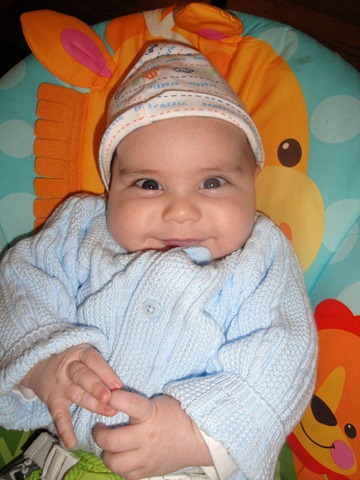
How I Love Babies!

Especially this little guy!

Kaj 1

Many blessings on this beautiful Sunday!

Carrie

Can Waldorf Work With Other Homeschooling Methods?

Yes, I do know mothers who do Waldorf with other methods, or employ the use of  a Main Lesson Book with other homeschooling methods and certain subjects.

But, I have several questions for you if this is something you would like to consider, and please do read this whole post and keep an open mind.  This is meant in a spirit of love and support, with questions for you to ponder and meditate on, not a “yes or no” answer.

1.  How well do you serve two masters?   I don’t mean this in a snarky way at all, I am asking you to consider and ponder this!   Something in your homeschool really does need to predominate I think or it can make one a little batty trying to do “the full monty” of all the methods you pick and still have a family life that is joyous and fun!  You absolutely can deviate away from the Waldorf curriculum if you feel it is appropriate for your child, (especially I think once your child is over the age of nine),  but our first impulse in the home environment for the younger child would see if we could satisfy the child’s need for things in small steps first.

For example, the four-year-old who wants to write letters.  We might try to see if the child could be happier doing typical Waldorf Kindergarten things, (ie, redirect)  and if that does not work OVER TIME (not just the first time I try!), I have had no problem teaching my four-year-old little girls how to write their first name.  They love that, it usually is all they really want to know regarding letters at this point and off they go to play.  The other example would be the six-year-old Kindergartner who wants a Main Lesson Book like the big brothers and sisters.  So they get a Main Lesson Book, they draw something in it, and then they are tired of it and go off to play.  The eight-year-old girl who wants to sew (sewing machines typically come in during the Eighth Grade) – can they be happy with hand sewing, with learning how to embroider by hand, and then perhaps yes, we look at a machine, but we do this with conscious knowing we are deviating from Waldorf indications.   How about the ten-year-old boy fascinated by paleontology? 

Start in small steps because of time and money and interests can change quickly!  It is WONDERFUL  to approach a child’s interest with interest and support, but also with a mindful pattern and way to proceed in order to  meet that interest!  Children try a lot of different interests on , and not all have to be met with the same intensity!    Can we work with that in smalls steps as we proceed?  We gauge how intense the interest is, because sometimes small things satisfy and sometimes they don’t.   And if the child eventually, over time, needs “more” or we do decide to deviate from the typical Waldorf indications it  is okay, but we bring a MINDFULNESS to it, and we try SMALL STEPS first. 

By the same token, if a child is not ready, we have the luxury of waiting in the home environment.  Many of you know the saga of my now second-grade daughter who is a knitting fool who could not seem to touch knitting needles in the first grade without tears starting.  She wasn’t ready, and we dropped it and did other forms of handwork, came back to it in Second Grade and boy, was she ready.

2. Why do you want to employ other methods?  Seriously, dig down, and see what is holding you back from only using Waldorf.  Bring a mindfulness to this, and meditate on it.  Steiner homeschooling is PHILOSOPHY driven; we do things for the development of the child and the ENTIRE curriculum builds on each thing during the year and during subsequent years. The curriculum is laid out in such a way that really, really, in my experience, speaks to the child.  The child will often ask to study a certain subject that you are coming up to!  It really is uncanny!   Steiner was an astute observer of children, what children needed, what the human being was and needed to develop.  Waldorf Education speaks to that.

In contrast, I see parents of other methods searching for the “best” reading program, the “best” math  program, trying to find that logical progression so there are  no “gaps”.  Waldorf has this already in place, time tested!  It all builds on itself. 

So what is holding you back?

As a related digression, not only are many countries starting academics later, but many are also spending less time in the classroom than the  average United States public school (or some of the homeschooling families I see!!) student.  My German friends tell me that in Germany students have about 15 hours of school a week (they go in the morning, go home for lunch and that is it)  until the sixth grade when they do return to school after lunch for an hour or so of further instruction.   More hours and jamming more facts down their throats in the Early Years and the Early Grades does not necessarily equate to increased knowledge, the ability to problem-solve or a love of learning. 

4. Is it that you want to be “eclectic”?  What exactly does that mean to you?  There are beautiful things in every method, I think, but sometimes we just cannot do it all and remain sane.  This is a lesson in life we also need to show our children, especially in this day and age:  you can’t have it all, you can’t do it all, sometimes you must choose a path and take it!   As homeschooling  mothers, our number one priority has to be our family life and they joy that is there, along with providing our children with an excellent education that will guide our children into becoming educated adults who are kind, who are loving, who are compassionate and who can also problem-solve, find information, and handle the stresses of modern life. 

I feel Waldorf Education in the home environment prepares children to do just that.    There are similarities in subject matter  between Waldorf and other methods in some ways, for example, as the child hits 5th grade and starts Ancient History. But even then there are extreme differences in how the subjects are presented.  The Waldorf teacher looks at a time period and we cover history through these scenes that BEST typify a historical time period and/or historical person in our Main Lesson Block.  We teach in a three-day rhythm, we teach and use sleep as an educational aid.  Most of all, we teach through art – art is not an “added in” subject, but the way through which we teach as part of that three-day rhythm.

The Early Years and the first few grades  probably pose the most problems for people, but from what I have seen is that many of the children who start academic work in the Early Years (particularly those little girls who want to start and fly ahead) end up with problems around eight or nine because they are just burned out.  They missed the experience of DOING  things, and the parents went “abstract” too quickly.  Children need a solid foundation in the things that they know, the things they experience every day, things that are real to them!  The concrete!   In my area, for example,  first graders are learning about Teddy Roosevelt – it means absolutely NOTHING to them, they have no historical context to put it in, but they have to know it for some standardized test. 

I am proud to be a Waldorf homeschooling mother, and thrilled my children get to learn this way.  I don’t feel as if my children are missing anything, I feel confident that every academic skill is being covered and that the whole curriculum is complete and my children will be prepared.  We also have plenty of time to spend together as a family in joy and love.

Still not satisfied?  Here is another voice addressing this subject, have a look:  http://waldorfjourney.typepad.com/a_journey_through_waldorf/2009/06/can-waldorf-work-with.html

Happy meditating on this important subject,

Carrie

January Focus On The Home: Meal Planning

Hi there!  Do you know where your meals are?

A very important part of both La Leche League, Attachment Parenting and Waldorf is a focus on nutrition derived from whole foods.  Waldorf also brings in the concept of warmth through food.

I don’t like to dwell specifically on HOW one should each – that really does make me bonkers and you can see my post when I was ranting about this here:  https://theparentingpassageway.com/2009/04/05/the-mini-rant-discussing-food-with-children-under-the-age-of-7/  , but I do think no matter how one chooses to eat, it should involve mindfulness. 

I will at some point post some things about an anthroposophic view of eating, just for fun, but here are a few things to ponder to help you get organized:

First, do you have a menu plan each week?  If you abhor making your own and making the grocery lists that go with it, here are a few options for dinner:

Do you have a plan for breakfasts, lunches and snacks?  If you say that the first snack of the day always involves the grain of the day or is always cut-up vegetables with a homemade dip, this simplifies meal planning.  If you are searching for the grain of the day and trying to incorporate that into your week, try this back post:  https://theparentingpassageway.com/2008/11/23/steiners-grain-of-the-day/

Melisa Nielsen has a lovely post about her “Snack Tray” here:  http://waldorfjourney.typepad.com/a_journey_through_waldorf/2009/03/behold-the-wisdom-of-the-snack-tray.html

Do have a rhythm as to what day of the week you shop and what you buy when?

For the way we eat, and for those of you who want to eat with whole foods, many times there are no cost-savings coupons available.  I suggest connecting with your local farmers or farmers market and eating what is in season.  I have farmers now to supply any meat my family would eat in bulk, eggs, cheese, raw milk, vegetables and there is a farmer’s market (granted 41 miles away!) where I can buy cases of organic oranges and young coconuts, for example.  Sometimes smaller ethnic grocery stores also have good deals.

If you do shop in a store or at a farm, don’t rush.  This is a great opportunity for your small children to learn in life.  Make a morning of your “market day.”  Too often I see parents rushing through shopping and I wonder why. Nourishing our families in warmth and love should be important enough to teach our children about it in an unhurried manner.

Third, do you have a daily rhythm to how you cook?  I think with small children as much preparation ahead of time is good as many children are not happy around meal time – that witching hour!

Here are some suggestions for dealing with the dinner hour:

  • For those of you who are not eating raw and are cooking things, I suggest using a crock pot for wonderful bean soups and other warm meals.
  • Try feeding the children a small snack whilst you cook.
  • Involve the little ones in your cooking as much as possible – keep your gestures light, warm and loving.  Start dinner early so you have time.
  • Give your children some leftover spices or dough or whathave you to make their own concoctions!
  • Try also setting up a small play scenario near the kitchen so your little ones can weave in and out of work and play.

Please don’t forget that an integral part of cooking is the tender way you wipe the counters down, clean off the cabinets, dry dishes – sing, hum, immerse yourself in the task and your children will see the revernce and love one can find in the ordinary.

Much love,

Carrie

The Waldorf Baby in January

(This post is geared toward infants/toddlers still using diapers).

This is a great month to focus on your rhythm and interaction with your baby during diaper changing time.  In an interview entitled “Do We Know Why We Do What We Do?  An Interview with Helle Heckmann” by Margaret Ris,  Helle Heckman was asked a question about the process of caring for the young child and  she said, “The whole process of caring for the little child matters.  For instance, with changing diapers, so few use cloth, but instead use the highly effective diapers that eliminate smells.  These diapers can be left on for five or six hours, rather than two hours, so now diapering time, that “You-and-I”, intimate, private time when one talks or sings to the child, is much reduced.”    (to read more about Helle Heckmann’s work at Nokken, please see this post:  https://theparentingpassageway.com/2009/08/31/nokken-a-review-of-two-books-and-a-few-thoughts/)

A few of my thoughts:

  • Change diapers frequently and allow plenty of  time for eye contact, interaction, singing, finger plays and toe plays.  Many  times  the baby is a passive witness to things going on in the home via a sling, but diaper changing time is a time to slow down and interact with that adorable baby!
  • You can take off an old diaper on a child who can stand standing up and then just quickly lay them down to put on a new diaper if an older baby is resistant to diaper changes.
  • Try a beautiful mobile overhead if you have a usual changing space.  You can make charming silk fairies to hang up, or little paper cut figures according to the seasons
  • Pick some wonderful songs that you can sing at diaper changing time and keep them consistent.
  • Older children can enjoy finger plays and toe plays during diaper changing time.
  • Keep in mind your beautiful gestures whilst you are doing this activity.  Honor your child’s body and its function.  Smile, don’t rush, be careful and gentle.  Smooth the diaper out before putting it on, be cheerful whilst reaching for supplies.    Some adults make all kinds of “jokes” about babies and their stool, which really bothers, irritates and angers me because this  is a healthy, normal function.  Why one would  shame a baby over a biological function that is necessary to live and not be sick amazes me.
  • Some folks have asked me about Elimination Communication and Waldorf, and to be honest, I am not sure there is any “official” sort of position on it; to me, if practicing Elimination Communication would fit into the natural rhythm and would not put individual pressure on the individual child, then it would be okay…(Remember, we are not trying to draw children out into their individual consciousness early on, so to me it would just have to  fit into the natural rhythm of things as a family)….  I do know Waldorf mothers who practice EC, and they are far more qualified to speak on this issue than I!   I believe there may also be a subform for Elimination Communication at the Mothering Magazine Forum.
  • If you are interested in cloth diapering (and yes, I know in areas with low water, people may choose not to in order to conserve) here is an article from Mothering Magazine:  http://www.mothering.com/green-living/joy-of-cloth-diapers.  Here is a primer as to the different types of diapers:  http://www.greenmountaindiapers.com/newmom.htm.   There are also pocket diapers out there such as FuzziBunz.   There are many, many kinds of  cloth diapers, and those of us who use cloth usually  have quite a few different types in our homes.  🙂

There are many posts on this blog about the Waldorf Baby,and  each month I will be picking a different area to focus on as a gentle reminder.

Love,

Carrie

Waldorf In The Home With The One- And Two-Year Old

Sometimes I believe the “Waldorf Toddler Years” are the hardest areas to find information about regarding exact specifics as to what to expect and do, especially in the home environment.  Many of things one reads in the books touted for the Waldorf  Early Years (including Heaven on Earth, Beyond the Rainbow Bridge, etc)  seem to be more for children around age 3 (and I would argue that if your oldest is three and in the home environment with no older children around to imitate, that many of these activities should actually be brought in later than in the Waldorf Kindergarten!  More about that in a later post!)

The two main focus areas for the first two years are walking and speech.  Therefore, things to think about include gross motor movement and speech.  Here are some quick suggestions in these areas:

For those children who are  walking – walking and pushing weighted things, getting something off a table and putting into a bucket repeatedly, something where the child is squatting and then standing up to put things into a container, (and then you can do this with the child standing on a squishy throw pillow), toddling outside in all kinds of weather, squatting to play

For those more advanced walkers – walking on different surfaces in bare feet, stepping over things, going up and down stairs with a small railing, climbing on all four’s over things on the floor (to get into a bear’s cave maybe?), different textures to feel and walk on outside in barefeet if possible

For all ages – massage, water play, fingerplays, toeplays, being swaddled and unswaddled in blankets of different textures,  sitting on a blanket and being pulled around the house on a “Magic Carpet Ride”,

But the point is we approach these things with love and with imagination.  Be silent with warm looks or warm  gestures and do what you want the child to do or set a small scene for the older toddler with a few simple words – a  few words really do suffice!  Use music for your simple scenario.  (“My Big dwarf collecting jewels!” and sing a song about a dwarf or   “My beautiful butterfly just emerged from the cocoon!”  etc.)  

For two year olds working on speech, now YOU need to prepare as they will ask you over and over what something is.  You can answer that in one word, but then pull out a Mother Good rhyme or a song to sing.  That will expand their vocabulary even more and keep you from going into Adult Land with scientific explanations of how fish have gills to breathe and etc, etc.

Other things to work on:

Bodily care, toileting or diaper changes, is HUGE. I cannot stress this enough.  Times for bodily care should involve love, their involvement, singing and joy.

Meal times.  Again, unhurried, unrushed, singing, having your child help with preparation and clean-up.

Nap times/Rest Times.  Sing lullabies, have a blanket that is special for sleeping, have a routine involving physical touch of gentle massage or foot rubs

Bath times.  Singing, finger plays and toe plays, gentle rub downs with the towel (those textures again)

Outside time.  This is another place where verses come in handy.  If a child sees a flower, you can recite Mother Goose’s “DaffaDown Lily”, if they see a goose you can recite “

Participation in household life.  Your very gesture is so important, it should not be you rushing around trying to get the whole house clean in one day.  It is taking each article of laundry and smoothing it out, folding it tenderly, putting it in the pile to be put away with love for your family. What is important is not only that the child sees the work being done, but imitates that gesture of love and care.  That extends into caring for plants and animals, this is the very first “environmental education” that a child gets with you, right at home.

Music – as mentioned many times above, music and rhymes and verses should take precedence at this point over any written word. 

Inner Work/Personal Parenting Development:  The most spiritually mature people should be the ones coming into contact with the youngest children.  This is a very important time for your own work and  development.  If you are anxious, practice being calm.  If you are impatient, practice being patient.  If you talk in a stream of conscious way, practice being silent.  This is a time to develop your spiritual and religious beliefs.  It is a time to become more aware of the things unseen.

Joy!  Having a toddler should be joyful.  This age will never come again, enjoy it and marvel with them at their wonder!

Love,

Carrie

An Emergency How-To: How To Parent Peacefully With Children Under Age 9

(This post is geared toward those times when you are feeling angry daily with your children, not so much for the occasional angry moments.  This is sort of like “Emergency Management for Chronic Anger”…)

If you are having an emergency in attempting  to parent peacefully, here is a top 10 list of how to do this:

1.  Start with understanding your own triggers for anger.  Write down the things that are “making” you angry.  If every item on that list is child-related, please check and double-check if your expectations are realistic.  Underneath anger are usually other feelings such as fear or sadness.

We are all human, and we do get angry.   Here is a great post about the opportunity that occasional episode of  anger affords children in learning:   http://christopherushomeschool.typepad.com/blog/2008/08/dealing-with-anger.html  , just to remind you that the complete elimination of anger is not a realistic goal, and that occasional anger is normal and even healthy.  The important thing is to show your child constructive ways to deal with anger AND how one can transfor oneself from “Angry Person” back into “Normal Person” without hurting anyone physically or verbally in the process!

2.  Get support.  Find your local La Leche League group here: www.llli.org and find your local Attachment Parenting group here:   http://www.attachmentparenting.org/.   Call these Leaders on the phone and talk to them.  Both La Leche League and Attachment Parenting put loving guidance/gentle discipline as a main philosophical tenet.  Get a family counselor’s assistance as well.  Many health care professionals will work on a sliding fee scale.

3.  Get support from your family, friends and neighbors.  If you are out of control angry everyday with your children, you may need more support right now.  Even the 10 year old down the street who could come and play for an hour with with toddler while you are there could be helpful.  Investigate all possibilities for help.  Call in your friends and explain that you need extra help right now.

4.  Check out what is going on with you and your family members physically.  Is there a physical reason why you are so tired or depressed?  Is there something going on with your child?

5.  Check your environment – visual clutter can wind many children up.  Clean up their sleeping areas to be restful.

6.  Make a list of what you will do to calm down when you are angry and post it somewhere prominent.  There is no problem that cannot wait a moment to be solved, and on top of that, how many problems can be solved anyway with everyone yelling and crying?  That is not a teachable moment.  It is okay to take a moment before you address the situation.    Remember that your role is to teach and to guide your children toward being capable, loving, responsible adults.

7. Check out your food; dyes and preservatives and common allergens can make behavior worse.

8.  Check out the amount of outside active  play your children are getting!  They need to get some energy out before they can sit still.

9.  Check out what you are requesting of your children; particularly with chores, which seem to particularly anger parents, children under 9 need you there to supervise and assist, to show them how to do itChildren under 7 need to most likely do it with you to have it done to your satisfaction.  Children should be expected to work round the house as part of the family; however, for small children we view the parent working and the child weaving in and out  and then moving into chores that you have helped them to learn over time, and at under 9 they may still need some supervision or they will get distracted by something else along the way.  Check how many times a day you are requesting your children to do something; if it is constant nagging and asking a child to clean up or assist in household chores, that to me is a signal that there 1. Is too many things out in the environment to clean up and/or  2.  is no consistent rhythm to chores on a daily basis or a weekly basis.

Watch what you say to your children!  Use your words like pearls: https://theparentingpassageway.com/2009/08/19/using-our-words-like-pearls/

Promote kindness in your home: https://theparentingpassageway.com/2009/05/03/kindness-in-your-home/

10.  Learn how to forgive yourself.  See this post for help:  https://theparentingpassageway.com/2009/05/22/waldorf-guilt/

and this one:  https://theparentingpassageway.com/2009/04/15/my-kids-deserve-a-different-mother/

Much love and peace to you,

Carrie

Starting to Homeschool with Waldorf Mid-Year

I guess because I am wrapped up in Babyland, I forgot that this is the time of year our homeschooling group gets calls from parents who have just pulled their children from school over Christmas break and need information fast!  I quickly remembered this, however, when I got calls from several parents at the end of last week.

Here are a few tips I have for this transition period from my experiences with families:

1.  Plan some time for de-schooling.  I had one mother come over to my house over the weekend so we could discuss a plan for her children and I advised her that starting with very simple things such as crafting, baking, cooking, being outside,  even taking a few field trips for the children in the grades, would be a good start without jumping right into Main Lesson Books and such. 

We have to not only deschool the children from the “worksheet” mentality that seems to so frequently pervade schools these days and show them that life at school is not life at home, but we have to deschool ourselves.  We have to let go of our own ideas and preconceived notions from our own schooling experience.  This takes time, and more time.  I have heard some mothers tell me that it took at least a year to really feel comfortable in their own skin and home learning after taking their child out of school.

The most important piece of any homeschooling is spending time with your children in love.  That’s the bottom line, and the rest will come.  Learn to slow down and enjoy each other and some  of the simpler things in life.

2.  Look at your child’s age to determine what year of Waldorf school they should be in.  Remember, a child should be 7 for most of Grade One, 8 for most of Grade Two, etc.  Waldorf at home is different than Waldorf at school, and in my experience these are the ages that work best.

3.  Hopefully you are familiar with the Waldorf curriculum if you are planning to school this way!   If not, take time to familiarize yourself with the essential components of each grade, the three-day rhythm, and consider scheduling a consultation with one of the national Waldorf Consultants.  I typically recommend Melisa Nielsen, Barbara Dewey and Donna Simmons.  Find whose voice speaks to you, start there, and stick with their products if you need a curriculum to follow to start.  Also be sure to check out Marsha Johnson’s free files at her Yahoo!Group www.waldorfhomeeducators.com’

4.  See where your child is.  I found the place where many public school children are lacking when they come to Waldorf homeschooling is form drawing and math. For example, a second grade math student in public school in my area is typically learning carrying and borrowing with addition and subtraction, but have never tackled division or multiplication or Roman Numerals and most of all, they have NEVER been taught math from whole to parts.

Parents always ask about well, with my second or third grader should I go back and do Main Lesson Blocks on the things we missed, such as fairy tales from the first grade or stories of saints and heroes from the second grade?  You could tell those stories at bedtime or before quiet time, but don’t go backward with school.   The only exception I would consider is a block to introduce all four math processes together and whole to parts.   Meet the child with the food their soul needs for their grade.

5.  Make a short list of what resources you will need right away.  This may include essentials such as Main Lesson Books,  beeswax crayons (block and stick), beeswax modeling material, a blowing instrument, knitting needles and yarn, wet on wet painting materials.   Add in what curriculum books you will need right away – perhaps a form drawing book, and other products.  At this point in the year though, consider your finances.  You will want to order products for fall homeschooling around April so you have time to work with it over the summer (if you don’t write your own), so consider what you will need now and what you will need for fall and plan  your budget accordingly.

6.  Consider how your day will flow.  Map it out, choose some verses for opening and closing, think about breaks and how you will incorporate movement and activity into your homeschool and main lessons.  Think strongly about carving an hour or even hour and a half break in the middle of the day for your grades children where you eat lunch and have quiet time.  Everyone needs the rest by the middle of the day, and the grades children can use this time to draw, rest, read, or knit.

7.  Think about where you are in your inner work and how you want to progress with that.  I recommend you start by reading some Steiner.

Melisa Nielsen had a good post that really broke things down for entering Waldorf at each grade and I encourage you to check it out: 

 http://waldorfjourney.typepad.com/a_journey_through_waldorf/2010/01/coming-to-waldorf-midyear.html

Most of all, home is not school.  Use your home to your advantage; hike during the week, enjoy the fact your Main Lesson can be completed in 90 minutes or so, work on things as a family such as gardening and cooking.

Homeschooling is a joy!

In Joy,

Carrie

“Discipline Without Distress”, Chapter Five

(This is such a valuable chapter, focusing on parental anger and how to handle anger in children.  Here is a brief summary of the chapter and some of the tips and some of my thoughts; I encourage you to get the book and read it for yourself.  It is a keeper for the bookshelf, and  covers ages from babyhood through teenagers, so you can use it for many years).

Onto the post:

Ah, you all thought I forgot about this!  I did summaries of the first four chapters, and yes, we are going to finish the book! (You can find summaries of the first four chapters of this book if you use the little search bar and type in “discipline without distress”).    This chapter is entitled, “Good Parents Feel Angry:  Separate Your Anger From Your Discipline”.

Judy Arnall writes,” We need to take responsibility of our actions when we are angry.  Discipline means having the vision to see the long-term picture and keep things in balance.  A Chinese proverb teaches, “If you are patient in one moment of anger, you will escape a hundred days of sorrow.” It’s so much easier to watch what we say in anger than to apologize and try to make amends.”

She lists the reasons parents becomes angry; it is a long list but at the top of the list is “My child doesn’t listen to me”, which, of course, really means “My child doesn’t do as I ask.”  (Their hearing is fine!)

She adds to list anger caused not by the child, but by things going on with US.  Alcohol, stress, our own needs not being met, low tolerance of normal childhood behaviors (remember ALL those posts I did on “realistic expectations” for each age up to age 8??!)

Anger is healthy, it is normal, but the author points out the goal should be to solve a problem.  It alerts us to change, she writes.  Marshall Rosenberg of Nonviolent Communication writes how anger is a sign our needs are not being met. 

Judy Arnall’s method of managing anger is based on the acronym ANGER.  A=Accept it, N=Neutralize it, G=Get Away, E=Examine why, R=Resolve and problem-solve.

She goes through all these steps in this chapter.  There are pages of “calm-down tools” for the adult (that could also work for children).  She talks candidly about avoiding child-time outs when the parent is angry (and if you read this blog, you know I am not for child time-outs period.  I think they essentially teach the child nothing at all.  It does not solve the original problem in any way, shape or form.)

She writes, (and I agree 100 percent):  “When a parent sends a child to time-out, she feels stretched to the limit.  The parent feels upset because she is unable to control the child.  She needs a break from the child and has the power to send the child away.  When the child is gone, she can calm down and she feels more in control of herself, the child and the situation.  It SEEMS to be working.  Parents lose it because they believe they are supposed to be in control. Control is illusionary.  There is no such thing as control when another human being is mixed in the equation. Children have their own control.  The appearance of control is only maintained by our power as long as the children are little.  It’s easier to take a time-out yourself  than to force another person in time-out.”

There is a whole list of ways a parent can take a time-out for themselves even if their child is standing there.  She also has great tips for breaking the yelling habit.

The next section of this chapter is all about dealing with an angry child.  She writes, “We don’t have many role models of adults handling children’s anger.  Most often, we handle it the way our parents handled it.”

She details the ways children express anger: Babies with red faces and crying and grunts of protest; toddlers and preschoolers with hitting, screaming, yelling, crying, tantrums, throwing things, stomping feet; for middle childhood teasing, sarcasm, bullying, hitting, yelling, crying, throwing things, withdrawal and a sulky attitude and for teenagers sulking, teasing, sarcasm, hitting, yelling, throwing things, depression, withdrawal and other things under the heading of “attitude”.  Typically by age 10 or 12, she writes, a child can begin to handle anger without hitting or throwing things.

Children can get frustrated and angry from not having their needs met, by a parent who has completely unrealistic expectations for the age their child is (or the child’s developmental level is my added thought), feeling they have been treated unfairly, etc.

Carrie here:  As the parent, you are not responsible for your child’s feelings.  This can be such a hard thing to not want to own.  We listen to our child’s feelings, but the feeling does not belong to us to solve.  If your child is bored, sad, angry, happy – that belongs to the child.  You can have a rhythm, you can have a calm house and some children are still going to be more wild or more negative or whatever than other children of the same age (even accounting for those realistic expectations for their age!).  The only thing you can control is you.

I think the other work for you is to figure out your own “triggers” – does the house being a disaster set you off?  Being hurried?  Not having food or a menu plan going on so you are stressed around dinner time?  If you can figure out your stress triggers, then you can solve it and put a plan in place to make your house a calmer, happier place. 

Judy Arnall’s tips for reducing your child’s anger include using tools of solving problems, having realistic expectations for your child’s age (she is singing my song here!), avoiding hitting because that just shows that hitting  is what we do when we are angry, not to isolate the child if that makes them more angry, not comparing children, listening to your child’s frustration if they can verbalize it without interrupting.  She goes through her ANGER acronym approach for helping children manage their anger. 

She talks about “negating phrases”, which I especially liked because you hear them so much:  “Stop making a fuss”  “It’s no big deal”  “Can’t you be nice?”  “Nice little boys (or girls) don’t act that way.” “You don’t really feel that way.” “What’s wrong with you?”  “You are so ungrateful!” and many more.  It is a sobering list to read and think about how many times we hear parents talk this way to their child. 

The tongue is a powerful ally in parenting but it can also be a terrible weapon.  It is an area where many of us need to learn to be able to relax into silence ourselves, to smile or pat a child on the back, to just breathe a minute before we say something we will completely regret later on.

She has a whole section on temper tantrums, which are most common between the ages of  one and three and a half (although really, a teenager who is running around slamming doors to me is having a temper tantrum of sorts.  Do they ever totally disappear?)  But at any rate, this part of the chapter has tips and techniques for dealing with tantrums.  I do disagree with the author that a way to prevent power struggle temper tantrums is to “give lots of choices”.  I find most small children under 9 are much happier and less prone to tantrums if all the decision-making is not on their shoulders for what they should wear, eat, do.  Time-out is a very ineffective way of dealing with a temper tantrum.

She does detail how to move a tantruming toddler, how to get a tantruming toddler into a car seat (I personally have found it just best to breathe and wait a minute or minutes and not force a child into a car seat as hard as it can be to wait), how to deal with the “spirited child’’s temper tantrums, how to handle public misbehavior (and her number one tip is to have realistic expectations!  A toddler is not going to sit through going out to dinner!), what to do with the older angry child, and what to do about apologies. 

Carrie here:  The trick with temper tantrums is that YOU must remain calm.  YOU must be the rock in the swiftly moving stream! You must show your child how to have self-control!  Let this practice of developing your own inner self-control be YOUR inner work!

The very last part of the chapter involves “Counteracting Parent Stress” and she addresses fatigue and how to deal with it, how to get time for yourself in five, twenty, two hour increments; she has a section for couples and encouragement for spending time together, de-cluttering your life, the cleanliness of your home, and helping children play independently.  For facilitating children’s play she talks about unplugging the TV and other media and packing away many toys, leaving out unstructured play materials.  Sounds Waldorf to me!

Anyway, if gentle parenting and not spanking are new paths for you in you this New Year, I encourage you to check out this book.  I don’t agree with every single thing in it, but it sure would be a good place to start!

Here’s the link:  http://www.amazon.com/Discipline-Without-Distress-responsible-punishment/dp/0978050908/ref=sr_1_1?ie=UTF8&s=books&qid=1262460572&sr=8-1

Much love,

Carrie