What To Do With Homeschooling In December

Homeschooling in December can be challenging!  I find most mothers who do not plan to take most of December lighter or off completely feel burned out and then end up taking some or most of the month off anyway.

Many veteran homeschoolers will tell you that they plan in advance for December to be a great month of cooking, crafting, perhaps doing a lighter rhythm of school with math only or with activities revolving around the holidays.

I think this is a smart idea.  So many homeschoolers feel completely burned out by this time of year, and attempting to homeschool on top of all the cleaning, cooking, baking, crafting that goes with the holidays seems to put so many mothers on edge.  This is the time of year many mothers start posting on the Waldorf boards that maybe their children really need to go into Unschooling more or that Waldorf homeschooling is not working for them.  I doubt that is really what is needed, it just feels like it this time of year!  I wrote a series of posts last January about Waldorf and Unschooling, so if you are really curious you can look there, but sometimes I think what we all really need is a break.  Our bodies naturally are connected to the inner grace of this time period in the cycle of the year.

The Twelve Holy Nights between Christmas and Epiphany are a welcome time for me to read and dream and plan more than usual.  It helps me recharge for the next part of the school year. I hope you will plan to get some time for reading and relaxing yourself!

If you are searching for ideas for December Homeschooling, I suggest the following:

Marsha Johnson has a December block on her Yahoo!Group that encompasses a week of Hannukah studies and activities, a week of the Three Wise Men and a week around the Winter Solstice.  You can get this block for free by joining her Waldorf group:  waldorfhomeeducators@yahoogroups.com

Many homeschooling families also seem to use these two units from Elizabeth Foss over at Serendipity:

Christmas and Advent Around the World: http://www.elizabethfoss.com/serendipity/2010/11/christmas-and-advent-around-the-world.html

Tomie de Paola Christmas:  http://ebeth.typepad.com/reallearning/advent-and-christmas-with.html

What do you all like to do during December in your homeschool?

Many blessings,

Carrie

Parenting and Homeschooling The Only Child

You might wonder what I could possibly say about the only child as I am raising three children, not an only child.  And if you have read this blog for any length of time you probably know I think the ideal number of children (at least for myself :)) would be four or five children.

However, I myself am an only child so I feel I can speak from my own experience on this subject!    I have also worked with many families who have only children, and all of these families  have had almost the exact same concerns regarding their child’s “only child status”:  are they getting enough time with other children their own age?  Are we doing enough to prepare this child to interact with their peers?  Less frequently parents with an only child have asked me if they were “spoiling” this child?  Will this child be prepared for life on their own or will they expect everything to go their own way?

First of all, I have to say that most  of the only children I meet are really sensitive, talented children.  Most of them are very attuned to adults and adult body language and how adults think and do things.  Most of them seem to have very high vocabulary levels.  Many of them are relaxed children who enjoy life.  Some of them do seem anxious socially and have problems in this regard, but so do many children who come from families with multiple children.

I feel the question of  “socializing” an only child to peers of the same age is often not an issue at all.  I think it is important to the only child to be viewed as the same as other children in  terms that the family as the basic unit of socialization is “enough”.  There can be many opportunities within one’s own family for the only child. 

In my own childhood, I had a large family where I was raised by and lived with  my grandparents and my great-grandmother, my father and my uncle and my other set of grandparents were frequently around  (and did I mention all my grandmothers’ brothers and sisters who showed up for a month at a time?  My family was big into “Surprise!  Here we are!  We are staying for a month!”)  I also had many cousins I was close to and stayed with for periods of time who treated me like a little sister.  🙂  Part of my family were in business together, so that added yet another dimension of “togetherness” to the equation. 

Possibly what is more of an issue is in socializing an only child to peers who are NOT of the same age as the child.  The only child often seems to relate well to a child who is older, perhaps because that older child is viewed as closer to an adult, but may have trouble accepting the noise, attention span, and  immature behavior of a younger child.  They may not understand how to play with and include a younger child the way an older child from a family with multiple children does.    Again, this is just my experience in working with only children, and it may not be typical of your experience at all.  🙂

Another area that I think *could*, (but again may not be in your case), pose challenges is that of a mother homeschooling an only daughter.  I don’t think this is such a challenge in the younger years, but I do think sometimes mothers and daughters can really get into each other’s “stuff” the older a child is.

One area I think all parents in general need to be aware of is what is appropriate for the child developmentally and how to parent the ever-changing stages of childhood.  I have seen only children in the early grades who were treated as much younger and less capable of doing things than they really were, and this may be because there was no smaller sibling around to gently remind the parents what small really looks like. 🙂  Conversely, perhaps that only child seems so mature and adult-oriented that we forget that child really is still very young.  To me, if you can figure out how to parent the only child, you can homeschool the only child!  The parenting is the harder part!

There are things about having siblings that just can never be replicated for the only child, and I am not so sure that should be a goal.  The only child is having an experience that is different than a household full of children, but there is value in the experience the only child is having as well.  Why should we try to make the only child’s experience into something else?

If you are a mindful enough parent to be considering these issues, then I am sure all will be well.  🙂

I would love to hear your thoughts, challenges  and successes on the subject.

Blessings,

Carrie

The Schoolroom

Ah, I am breaking the “no-picture” rule on my blog today to show you my schoolroom.  I do this to show you that I have a very small school room and to demonstrate that the goal truly  is NOT to re-create a Waldorf School in your home!  Sarah Baldwin over at Bella Luna Toys has a great post on that here: http://blog.bellalunatoys.com/2010/waldorf-homeschooling-letting-go-of-perfect.html

Your schoolroom is still part of your home!  My schoolroom is in the room that is supposed to be a small dining room.  I feel blessed because many homeschoolers do not have a dedicated homeschooling space, and I truly enjoy mine.

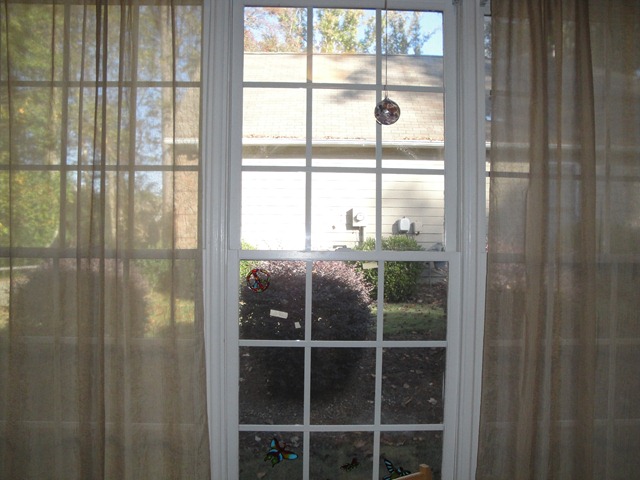
Facing the South:

 DSC00773

Just a small view of outside with sheers and a suncatcher.    Next to the window, also on the South wall:

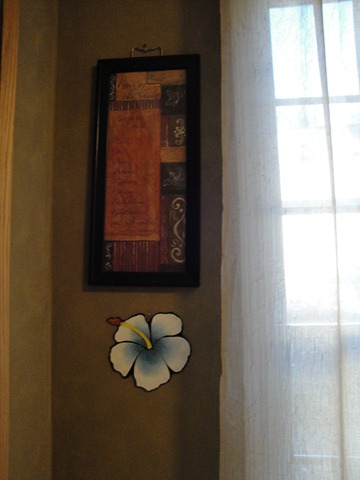
DSC00774

Crucian glass and a plaque about “The Fruit of the Spirit.”

I don’t know why, but I have no picture of the East wall.  It has a very large blackboard that you can see in the Old Testament block post, and a homeschooling cabinet.  Cabinets are very important.  I have a cabinet that was made for scrapbooking, so it has tons of pockets and places to stash all the art supplies associated with Waldorf.  It was a gift for my 40th birthday, and I am grateful for it every day.

The North wall has a doorway and a large two sided-chalkboard slid next to the cabinet.  Then we come to the  West wall:

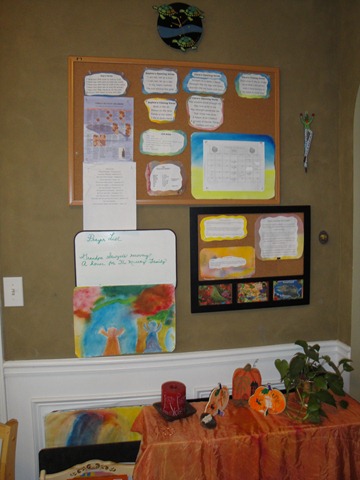
DSC00769

Bulletin boards are not especially Waldorf-y but I have to have one.  It has all our prayers for the day, our white little prayer board, more Crucian glass.  The silks are covering a bookcase.  There are painting boards and lap-sized chalkboards slid behind the bookcase.  Foreign language materials are in a little painted wooden holder next to the bookcase.  Then there is a doorway to the kitchen and this little bookcase and Nature Table in the corner:

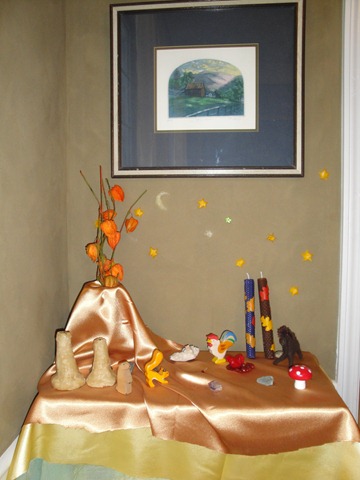
DSC00772

My Nature Table is very simple as you can see.  I realize I did not take a picture of our kidney-shaped table and chairs.  We also have a braided rug to warm the room.

One thing I would like to get is a mobile of some sort to hang from the ceiling.  A school room is a wonderful thing, and its organization is often a work in progress.  We also homeschool in the kitchen and garden a lot, and many times I will move the large two-sided chalkboard out into the dining room to work on it.  Right now I have three chalkboards and would like to get one more for next year when I have a first and fourth grader together.

Thanks for looking!

Many blessings,

Carrie

Waldorf Homeschooling Third Grade- First Old Testament Block

(Note – this is long so feel free to go and get a cup of tea!) 🙂

We started our school year with Form Drawing and then moved into our first Old Testament Block.

The Old Testament Block is one that many folks struggle with due to their own experiences with religion.  Please remember, these are stories of a people and that people’s relationship to authority; they are also the stories of a people trying to make a home for themselves on earth.  These issues speak  clearly to a nine-year old who is grappling with these ideas if only subconsciously.  These stories are not dealt with from a religious perspective within the Waldorf curriculum, although of course one is free to do this at home if one is Christian or Jewish.  I am Christian and tend to look at these stories from that viewpoint.    I highly suggest you obtain a copy of  the Christopherus Homeschool Resources’ Old Testament Manual and Stories:  http://www.christopherushomeschool.org/bookstore-for-waldorf-homeschooling/publications-for-grades-1-through-5/old-testament-stories-3rd-grade-curriculum.html  I think that the Christopherus notes to approaching these stories is helpful.  The other source that helped me approach this block was the Christian resource “Genesis:  Finding Our Roots” by Ruth Beechick.

We looked at what was present before Creation occurred and  how the singing of the stars accompanied Creation (another quote for the Main Lesson book – see Job 38:7). We also looked at the beginning of the Book of John, of which many of you are familiar, that talks about what was present from the beginning of time.   We started with these quotes in print and moved into cursive writing later in this block.

So then we were ready to start talking about the first story in the book of Genesis, the story of Creation.  We wet –on- wet watercolor painted the 7 Days of Creation.  My main resource for the painting inspiration came from the Christopherus Third Grade Curriculum.  We looked at God creating man in His own image,  I had my Third Grader write in her Main Lesson Book “God created human beings in His image” (Genesis 1:27).  I pulled spelling words from the story of Creation.

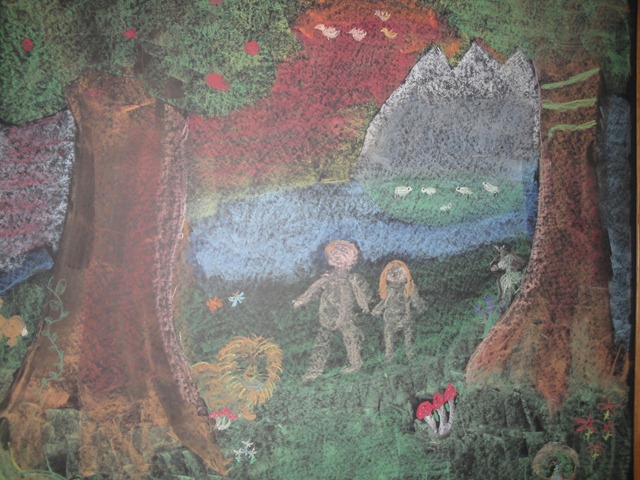
We then moved into the story of Adam and Eve, The Garden Of Eden and the Fall.  I used the animals and plants inhabiting the Garden of Eden as a way to start forming sentences with a subject and a predicate (subjects in blue and predicates in red).  I have mentioned before that we have done a little more grammar than is typical of this point in the Waldorf curriculum due to the fact that my Third Grader is also in German School  on Saturdays and was getting the grammar between German and English rather mixed-up. 
DSC00677

The story of  The Fall and of Cain and Abel can be very challenging ones!  We found  the language to use for the summary of Cain and Abel to be challenging and we consulted several different renditions of this story – the Bible, Ruth Beechick’s “Adam and His Kin”  and Jakcob Streit’s “And Then There Was Light”.

My daughter’s narration of The Fall ended up being this:  “Adam and Eve ate from the Tree of Knowledge.  They were driven out of the Garden of Eden.  On earth they had to make clothes, build a shelter and gather food.”   It is very important to really go through this process on the board and not rush trying to obtain a summary.

We then looked at the story of  Cain and Abel.  My daughter’s narration about this was:  “Adam and Eve had two sons.  Their names were Cain and Abel.  Cain was a farmer and Abel was a shepherd. Cain thought God refused his sacrifice but accepted Abel’s.  Cain became angry and struck his brother dead.  The Lord punished Cain and Cain became a wanderer on earth.” 

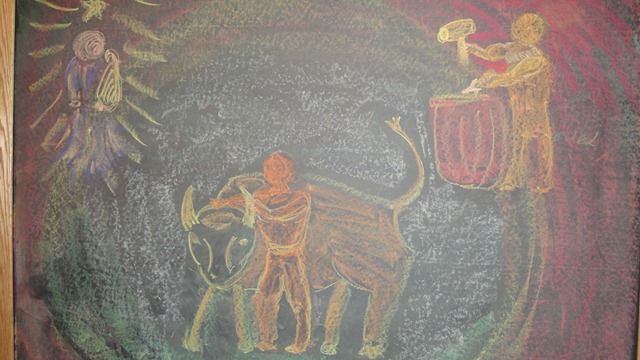
After this we traced the descendents of Cain and Seth and my daughter drew these family trees in her Main Lesson book.   This idea came to me through Christian author and homeschooling consultant Ruth Beechick’s book “”Adam and His Kin”.   This lineage will become important later as we trace the lineage leading to Abraham (and in our faith, leading to Jesus) in our second Old Testament block.  We talked about the sons of Lamech (a descendent of Cain):  Jabal, Jubal and Tubal Cain and their contributions to civilization.   For these stories I used a combination of what is in the Bible and what Ruth Beechick fleshed out of the sparse  lines in the Book of Genesis in story form in “Adam and His Kin”.  I also found the section of these stories in his book mentioned above to be helpful.

Here is a chalkboard drawing of Jabal, Jubal and Tubal Cain.  Go peek at the Book of Genesis and see if you can match my drawing up with who is who! 🙂
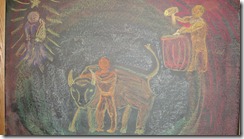
DSC00685

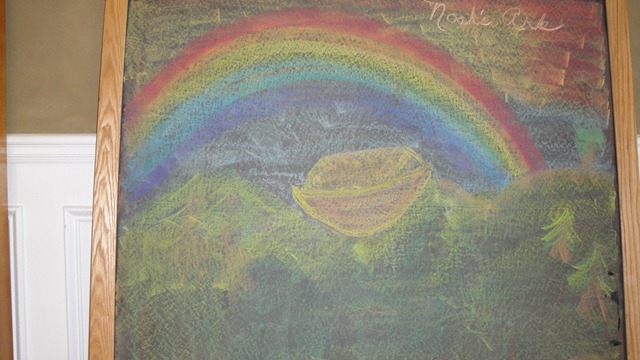
After that we moved into the story of Noah and the Ark:
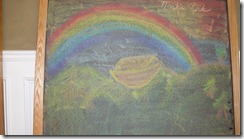
DSC00703

We used the animals of the Ark as a springboard to talk about naming words, doing words, how words and picture words and made many sentences with pictures.  We ended this block with the story of what happened to Noah after the ark came to rest and how Noah’s descendents populated the earth.  We will pick up  our next block with the story of The Tower of Babel.

For this block I would highly recommend the following resources:

  • The Christopherus Old Testament Manual and Stories – the background information in there, the full-color reproductions of the seven days of creation and other ideas for working with this block are helpful.  Also, the music section of the complete Christopherus Third Grade syllabus had helpful music and poetry suggestions to go along with this block, including an intriguing poem about Tubal Cain.
  • Ruth Beechick’s “Genesis:  Finding Our Roots” and “Adam and His Kin”
  • Jakob Streit’s  “And Then There Was Light.”    Some may find this esoteric companion to be quite startling, but I found much of it matched up to Ruth Beechick’s book quite well because both incorporate what is said in the Bible and what was said in Hebrew legends surrounding these events and fleshes the Biblical events out in a story format.
  • Arthur Auer’s “Modeling:  Sculptural Ideas for For School and Home” had excellent suggestions for modeling for Noah’s Ark, and the animals of the Ark and the Garden of Eden.
  • Dorothy Harrer’s “An English Manual”
  • Roy Wilkinson’s “Commentary on Old Testament Stories.”
  • One resource I do not have but would really like to get for when I do this block again is this one: http://www.amazon.com/Legends-Bible-Louis-Ginzberg/dp/0827604041/ref=sr_1_1?ie=UTF8&qid=1288451554&sr=8-1    I believe Eva over at Untrodden Paths mentioned this on her blog and it was the first place I had heard about it.  Thank you Eva.

The challenging areas about this block outside of  the themes and stories themselves included the drawing – moving into drawing animals and the importance of gesture and color in these drawings; what spelling words to really pull from these stories (too hard? too easy?); and being able to really pull in the music, painting, modeling, poetry in conjunction with all the grammar and spelling and introductory cursive writing.  Again, I enjoyed working grammar in with these stories for my child  but not every child will be ready for that. 

The other interesting aspect of this block for me personally was seeing my nine-year-old’s work. It was, to be frank, rushed and sloppy.  Some of this was no doubt due to me having  to stand up and hold and dance around with a baby and tend to a kindergartner and not being able to always sit right there and draw each step by step, but some of this was also due to where my nine-year-old was.  She did not want to rush, she told me, but she wanted to “get through the stories and drawings.” (She told me this after the block was over, and you can see the logic of a nine-year old right there, bless her heart).   I felt we did a lot of “active” in this block, singing and stamping and poetry and modeling and painting and drawing, so I do think some of that is just indicative of where she is developmentally right now.   This is the blessing of being able to work with our children at home and meet them where they are.

Hope that this post will be helpful to some of you as you plan.

Many blessings,

Carrie

How Old Should My Child Be For Dry Needle Felting?

My wonderful handwork teacher Judy Forster noted to me the other day that the control and sharpness of the needle for dry needle felting are challenges that are just right for the physical and emotional changes that occur in middle school (typically 7th and 8th grade). 

From my observations of the development of the child at different ages, I agree with her. I also think there are many, many projects one can be busy with, so why be in such a rush to get to that rather hardening gesture?  This is an important point for Waldorf homeschooling parents who may be guiding their children’s handwork program without having a Waldorf-trained handwork teacher to assist them!

Wet felting is a wonderful alternative, and children in the grades can knit, crochet, macrame, cross stitch (fourth grade, age 10), sew (typically grades six and seven for projects) and do many other types of work with their hands.

If you have small children under the age of 7, I like to think about color and freedom.  The small child should be able to choose colors and materials and turn them into whatever suits the child’s fancy of the moment, whether that be a ghost or an elephant.  They may imitate you, but often they are just a wellspring of creativity.    I remember I had one good friend whose little boy made a whole bunch of creatures and critters from sheets of felt when he was around four or five.  The colors and shapes and what they were called were all his and he loved them.

Even in older children, seeing what colors the children pick and what they want to make is fascinating.   My Third Grader is currently drawn to blues and greens and I feel this is meeting her temperamental traits and where she is.  Color and form is fascinating!

If you need help determining what project comes when within the Waldorf curriculum,, please look at this back post that Ms. Judy Forster was so kind to write for this blog:  https://theparentingpassageway.com/2010/03/28/handwork/

Many blessings to you all,

Carrie

Waldorf Third Grade Handwork Projects For Fall

So far my third grader is learning to crochet.  Here are examples of beginning crochet work that she has done so far:

A belt with wooden beads:

\DSC00687

A crocheted “Thread of Life” (my term)  for our All Souls’ Day (November 2nd)  table:

DSC00791

And another view, with some orange paper flowers the children made for this festival:

DSC00790

Note there are no examples of knitting projects yet as our year just began in September.   Third Grade is also the correct time to teach the purl stitch as the nine-year change marks the appropriate time to move out into the space beyond and behind oneself.  This experience of  self- awareness and what may lie away from oneself belongs to the nine-year old who is beginning to separate. 

If you need a recap as to what types of handwork comes where within the framework of Waldorf Education and why, here is a wonderful article by my Waldorf homeschooling group’s handwork teacher Ms. Forster:  https://theparentingpassageway.com/2010/03/28/handwork/

Many blessings,

Carrie

Waldorf in The One Room Schoolhouse

I was a guest speaker at the La Leche League of Georgia Area  Conference  over the weekend.  What good providence that Sharifa Oppenheimer, author of “Heaven On Earth:  A Handbook For Parents Of Young Children”,  was the keynote speaker!  It was lovely to meet her and spend time with her in person.  I so appreciate authors such as Sharifa and Kim John Payne who are really doing their best to bring the healing and therapeutic sides of Waldorf education to broader audiences.

Whilst I was driving Sharifa back to the airport, she and I were talking about the translation of Waldorf Education from the classroom, where the class becomes a social organization of its own, to the homeschool. It is interesting to think about and it was an interesting discussion!

I truly believe that the Waldorf Curriculum stands well with individual homeschooling students. After all, Steiner himself was aware of education in both group and individual settings through his own life experiences.  I feel what can be more challenging to translate is the “one room schoolhouse” situation where mothers are homeschooling students in different seven-year cycles.

If you think about it, Waldorf teachers go through training to become a teacher dealing with children in ONE of the seven year cycles.  For example, one is trained as an Early Years educator or a grades teacher or a Waldorf high school teacher.  One teacher does not have to cut across all the seven year cycles as a homeschooling mother may have to if she has children who are 16, 10, 6 and 4 years old!

So what is one to do?  Here are some of my suggestions!

1.  As always, we must work with ourselves.  We work to become authentic human beings. We work to learn how to set boundaries in a loving way.  We work to understand how we speak and work with  a 4-year-old and how that is different when we work and speak with our 10-year old.  We work to understand the seven-year cycles.

2.  We learn to  juggle.  There is no reason that Waldorf education cannot work within this one room schoolhouse model!  However, it may look different than in a traditional Waldorf classroom.  There has to be more of a back and forth flow between the children of different ages so that all of their needs are met.  This is absolutely true no matter what homeschool method you choose.

3.  We work to preserve what homeschooling is all about – and that is family.  We work to foster relationships between all family members and to create a rhythm that works for all family members.  We include boundaries as to what is needed for a teenager is not what is needed by our under-7 child and we know when we can be flexible and do things on a bit of a different timetable that is still appropriate, but perhaps not exactly  what one would experience within a Waldorf school.  I like this post by Donna Simmons on that subject:  http://christopherushomeschool.typepad.com/blog/2005/07/how_to_do_it.html

4.  We utilize the advantages of learning within the home environment. Home is a great place to cook and to garden, for example.  Make the most of your environment!

5.  We garner support:  a homeschooling group, the use of other family members or friends or neighbors who could help you if you do need some uninterrupted time, some more meditative time with your sixth grader.

6.  We guard our time. If you are rushing around and always leaving the house and going here and running there, that is not going to be peaceful or conducive for good learning or home stability for ANY age. 

I would love to hear your ideas and experiences; please leave them in the comment box!

Many blessings and much love,

Carrie

Homeschooling and Exhausted?

Parents were joking today at our homeschool co-op  that we are at the beginning of the year and we are already all tired!  There is something about that end of summer (planning and more planning), leading into the start of the homeschool year (where you have to remember that life and disruption is part of homeschooling!), holding it together for children of all different ages –that really can take it out of a momma.

One thing that I was mentioning to a dear friend of mine (hi Sara M!) is that I think protection of the etheric is very important, even in teaching the grades.  So I highly recommend wearing long skirts and aprons during school hours and head coverings of some kind.  I also like silk scarves and warm vests when the weather gets a bit cooler.

The other areas we brainstormed about as a group was having a nourishing diet of warming foods and getting enough sleep!  Going to bed is so vitally important when you are homeschooling!

I think there is one other piece as well:  this really wonderful idea of the rhythm of the week.  The grains of the day, the color of the day, the scent of the day.  I wrote about the grain of the day a long time ago, but here is that back post if you have never seen it:  https://theparentingpassageway.com/2008/11/23/steiners-grain-of-the-day/

This is my current dream: to order some long skirts/dresses and long aprons from Dharma Trading Company and to dye them in the  color of the day.  Then I have clothes for every day of the school week in the right color AND I protection from becoming drained during the school day!

Rhythm is a key help in homeschooling, parenting and life.  If you feel like you need to jump start your rhythm, here is a back post to help: https://theparentingpassageway.com/2009/03/13/baby-steps-to-waldorf-rhythm/

Many blessings,

Carrie

Running Yourself Ragged?

I see many mothers this time of year really running themselves ragged with taking their small, preschool-aged children to “things” – museums, group play dates, the zoo, music and gymnastics and dance classes…And the mothers are exhausted and stressed out trying to get their children out the door!

I know this is not popular opinion, so please do take this and meditate on it (even if this idea totally irritates you for this moment!) and see if anything about it resonates with you! I think small children under the age of 7 need rhythm and being home, especially if this under -7 child is your oldest child.  Those of us with babies and older children lament that the little ones have to come along to things – when your preschool aged child is your oldest, you have options!   Trust me, there will be plenty of time for “field trips”, classes, lessons and other things as your child matures, and these things will mean much more to them at that time.   I have written many back posts on this!

Here are some things I think are important for small children:

  • A strong rhythm of in-breath and out-breath, ie, quiet times and more active times.
  • Learning how to do lots of practical things around the house with cooking, cleaning, washing, gardening, baking.
  • Having lots of time in nature.
  • Having lots of time to help prepare for festivals, holidays, religious celebrations. Surrounding yourself and your child with your deep spiritual beliefs.  If you don’t know what those are, now is the time to figure it out! 🙂
  • Having unhurried time.  Time to sleep and to rest, which a child cannot do if they are rushing around.
  • Doing activities that stimulate the imagination and limiting adult stresses.
  • Parents who are doing inner work in the five things that every parent needs:  https://theparentingpassageway.com/2010/03/29/five-things-every-parent-needs/
  • The Laws of Childhood: https://theparentingpassageway.com/2009/07/23/carries-laws-of-childhood/

These are the years that you will not be able to get back, and it is important to meditate mindfully upon what is best for your family.  Please do!

If you need some back post help, here are a few that you may want to read or re-read and think about:

Many blessings to all of you!

Carrie

Bullying!

I read an interesting mainstream article the other day (and which mainstream magazine it was in, I cannot remember), but the article was talking about the massive rise in incidents of bullying across the United States and possible reasons for this increase.

One thing that was mentioned in the article that I found very interesting from both a Waldorf perspective and a homeschooling perspective is that researchers believe a contributing factor to bullying is that children no longer spend their free time playing in groups.  Instead, children have nearly all of  their free time scheduled in team sports, classes.  Recess has been all but eliminated at many schools.  In essence, there are no chances for children to get together and play and learn how to interact acceptably within mixed aged groups in creative, free play.  

I have been privileged to work with thousands of families over the years and observe children in a variety of situations surrounding school, places of worship, groups in hospitals, homeschooling groups.  Have you ever watched a truly mixed-age group of children play?  If you have the wonderful and unique opportunity to observe a group of children of vastly different ages all playing, you can see how the younger children are on the outskirts and fringes of play mainly just  watching, how the range of older children help organize the play, and how the children all work together to solve conflict.  Unfortunately, there is not too much of this going on these days.  In this day and age, it tends to be all children of one age playing together.

However, in this day and age there is another skill and piece of this group/free play to consider.  Children these days really get very little constructive practice with conflict resolution at the family level.  They are busy running around with activities and lessons and carpools.  Many children no longer have large families with multiple siblings or huge extended families with many cousins to take these first steps toward group play and conflict resolution.  

So, it is my opinion that naturally small children under the age of 7 do not know how to  “work it out” unless this has been modeling and demonstrated over time for them and that in the past there is no way a group of small children would be playing without the older children of the family or village involved.   There is no way these tiny children would be so responsible for their own play!  And now, these tiny children grow up and become older, larger, bigger children who still have no idea how to interact socially without things being dictated by a coach or someone else.  They missed the beginning foundation!

So, these play dates where  mothers are huddled in a corner talking and the children are running wild and free often do not work out well.  Parents need to be around to show how to take turns, how to show compassion, and how to solve conflict.  I have talked about this frequently on this blog; you can use the search engine to search back posts. 

The other piece is that if children are constantly rushing around, there is no time for the parent to demonstrate how to look carefully at an animal or insect close-up, there is no time to help the neighbor down the street who needs it, there is no time to drive the four hours to grandma after she fell and help take care of her house (since grandma does not live in town near her children in our society anymore).  These are the experiences that build compassion and understanding for the growing child.

I think there is another that the mainstream article did not mention that is contributing to the rise of bullying:  the rise of children who have sensory processing problems and challenges such as  ADD/ADHD.  These children may be bullied simply because they cannot read another child’s social behavior.  You can see the US Government Fact Sheet regarding bullying and children with special needs here:  http://stopbullyingnow.hrsa.gov/adults/tip-sheets/tip-sheet-24.aspx

One thing this fact sheet points out is that children with ADD/ADHD are not only more likely to be bullied themselves,  but that they are slightly more likely to bully their peers.  The American Academy of Child and Adolescent Psychiatry has a fact sheet here:   http://www.aacap.org/cs/root/facts_for_families/bullying  If your child is a bully, professional help is needed.  Children who identify themselves as a bully in the middle school years are four times more likely to have a criminal conviction by age 24, according to a study cited in this article here:  http://www.education.com/magazine/article/what-to-do-if-your-child-is-a-bully/

Two other factors that also seem to me contributing causes for bullying include lack of rites of passages and the inability of children these days to have flexibility and resiliency.  Kim John Payne has tied lack of cultural rites of passage to bullying for older children in this interesting article here:  http://kimjohnpayne.com/files/SocialInclusionArticleCalgary  I talked about the importance of rites of passage when I reviewed this book:  https://theparentingpassageway.com/2009/06/30/rite-of-passage-parenting-four-essential-experiences-to-equip-your-kids-for-life-heading-up-to-the-nine-year-change-and-beyond/

Kim John Payne also talks about the importance of slowing down, reducing clutter in the environment and other ways to help children lay good foundations for health but to increase resiliency.  You can refer to his book “Simplicity Parenting” for more information as to how to build resiliency in children.  You can see my review of Kim John Payne’s book here:  https://theparentingpassageway.com/2009/12/26/favorite-waldorf-resource-2-simplicity-parenting-using-the-extraordinary-power-of-less-to-raise-calmer-happier-and-more-secure-kids-by-kim-john-payne-and-lisa-ross/

Some parents believe that homeschooling will eliminate bullying from their children’s lives.  I do not think this is the case.  Bullying can occur even in homeschool groups!  Homeschooling children are not immune, and parents still  must be vigilant and involved.  Homeschooling involves being with your children 24/7 and sometimes parents really want to take a break at a homeschooling event – but this may not be the place!  Your children still need your help!  Parents must show their children how to slow down and have compassion for other people and animals.  Parents have a big job.

I would love to hear your experiences regarding bullying, social inclusion and issues related to this – leave me a comment in the box!  This post has many links, and a lot to think about, so I am going to leave this post up for a few days.  Thank you all!

Many blessings,

Carrie