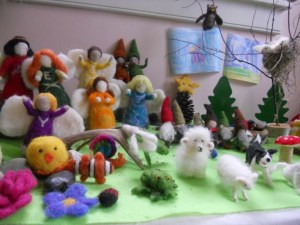
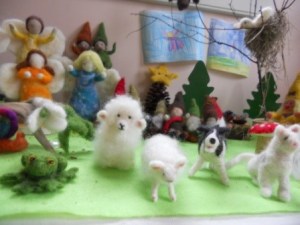
Fall Stories For Puppets!


For those of you looking for ideas for Autumn puppetry, here are some wonderful links to check out:  


Here is a sweet look at puppets to go with the story “The Star Apple”:  http://webloomhere.blogspot.com/2012/07/the-star-apple-puppet-play-story.html


Here is a puppet making tutorial for Jeremy Mouse and Tiptoes Lightly:  http://joygrows.wordpress.com/2012/07/12/tiptoes-and-jeremy-mouse-marionette-puppet-tutorials/


And a sweet Autumn story from 2009 that deserves a closer look:  http://domesticallyblissed.blogspot.com/2009/08/autumn-story.html


More about making marionettes: http://teachinghandwork.blogspot.com/2008/08/6th-grade-or-kindergarten-teacher.html


You can see a list of my favorite Autumn tales by age for children under the age of 7 here:  https://theparentingpassageway.com/2009/09/03/favorite-fall-tales-for-waldorf-kindergarten/ and some ideas for Autumn in the Kindergarten:  https://theparentingpassageway.com/2010/08/20/some-quick-autumn-ideas-for-waldorf-homeschool-kindergarten/


Many blessings as you bring sweet Autumn dreams to your wee little ones,

Carrie

“Overcome Gridlock”: The Seven Principles For Making Marriage Work


Dr. Gottman begins this chapter by writing that many couples actually handle “gridlock” well. You want children, he doesn’t; you want to go to church, he doesn’t; you are extroverted and want a party every night and he is introverted and wants to be home with a good book.  These problems seem insurmountable but yet some couples handle them exceedingly well and it does not tear them apart.  How do they do that?


Dr. Gottman asserts that the goal in dealing with gridlock is not always to get to solving the problem (believe it or not!) but to open a dialogue.  There are many problems in marriage that are just not solvable, but yet, we can still love each other and live in harmony. 


Sometimes the gridlock is caused by underlying feelings and dreams of things from childhood.  Perhaps the things you want most in life is being caused by wanting to emulate or distance yourself from your own childhood experiences.  Dr.  Gottman offers a helpful list on page 218 of people’s most common wishes,dream and desires that sometimes fuels gridlock in a marriage.


If we can communicate with each other and respect each other’s deepest dreams and wishes, then happy couples are often willing to overcome gridlock to help their partner be happy.  If the partner does not respect or find significance in their spouse’s dream or deep-rooted need, then this can cause severe marital problems. 


Sometimes when couples have opposing dreams regarding an issue, the only hope is to openly talk about why you feel that way and to listen as to why your spouse may feel another way.  When the real issues are out in the open, then you can have a dialogue and find a middle ground that feels okay to both of you.   Compromises are hard to accept, and yet, marriage is a field of compromise if the other person’s happiness matters as much or more to you than your own. 


Dr. Gottman notes on page 224: “Keep working on your unresolvable conflicts.  Couples who are demanding of their marriage are more likely to have deeply satisfying unions than those who lower their expectations.”


He provides a list of steps for those ready to move beyond gridlock in a series of exercises starting on page 225.  In Step One, Dr. Gottman lists common scenarios, and leaves us to fill in the dream that could possibly be found within the conflict.  One example he provides is a couple where the husband believes the wife is too neat and tidy and controlling.  The dream within this may be that the husband grew up in a very strict home and that the husband actually wants to be able to challenge authority; he wants his children to be able to challenge authority.  And perhaps the wife, who wants a neat tidy home, has as her dream a need for security because her home life was chaotic growing up.  She wants her children to feel safe; she wants to feel safe. 


In Step Two, Dr. Gottman guides the reader through picking a gridlocked issue in his or her own marriage and delving into the possible dreams beneath the conflict.  He asks that each person receive fifteen minutes to talk and explain his or her position without  attempting to solve the problem.  Listening is the first key to understanding. 


Step Three involves soothing each other, and goes back to the exercises found in the chapter, “Soothe Yourself and Each Other”, Chapter 8.  Step Four involves making a temporary compromise and living with that compromise for two months.  Dr.  Gottman provides the steps to work through  this in the exercise “Finding Common Ground”, found in Chapter 5.   He then instructs couples to live with that temporary solution for two months and then review.  He cautions readers not to expect the problem to be solved, but only that you and your spouse can live with the problem more peacefully than before.  Step Five is then to say thank you, in order to end on a positive note, and he provides an exercise for this on page 240-241. 


Another interesting chapter to read and think about!

Many blessings,
Carrie

Guest Post: Botany In The Waldorf-Inspired Homeschool

Our guest blogger today is the wonderful, wise and inspiring Lauri Bolland.  She lives in Pennsylvania with her husband, Eric, and their three always-homeschooled Waldorfy children who are now 22, 18 & 14. Their youngest, Gracie, recently published her first book, which grew out of their Seventh Grade Creative Writing Main Lesson Block. Gracie can be found on Lulu here:

http://www.lulu.com/spotlight/AmazingGrace

I asked Lauri to share some words regarding the “botany” block of fifth grade, and this is what she wrote:  Continue reading

Day Nine of Twenty Days Toward More Mindful Mothering


I think for many parents the ability to set limits and boundaries in a calm manner can be such a hard thing.

First of all, as a first-time attached parent, we have to learn how to surrender to this wee being and share our bodies, our time, our lives. We have to make the transition from being perhaps an outside-the-home career woman who has a schedule and deadlines to meet  and control over time to an extent to slowing down to the home environment where we are lucky to get a shower! We have visions based upon parenting books we read that the baby will sleep a lot and we will have all this time to clean our house and walk on our treadmills or something and quickly realize that is not reality with an infant. It can take time to transition into relaxing into our baby’s cues for breastfeeding, for sleep. Once we do that, and are nursing and sharing proximity in sleep and realizing that the child does not view himself as separate from us, we learn to surrender and have an ebb and flow of connection with our child.

However, then there comes the assertion of will from the child. We start to realize that the child is pushing against the forms of the day, the rhythm we have so carefully crafted. It seems so unfair after we worked so hard to learn to surrender and to connect!   Some people see this transition point as defiance, but in the land of Waldorf Education and even in the land of traditional childhood development pushing against the forms of the day is not seen as caused by  the child being malicious or trying to be devious! The child is learning, the child is realizing they are a person onto themselves.  However, this can be a frustrating time in parenting a small child because the child does have an idea of what they want, and  they do live in the moment without much thought of what happens before or after an action.    If you need further help, here is a post to help you: https://theparentingpassageway.com/2009/09/16/a-few-fast-words-regarding-defiance-in-children-under-the-age-of-6/


With our first child, we may slowly start to realize the child is not the same as us; not a psychological extension of us. We start to realize that the needs of the whole family absolutely do count and not just the needs of the child. Some parents realize these things earlier than others. Some parents come to this rather late, and because they are totally fed up and feel as if they must have done everything wrong as a parent because why else would their child act this way?


Some parents get truly frustrated and they say to me things such as: “I tell them what to do and they run the other way!” or other parents say, “I get frustrated because I am so mad and ready to lose it and they SMILE at me or LAUGH!” Continue reading

Guest Post: Using “A Donsy of Gnomes” In First Grade Homeschooling

My original post on the book “A Donsy of Gnomes” stirred quite a bit of interest!  You can read the original post here: https://theparentingpassageway.com/2012/07/09/a-donsy-of-gnomes-7-gentle-gnome-stories/ .  One of my wonderful readers wrote in with her story of how she used “A Donsy of Gnomes” in her daughter’s first grade experience.  Thank you to my reader Kristen from Vermont for sharing with all of The Parenting Passageway’s readers!

Here is what Kristen wrote, and I hope it will spark some creative ideas for your own homeschooling experience:

At the end of my daughter’s first  grade year, I decided to incorporate Sieglinde De Francesca’s sweet book of gnome stories into our Nature Block.“How to Create a Spring Nature Block for Grades  1-3”.  I loved her ideas but being the busy mama that I am with a small farm  to ‘manage’ and two  young girls under my constant care, I couldn’t possibly figure out how to find time to write my own stories.  Here in northern Vermont, we have seven to eight months of winter and relative ‘rest time’ but once it warms up, we are like crazed squirrels running here and there trying to fit everything in before it snows again!  I learned an important lesson this first year of homeschooling:  don’t leave any planning for spring undone before spring arrives.   You will never find the time once it’s warm enough to venture outside again and enjoy longer stretches of fresh air and the warmth of the sun.

So, I cheated.  I’ve been telling Sieglinde’s stories all year, with needle felted characters for each story, and my daughters have enjoyed them immensely.  (In fact, when I told the last story of the book, which occurs in late spring, my girls cried and I had to reassure them that they’d hear the stories all over again beginning in late summer!)  My plan was to tell the last two stories over the course of a month and tweak each story just a wee bit, adding bits of natural history here and there.  For instance, when I was in graduate school studying forest ecology, I loved reading about microhabitats and the ‘pillows and cradles’ you often see on the forest floor in mature stands.  Why not have the gnomes enjoy a rollicking time running up and down that lumpy ground, just for fun?  I also love wildflowers, especially the ephemeral ones in spring that look really groovy, like Jack-in-the-pulpit.  So why not have a gnome take shelter beneath a Jack-in-the-pulpit “roof” during a quick rain shower?   And, since I’m a bit obsessed with birds, why not have the gnomes comment on some of the bird songs as they scampered through the woods during the story?

The rhythm of our weeks was simple and was basically the same as telling the fairy tales, except that we incorporated nature walks into our afternoons to look for pillows and cradles and Jack-in-the-pulpits and notice what birds were singing their springtime songs.   We kept a nature journal which included a picture of the story and a short summary.

I also drew my own picture for story and hung them below our blackboard.  On these, I wrote words that my daughter could learn to write in her MLB and then practice reading.  We also incorporated a game in Peggy Kaye’s wonderful book “Games For Reading”.  It involved writing a short sentence related to the story, cutting up the sentence into pieces so that the words or phrases were separated, and asking my daughter to put the pieces back together in the right order to make a logical sentence.

She had already seen most words on my drawing and written many of them in her main lesson book so this was not as difficult a task as I thought it might be.  She is having a hard time learning to read and is not the type of kid who will sit down and try to figure it out herself.  A late bloomer, perhaps, but a child who loves to hear and retell stories!

Overall, I think this block was a stunning success and for weeks afterward my girls played with the needle felted gnomes (and other animal characters from the stories that I needle felted).    They both attended a garden camp this summer and during one of their walks in the forest  they gleefully showed their friends how much fun it is to run up the pillows and down the cradles in the forest, just like little gnomes do!

Many blessings, and much love,

Carrie

Part Two, Day Eight: Twenty Days Toward More Mindful Mothering


(You can see the first part of Day Eight here: https://theparentingpassageway.com/2012/06/25/day-eight-twenty-days-toward-being-a-more-mindful-mother/)


WP_000089


Watching a flower bloom is like watching a child grow in nature….their bodies growing bigger and stronger, developing all of their senses.


A wonderful exercise that I did in my Foundation Studies course was to draw a flower every day, bud stage through the final phases of the petals dropping.  I was drawing tonight and thinking about how our children blossom outside…


 WP_000091


WP_000090


Please give your children the gift of being outside – crossing streams on logs, hiking up hills and mountains, over rock and gravel, rolling down grassy hillsides and sitting in meadows and mud.  It is so important.


Have a blessed week,

Carrie

The Parenting Challenge: Gimme 5!!


It can be very easy to slip into a negative pattern of looking at our children’s behavior and to spend our days barking out what needs to happen:


“Please put your shoes away!”

“How many times do I have to ask you to take your plate up to the counter when you are done eating?”

“Get ready now!”

“Brush your teeth!”


and the list goes on.

More critically, sometimes we also approach our children with the “BUT’s” of life:


“Well, you did a pretty good job, but…”

“I was pleased with what happened, but..”

“It was a decent grade, but I know next time…”


Sometimes what we don’t say also sounds criticizing to the child and the messages they “hear” are I’m not athletic, I’m not smart, I’m not like my older brother, I’m not cute like the baby, I never do things right.


If we want to hold onto our children, and if we know that connection is the first and foremost basis of discipline, then take my Gimme 5 challenge!


5 times a day, say these words to your children:

“I like when you……”

“I appreciate when you…”

“You are (smart, funny, caring, loyal, helpful, kind, etc!)

Hug, kiss, pat your child on the back , put your arm around them– 5 times a day!


For tiny children under the age of 6, it is not so much about your words but your overall demeanor and attitude:  they don’t always need the words a child ages 6 and above need, but they do need sunny smiles, warm hugs, singing, and you saying short and positive phrases that confirm just how wonderful they are.


Because they really are!

Try five a day; it can take the most challenging child and the most challenging discipline season and turn it around.


I can’t wait to hear your results!

Blessings,
Carrie

Last Minute Homeschool Planning


In my neck of the woods, many of my homeschooling friends are planning to start school in the next few weeks.  The Deep South runs on a bit of a different time table than much of the country, who traditionally starts school after Labor Day.


Some mothers are still searching for curriculum to buy, or are realizing that there really is not a lot of money to buy curricula.  Others are wondering how to put it all together.


I always start with a calendar of the year, an idea of when we want breaks and a general idea of starting and ending and then decide what block I would like to do when.  I tend to stick to form drawing and math blocks that are shorter than language arts or history blocks.


Think about your child’s interests in planning blocks.  A Waldorf homeschool is not a Waldorf School. Sarah Baldwin, owner of Bella Luna Toys, wrote a lovely post about this very topic from her own experience here:  http://simplehomeschool.net/waldorf-homeschooling-learning-to-let-go/  If you know the curriculum and child development along with your child’s interests, you really can’t go wrong.  Bring things in at the right time, but look and observe your child – not only what they like, but what they really need to be balanced and to grow up healthy and strong and capable. 


Once you have an idea of your blocks, you can move into what your weekly rhythm looks like and your daily rhythm.  I shared a number of homeschooling forms that I used to plan my school year this year:  http://simplehomeschool.net/waldorf-homeschooling-learning-to-let-go/  and here:  https://theparentingpassageway.com/2012/06/16/get-your-planning-on-a-daily-homeschool-form-you-can-use/


Start plugging things in to your form – what verses will you use for your child to recite?  Can you get a poem related to your subject from the library?  What will you use as the basis for your block – fables, stories from history, etc?  Can you get these from the library or can you afford to order something you would like to have on your book shelf?


Where is the rhythm of using sleep as an aid?  Where is the movement, the arts (see this post to remind yourself: https://theparentingpassageway.com/2011/12/21/more-about-the-artistic-pillars-of-waldorf-education-a-virtual-tea/) , and the academic piece?  Where is the practice for the academic pieces:  your  daily math practice and your reading aloud or having your child read to you? I find most families do put these things in daily and do not let them go with no practice for a whole block…Again, this is the reality of how families do things, not some dogmatic way of approaching things.


And finally, where is the FUN?  Festival preparation, field trips, going out with your homeschool group, family outings or whole mornings or afternoons at the park or on a hike?  Get your fun going on so you won’t be burned out by the holidays!


Happy planning!

Inadequate 24 Hours A Day


I told my husband the other day that on my bad days, I feel like mothering is a stint in being inadequate 24 hours a day.  I can’t meet everyone’s needs; there is no way that  I, as one single faulty human being, can fully meet the needs of the other four people in my immediate family (not to mention extended family and other obligations!)


Have you ever felt like that?  I have gone through periods of that in my mothering where I have felt more strongly like that than others, and I am sure you have too. 


I am constantly encouraging mothers in this really short season of mothering and especially for my homeschooling mothers to do the best they can to slow down, to not wear so many hats and to simplify things.


But even in doing all these things, you probably still are not going to be able to “do it all”.  Doing it all is a fallacy.


I can set priorities.

I can recognize that everyone in the family has needs, and I can see who desperately has to have their needs met first or right away and then work down the list.  I can’t meet everyone’s needs at the exact same moment.

I can enlist help – my spouse, my extended family, my neighbors, my intimate friends.

I can help my children learn and take on more responsibility as they grow.

I can set aside time to nurture myself so I can be centered and calm. 

I can allow other people to also nurture me.


When we homeschool, I do think we so set that as a priority and give up other things in terms of time and energy…more about that in another post.   It is more important than ever when we parent, and especially when we homeschool, to find the best ways to  simplify, prioritize, delegate, and to allow the family to work as a team.


If I can work from this space:

Time and space in the rhythm of the day to allow for connections, and yes, to allow for when challenges occur.

Time and space in the rhythm of the school year to make up any work that didn’t go as smoothly as I originally thought.

Time and space for when life intervenes.

Less hats, less obligations because right now parenting smaller children and homeschooling is the priority.

Doing our best to plan ahead so we have the financial resources available to homeschool and parent. 

A laid-back attitude to know that this is how mothering rolls.

A good sense of humor to address the needs of children in multiple ages.

Our family works as a team, and the children have ways to contribute as well.

To remember to have fun!  This season of mothering is really small.  Fun actually is a priority!!


…than life flows more abundantly and more freely, and I can feel free to know life is life, no one can be perfect, and that family life has its ups and downs, its connection and fun.


Many blessings,
Carrie

Finding Center

I am busy reading “A Beginner’s Guide to Constructing The Universe:  The Mathematical Archetypes of Nature, Art, And Science” by Michael S. Schneider.  This is a fabulous read, especially for those of you homeschooling fifth graders and up in the Waldorf tradition, where the child moves from movement and form drawing to freehand geometry into geometry with tools.

I was re-reading the first section of the book, on the circle and the number one, and came across this passage:

“Nothing exists without a center around which it revolves, whether the nucleus of an atom, the heart of our body, hearth of the home, capital of a nation, sun in the solar system, or black hole at the core of a galaxy.  When the center does not hold, the entire affair collapses.  An idea or conversation is considered “pointless” not because it leads nowhere but because it has no center holding it together.”

I think parenting is learning how to revolve around our center, and how to find our center again if we loose it.  If our center is kindness, gentleness and self-control, then we have a center to return to in the moment (https://theparentingpassageway.com/2011/01/23/a-guest-post-take-pause-with-the-10-x-7-rule/).  We also then have a center to set our long-term vision around in terms of what drives the decisions in our family.

However, there is another very real and important reason to find our center:   If what we do and say becomes the inner voice of our children as adults, why not practice now?

Say these critical things to your child:

You are so strong.

You are so helpful.

I love you.

Thank you.

I know you can do this.

I am proud of you.

More importantly, show your child that they belong in your family.  That they make you laugh.  That they make you happy and make you  feel joyous.  Give them a smile, a hug, a kiss.  Tell them they are a precious treasure.  Because they are.

And you are too. If you are feeling dragged down, and lower than low about your parenting, your mothering, your life, please fight against those thoughts.  Some of the Early Church fathers had an idea about thoughts such as these; they called them logismi in Greek.  Thoughts that are not beautiful or joyous , helpful or kind are not from the Divine Source.  Don’t let them take you over.  Don’t wallow in them.

Find your center, find your joy again.  Work is a huge help in this.  Meaningful work for ourselves, our children.   A huge part of the Waldorf curriculum, outside of the art and the movement, is work.  Within Waldorf homeschooling, we learn practical skills,  we learn how to do things with our hands to help our family and to help our neighbor.

Find your center of kindness.  Your children can help you work and nurture your home, they can work and help make something for a member of your community who needs it.

You are so strong.

You are so kind.

You are such a good mother.

You make great decisions for your family.

You bring joy to those around you.

Peace,

Carrie