Waldorf Homeschooling Third Grade- First Old Testament Block

(Note – this is long so feel free to go and get a cup of tea!) 🙂

We started our school year with Form Drawing and then moved into our first Old Testament Block.

The Old Testament Block is one that many folks struggle with due to their own experiences with religion.  Please remember, these are stories of a people and that people’s relationship to authority; they are also the stories of a people trying to make a home for themselves on earth.  These issues speak  clearly to a nine-year old who is grappling with these ideas if only subconsciously.  These stories are not dealt with from a religious perspective within the Waldorf curriculum, although of course one is free to do this at home if one is Christian or Jewish.  I am Christian and tend to look at these stories from that viewpoint.    I highly suggest you obtain a copy of  the Christopherus Homeschool Resources’ Old Testament Manual and Stories:  http://www.christopherushomeschool.org/bookstore-for-waldorf-homeschooling/publications-for-grades-1-through-5/old-testament-stories-3rd-grade-curriculum.html  I think that the Christopherus notes to approaching these stories is helpful.  The other source that helped me approach this block was the Christian resource “Genesis:  Finding Our Roots” by Ruth Beechick.

We looked at what was present before Creation occurred and  how the singing of the stars accompanied Creation (another quote for the Main Lesson book – see Job 38:7). We also looked at the beginning of the Book of John, of which many of you are familiar, that talks about what was present from the beginning of time.   We started with these quotes in print and moved into cursive writing later in this block.

So then we were ready to start talking about the first story in the book of Genesis, the story of Creation.  We wet –on- wet watercolor painted the 7 Days of Creation.  My main resource for the painting inspiration came from the Christopherus Third Grade Curriculum.  We looked at God creating man in His own image,  I had my Third Grader write in her Main Lesson Book “God created human beings in His image” (Genesis 1:27).  I pulled spelling words from the story of Creation.

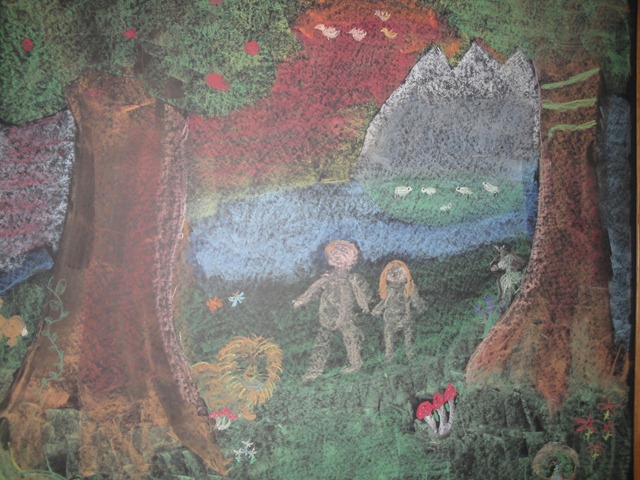
We then moved into the story of Adam and Eve, The Garden Of Eden and the Fall.  I used the animals and plants inhabiting the Garden of Eden as a way to start forming sentences with a subject and a predicate (subjects in blue and predicates in red).  I have mentioned before that we have done a little more grammar than is typical of this point in the Waldorf curriculum due to the fact that my Third Grader is also in German School  on Saturdays and was getting the grammar between German and English rather mixed-up. 
DSC00677

The story of  The Fall and of Cain and Abel can be very challenging ones!  We found  the language to use for the summary of Cain and Abel to be challenging and we consulted several different renditions of this story – the Bible, Ruth Beechick’s “Adam and His Kin”  and Jakcob Streit’s “And Then There Was Light”.

My daughter’s narration of The Fall ended up being this:  “Adam and Eve ate from the Tree of Knowledge.  They were driven out of the Garden of Eden.  On earth they had to make clothes, build a shelter and gather food.”   It is very important to really go through this process on the board and not rush trying to obtain a summary.

We then looked at the story of  Cain and Abel.  My daughter’s narration about this was:  “Adam and Eve had two sons.  Their names were Cain and Abel.  Cain was a farmer and Abel was a shepherd. Cain thought God refused his sacrifice but accepted Abel’s.  Cain became angry and struck his brother dead.  The Lord punished Cain and Cain became a wanderer on earth.” 

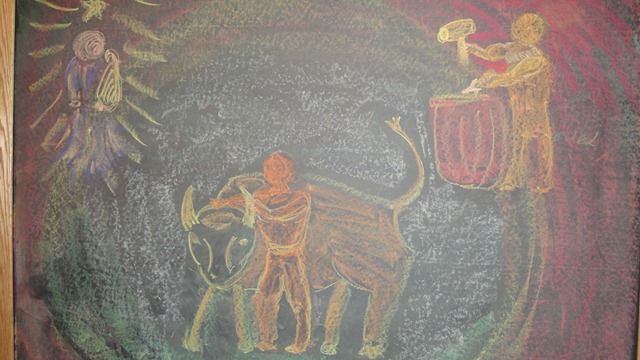
After this we traced the descendents of Cain and Seth and my daughter drew these family trees in her Main Lesson book.   This idea came to me through Christian author and homeschooling consultant Ruth Beechick’s book “”Adam and His Kin”.   This lineage will become important later as we trace the lineage leading to Abraham (and in our faith, leading to Jesus) in our second Old Testament block.  We talked about the sons of Lamech (a descendent of Cain):  Jabal, Jubal and Tubal Cain and their contributions to civilization.   For these stories I used a combination of what is in the Bible and what Ruth Beechick fleshed out of the sparse  lines in the Book of Genesis in story form in “Adam and His Kin”.  I also found the section of these stories in his book mentioned above to be helpful.

Here is a chalkboard drawing of Jabal, Jubal and Tubal Cain.  Go peek at the Book of Genesis and see if you can match my drawing up with who is who! 🙂
DSC00685

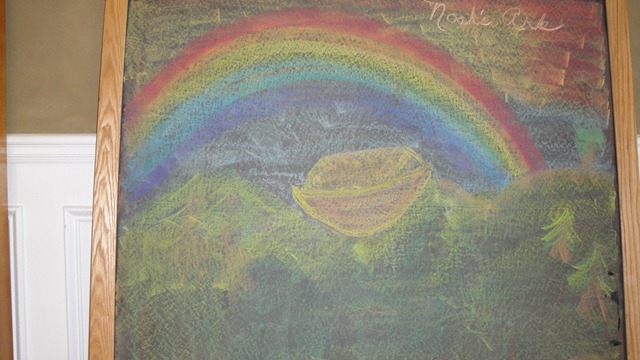
After that we moved into the story of Noah and the Ark:
DSC00703

We used the animals of the Ark as a springboard to talk about naming words, doing words, how words and picture words and made many sentences with pictures.  We ended this block with the story of what happened to Noah after the ark came to rest and how Noah’s descendents populated the earth.  We will pick up  our next block with the story of The Tower of Babel.

For this block I would highly recommend the following resources:

  • The Christopherus Old Testament Manual and Stories – the background information in there, the full-color reproductions of the seven days of creation and other ideas for working with this block are helpful.  Also, the music section of the complete Christopherus Third Grade syllabus had helpful music and poetry suggestions to go along with this block, including an intriguing poem about Tubal Cain.
  • Ruth Beechick’s “Genesis:  Finding Our Roots” and “Adam and His Kin”
  • Jakob Streit’s  “And Then There Was Light.”    Some may find this esoteric companion to be quite startling, but I found much of it matched up to Ruth Beechick’s book quite well because both incorporate what is said in the Bible and what was said in Hebrew legends surrounding these events and fleshes the Biblical events out in a story format.
  • Arthur Auer’s “Modeling:  Sculptural Ideas for For School and Home” had excellent suggestions for modeling for Noah’s Ark, and the animals of the Ark and the Garden of Eden.
  • Dorothy Harrer’s “An English Manual”
  • Roy Wilkinson’s “Commentary on Old Testament Stories.”
  • One resource I do not have but would really like to get for when I do this block again is this one: http://www.amazon.com/Legends-Bible-Louis-Ginzberg/dp/0827604041/ref=sr_1_1?ie=UTF8&qid=1288451554&sr=8-1    I believe Eva over at Untrodden Paths mentioned this on her blog and it was the first place I had heard about it.  Thank you Eva.

The challenging areas about this block outside of  the themes and stories themselves included the drawing – moving into drawing animals and the importance of gesture and color in these drawings; what spelling words to really pull from these stories (too hard? too easy?); and being able to really pull in the music, painting, modeling, poetry in conjunction with all the grammar and spelling and introductory cursive writing.  Again, I enjoyed working grammar in with these stories for my child  but not every child will be ready for that. 

The other interesting aspect of this block for me personally was seeing my nine-year-old’s work. It was, to be frank, rushed and sloppy.  Some of this was no doubt due to me having  to stand up and hold and dance around with a baby and tend to a kindergartner and not being able to always sit right there and draw each step by step, but some of this was also due to where my nine-year-old was.  She did not want to rush, she told me, but she wanted to “get through the stories and drawings.” (She told me this after the block was over, and you can see the logic of a nine-year old right there, bless her heart).   I felt we did a lot of “active” in this block, singing and stamping and poetry and modeling and painting and drawing, so I do think some of that is just indicative of where she is developmentally right now.   This is the blessing of being able to work with our children at home and meet them where they are.

Hope that this post will be helpful to some of you as you plan.

Many blessings,

Carrie

How Old Should My Child Be For Dry Needle Felting?

My wonderful handwork teacher Judy Forster noted to me the other day that the control and sharpness of the needle for dry needle felting are challenges that are just right for the physical and emotional changes that occur in middle school (typically 7th and 8th grade). 

From my observations of the development of the child at different ages, I agree with her. I also think there are many, many projects one can be busy with, so why be in such a rush to get to that rather hardening gesture?  This is an important point for Waldorf homeschooling parents who may be guiding their children’s handwork program without having a Waldorf-trained handwork teacher to assist them!

Wet felting is a wonderful alternative, and children in the grades can knit, crochet, macrame, cross stitch (fourth grade, age 10), sew (typically grades six and seven for projects) and do many other types of work with their hands.

If you have small children under the age of 7, I like to think about color and freedom.  The small child should be able to choose colors and materials and turn them into whatever suits the child’s fancy of the moment, whether that be a ghost or an elephant.  They may imitate you, but often they are just a wellspring of creativity.    I remember I had one good friend whose little boy made a whole bunch of creatures and critters from sheets of felt when he was around four or five.  The colors and shapes and what they were called were all his and he loved them.

Even in older children, seeing what colors the children pick and what they want to make is fascinating.   My Third Grader is currently drawn to blues and greens and I feel this is meeting her temperamental traits and where she is.  Color and form is fascinating!

If you need help determining what project comes when within the Waldorf curriculum,, please look at this back post that Ms. Judy Forster was so kind to write for this blog:  https://theparentingpassageway.com/2010/03/28/handwork/

Many blessings to you all,

Carrie

An Example Housekeeping Rhythm

Several readers of this blog really wanted to know what Lovey’s household cleaning rhythms were, and Lovey was gracious enough to reply so I thought I would post it here.  (It is also listed in the comment that Lovey sent in!)

Without further ado, Lovey writes:

Since I no longer maintain a blog, I will post our cleaning schedule here.

Mom:
Monday – kitchen/dining
Tuesday – vehicles (don’t forget this is an extension of your home)
Wednesday – living room
Thursday – basement
Friday – bedroom/bathroom
Sunday – yard

Within this framework I keep a schedule throughout the month so everything gets done. For instance in the kitchen, week one I will polish silver, week two is pantry and shelves, week three is floor and walls, and week for is appliances and cupboards. I have a rotation like this for each room so that in any given month every single area will be cleaned. I also clear out rooms every season gathering donations and changing out decor (and tidying the clutter that inevitably collects).

Dad:
Daily – laundry, dog care
Weekly – yard, maintenance

Child 1:
Monday – trash/recycling, kitchen
Tuesday – trash/recycling, bathroom
Wednesday – trash/recycling, kitchen
Thursday – trash/recycling, sweep & mop
Friday – trash/recycling, sweep & mop
Sunday – wash & iron own clothes, bedroom

Child 2:
Monday – vacuum, sweep & mop
Tuesday – vacuum, sweep & mop
Wednesday – vacuum, kitchen
Thursday – vacuum, bathroom,
Friday – vacuum, kitchen
Sunday – clothes, bedroom

The children have had a chore since about age 4. They progressively got harder as they grew older until by age 10, they were expected to contribute at their current level.

Daily I do a clean sweep picking up stray items throughout the house, gardening, cooking and dishes, and paper sorting.

We also have seasonal chores such as cleaning the siding, shampooing the carpets, washing the screens,etc.

Annual chores include clearing out and organizing the garage and attic, painting, etc.

Since moving to a cleaning schedule years ago, our home has been tidy and organized

Lovey

Thank you Lovey for sharing this as I am sure it will be an inspiration to many readers out there to come up with their own rhythm for housekeeping.

Many blessings and thanks,

Carrie

Waldorf Third Grade Handwork Projects For Fall

So far my third grader is learning to crochet.  Here are examples of beginning crochet work that she has done so far:

A belt with wooden beads:

\DSC00687

A crocheted “Thread of Life” (my term)  for our All Souls’ Day (November 2nd)  table:

DSC00791

And another view, with some orange paper flowers the children made for this festival:

DSC00790

Note there are no examples of knitting projects yet as our year just began in September.   Third Grade is also the correct time to teach the purl stitch as the nine-year change marks the appropriate time to move out into the space beyond and behind oneself.  This experience of  self- awareness and what may lie away from oneself belongs to the nine-year old who is beginning to separate. 

If you need a recap as to what types of handwork comes where within the framework of Waldorf Education and why, here is a wonderful article by my Waldorf homeschooling group’s handwork teacher Ms. Forster:  https://theparentingpassageway.com/2010/03/28/handwork/

Many blessings,

Carrie

Back To Basics: Bringing Out The Beauty In Your Home

I wanted to write a post about rhythm tonight, but felt I needed to write about the physical environment of the home first.  After all, it can be hard to attain a peaceful rhythm if laundry is piled everywhere, the sink is full of dishes and every surface is dirty.

Mothers ask all the time about establishing a rhythm for their families and I always recommend starting with bedtimes/consistent awake times, and then look at meal times.  However, what many mothers do not realize is that “clean-up” time is built into these bursts of activity.  Whilst your children are in the bathtub, have the children scrub it whilst you tackle the floor and sing!  After a meal time, everyone brings their plates up and washes and dries the dishes.  Together.  This is the beginning of the children using their will forces, their hands, their bodies and developing habits.  The things that you teach them to do with their hands will be the things they can do once they leave your house to live on their own!

So, the first place to start is with in regards to your home is, of course, yourself.   You set the tone for how things are done in your home, and you are worthy of having an nice home!  A home is really about the intangible feelings you get when you walk in the door.  Is it comfortable, is it warm, is it a place of love?  I wrote about that some here:  https://dendtler.wordpress.com/wp-admin/post.php?post=881&action=edit&message=1

In this post entitled, “Is Your Home A Sanctuary?”  (https://theparentingpassageway.com/2009/09/12/is-your-home-a-sanctuary/)  I wrote a few things down about starting from the bare bones of envisioning a home and building outward:

One of the first things one can do to improve the physical beauty of the home is to seriously look at the amount of stuff and clutter in the home and pare it all down.  Pare down your toys, the amount of clothes your kids have and how many things you have.  Your small home will seem spacious!

The second thing may be to consider unusual uses of space.  I currently have a lovely school room in my dining room area and my dining room in a sunroom area.  The dining room is more contained for homeschooling (ie, can’t see it from the front door when you walk in) and the sunroom area is larger and visible directly from the front door.  Our breakfast nook area off the kitchen is a also now a playroom to keep the children close whilst I cook or clean.

Paint is something to consider as well.  The right shade of paint can really warm a room and make it inviting.  Evaluate your furniture as well – if you painted this piece of furniture or changed the drawer pulls, would it look totally different?  Many times this is just as good as getting new furniture!  Can you reupholster anything?

Rugs, curtains and pillows are last.  If you can sew, that is so helpful but even if you cannot, perhaps you can find wonderful thrift store bargains.  Can you take down the blinds and clean them all before you put up new curtains?

Then look at the outside of your house.  Does it need painting?  Pressure washing? Mulch?  Is the front entry inviting? If you enter through the garage can you walk through the garage?  Does the garage need painting?

This is a lot about the physical environment because I think when we are home all day the physical clutter, cleanliness and appearance of our homes can really affect how we feel!

Here are some cleaning lists for what chores to do when:  https://theparentingpassageway.com/2009/05/11/housecleaning-and-homeschooling/  If you can tailor this to your own needs and work it into your daily and weekly rhythm, then you will have a foundation of a home that is generally well-put together. 

One website that has helped me in the past has been Flylady:  www.flylady.net.  Baby steps really assisted me when I did not have routines for homemaking in place.  Perhaps this will be a place to help you.

There are many blogs with beautiful pictures of gorgeous handmade homey spaces with clean, smiling children.  Do not let these photographs stress you out!  Use them and look at them only if they inspire you!  You are worthy of having your own tranquil physical space and you can get there!

Remember, people before things, baby steps toward routines!

Many blessings in homemaking,

Carrie

Back to Basics: Dealing With Anger

Anger is a very real emotion in parenting, and I think so many times people are afraid to talk about it.  Acknowledging that anger can exist in ourselves towards our children not only makes us feel sad and guilty, it forces us to face our own imperfections.

I wrote this in May of last year:

“If we create a battlefield in our mind against our children, then all is lost.  By battlefield, I mean the minute we begin thinking, “My child is doing this on purpose!”  “My child is out to get me and make me miserable!”  “My child knew what they were doing and planned this!”  “My child is just wanting to push each and every one of the buttons I have!”   Keep reading to find out the implications of what I mean by that!

Mamas, I have been there and done that and I would like to share something with you that I have learned:  If we create a us versus them mentality in our mind and in our attitude before we even open our mouths, then we have lost.

We have lost the opportunity to warmly hold the space for our children, we have lost the moment to guide in peaceful energy the behavior we would like our child to show, we have lost the connection between us and our child.”

The whole post the above came from is here:  https://theparentingpassageway.com/2009/05/22/the-battlefield-of-the-mind-anger-and-parenting/

I wrote some more regarding anger in parenting last November (modified text for this post today):

Conflict is a part of life, and anger is not a BAD emotion – it is just a feeling like other feelings.  However, many parents choose to discipline their children when they are angry or hurt.  Some parents choose to hit their children when they are angry.  Hitting a child is wrong, (if you need an argument for this please see this post:   https://theparentingpassageway.com/2008/10/20/getting-past-fear/ )  and when we lose control and responsibility for our actions when we are angry we lose that teachable moment.  A  split-second action in anger can also cause a parent to have remorse and guilt.  It can necessitate an apology!

Instead of losing control, I would like to talk to you today about how not to be the angry parent……I believe anger issues actually are OUR problem, the parent’s problem.  Usually we are trying to do something in a tight time frame, we are carrying in baggage from our own childhood (“I NEVER would have talked to MY parents that way!), we are tired and stressed out over things that may or may not even have to do with that child, we are carrying unrealistic expectations of that child’s behavior, or just in general our needs are not being met.

The questions becomes:  what do we want our CHILDREN to do when they are angry and how can we model that for them?  If we walk around yelling and slamming doors, how can we be surprised when our six-year old does that?

After you are calm, hopefully you can return to the situation and work to solve the problem. Help the child, guide the child.  Breathe in and breathe out.

Patience is developed over time.  I am certain I am more patient with this third child than I was with my first child.  Learning to relax into parenting and how to let go of the mentality that every single thing must be addressed so the child will not become a Detriment To Society is also learned.  Set a timer and see if you can keep your patience for half an hour if that is where you are, and work up from there. You can do this!  Fill your own tank so you have something to give.  Get your children into a rhythm with an early bedtime so you have time for you and time for you and your spouse.

Most of all, be thankful.  Go look at your children while they are sleeping, those small faces, realize how very little ages three, four and five really are.  And in this time of dwindling light and moving into darkness, work to cultivate yourself as a light for your family.

Need more help?

Here is the popular back post on “defiance”:  https://theparentingpassageway.com/2009/09/16/a-few-fast-words-regarding-defiance-in-children-under-the-age-of-6/

Here is a post for when you are feeling chronically angry toward your family:  https://theparentingpassageway.com/2010/01/05/an-emergency-how-to-how-to-parent-peacefully-with-children-under-age-9/  This is probably my personal favorite post I have ever written on anger.

Many blessings to you all tonight,

Carrie

Back To Basics: The Parenting Challenge Of The Week

I ran this parenting challenge last November and it deserves to be worked with and focused on again by parents!  So here it is, the famous “Stop Talking” challenge that was so popular and resonated with so many parents last year!

For those of you with children under the age of 7, have you ever thought how many times a day you are giving a directive to your child?  Even if it is a positively phrased directive, it is still a directive that causes a child to go up into his head and awakens the child into self-awareness. 

To put this boldly, if you are providing lots of verbal directives to your small child, you are putting the cart before the horse by using a tool that is not really needed until later developmental stages. 

“But what do I use then?”  you cry. “Children need direct instruction!”

(You can read the full back post here:  https://theparentingpassageway.com/2008/11/01/take-my-three-day-challenge/)

Yes, but children do not live in their heads with their words.  They live in their bodies and with their impulses.  You cannot parent from the sofa or from another room with a small under-7 child.

I postulate that many of the challenges we are seeing with children in the early years are due to parents involving children in too many decisions, using too many words, explaining too much.  This is leading to a very strong emphasis on the child being an individual before they are really ready.  You can see this article regarding ADHD and too many choices here: https://theparentingpassageway.com/2009/06/24/waldorf-education-adhd-and-what-the-parent-of-the-normal-child-can-learn/

So, if any of the above resonates with you, come along with me and take my three day challenge.  For three days, try to bring a consciousness to the words you choose with your children.  How much chit chat do you do all day with your children?  Can you replace that with peaceful  humming or singing? Here is a back post about this issue:  https://theparentingpassageway.com/2009/08/19/using-our-words-like-pearls/

How many directives do you give that could be either carried by your rhythm, done with no words at all (for example, instead of saying, “Now let’s brush our teeth!” could you just hand Little Johnny his toothbrush?) or could your words be phrased in a way that involves fantasy or movement?  For example, if you need your child to sit down at the table to eat, you could ask your baby bird to fly over to the table and sit in its nest.  “Mama Bird has food for you!”  Could you redirect your child into some sort of movement that involves their imagination that would satisfy the need for peace in your home?

Music through singing and the poetry of verses are wonderful ways to provide transitions throughout the day along with the strength of your rhythm.  Many of the old Mother Goose rhymes are fabulous for all parts of the daily routine.  Songs provide a peaceful energy and a needed source of warmth for the young child’s soul.

A mother asked, “What do I do if my child is doing something harmful to me or to another child? Don’t I need to use direct words then?”

I believe this depends on the age and temperament of the child.  As mentioned in other posts, many times the most effective method is to be able to physically move the child away from the situation or to physically follow through in a calm way.  You would never expect your words to be enough in a highly charged emotional situation for a child under 7.  A Complete and Unabridged Lecture on the Harms of Hurting Others is often not what is needed in the moment.

Perhaps in this case, helping the child to make amends after the emotions of the situation have decreased would be a most powerful means to redemption.  When we make a mistake, even an accidental mistake, we strive to make it right.  An excellent lesson for us all, no matter what our age.  We do not let this behavior slide, but we do work toward setting it all right again.

“What about giving my child a warning that an activity will change?  Don’t I need words then?”

If you are at home, your rhythm should carry many of the words you would otherwise use.  There may be older children of five or six that appreciate a warning, again dependent upon their temperament, and there may be some children that think they need to know everything that happens in advance but in reality it only makes them anxious and they talk of nothing else.

These are all important questions, and perhaps this three day challenge will assist you in sorting out the answers for you and your family as you strive toward a more peaceful home.

Many blessings for a peaceful family life,

Carrie

A Prudent Response to the New Infant Iron Guidelines

The American Academy of Pediatrics has recently released a new set of recommendations involving iron supplementation for infants.  My colleague Melissa Vickers has raised a number of points to look at this issue in a prudent manner here:  http://www.babygooroo.com/index.php/2010/10/21/aap-releases-new-guidelines-for-preventing-iron-deficiency-anemia/

Many blessings to you all,

Carrie

Back to Basics: Developmentally Appropriate

I recently was grocery shopping and watched a exhausted mother put her approximately 18-month old in time-out whilst they were in the check-out line.  I felt so badly for the mother, who clearly had had a hard shopping trip, and I also felt badly for the crying  little child sitting with his back against the wall across from the check-out line who could get up once he was quiet.

Sometimes it is so hard to pull out the right tool at the right time, isn’t it?

Part of what can really help you in your parenting is:

1.  To get very clear with yourself and your partner how you view the small child.  This provides a framework for everything from guiding a child’s behavior to education.

I have written about this time and time again.  The consciousness of the small child is completely different than an adult consciousness.  In our society we tend to think of small children as miniature adults with less experience and then are disappointed when talking and reasoning and offering a million choices doesn’t seem to make things go smoothly.

Small children, to me, are beautiful spiritual beings who are here learning.  They don’t do things to make you angry on purpose!  They are trying things out, they are complete sense organs who are taking everything in, they imitate everything they see, and yes, they pull out their own things as well!  I have had so many mothers lament to me, “Wow, I cannot believe little Billy just (fill-in-the-blank:  kicked me, spit at me, hit me, yelled at me).  We don’t do that to him, I can’t believe it!”

In discipline, small children need you to re-direct them into PHYSICAL activity with a pictorial way of speaking.  They need you to not crumple into a ball over their behavior, but to help them make it right through restitution.  And they really need you to stop talking so much!  Hum, sing, move them, work.  Stop talking so much and pulling them so much into their heads!

Protect their senses by being home and having a rhythmic, non-hurried household, and you will see your children shine!

If you need  further realistic expectations for each age, here they are:

For the three and four-year-old:  https://theparentingpassageway.com/2009/09/28/realistic-expectations-day-number-ten-of-20-days-toward-being-a-more-mindful-mother/

For the four-year-old:   https://theparentingpassageway.com/2009/09/05/realistic-expectations-for-the-four-year-old/

For the five and six-year-old:  https://theparentingpassageway.com/2009/09/29/more-realistic-expectations-day-number-ten-of-20-days-toward-being-a-more-mindful-mother/

For the seven and eight-year-old:  https://theparentingpassageway.com/2009/10/02/the-seven-and-eight-year-old-realistic-expectations-last-installment-of-day-number-10-of-20-days-toward-being-a-more-mindful-mother/

For the nine-year-old:  https://theparentingpassageway.com/2010/02/03/discipline-support-and-guidance-of-the-nine-year-old/

The second step to help you in your parenting is this:

2.  To understand that whatever your child’s more challenging behaviors are being caused by, the behavior is still there and you still need to meet it.  I recommend you get very familiar with the options that are in your tool box for parenting.  This includes gentle discipline techniques but also includes such things as knowing what you will allow at what age, and what your boundaries truly are. 

Some parents really don’t seem to have many boundaries at all.  If you need help in this area, try this back post:https://theparentingpassageway.com/2010/06/23/gentle-parenting-and-boundaries/

Many blessings,

Carrie

Back To Basics: Realistic Expectations For Mealtimes

Parents get very vexed about why their small three or four-year old cannot sit still through a meal….but if you know about normal development, you will see this is difficult for a six-year-old! 

Here is normal developmental behavior for mealtimes in regard to each age from 12 months through eight years of age:

  • At 12 to 15 months, the gross motor drive is strong – may be difficult to sit and eat a meal, may want to stand in highchair if family using one
  • After 12 months, toddler may go through phase of not being interested in cup
  • 15 to 18 months toddler very interested in self-feeding; may throw food
  • 21 month old may have definite preferences, such as a certain bib, a certain spoon, a certain dish – but may not have the words to express it and therefore becomes frustrated!
  • 24 months – preferences are high as related to taste, form, consistency, color – Think small helpings, teaspoon sized! Ritual demand of eating the same things reaches its height at 2 ½.
  • 3 years old – Eating better, appetite fluctuates less, the child has become a good chewer . On the downside, may dawdle if eats with whole family.
  • 4 years old – Typically talks  a lot, usually has to interrupt meal to go to bathroom, has much trouble sitting still
  • 4 ½ to 5 – A distinct rise in appetite, can listen as well as talk at the dinner table, may use a knife for spreading but not for cutting
  • 6 years – Perpetual activity! Cannot sit still, wiggles in chair, eats with finger, talks with mouth full, cannot finish meal. Preferences and refusals very strong.
  • 7 years –  Handles knives, forks, spoons better than they did at age six although may still use fingers to push food onto fork; liable to pop up from table to see something outside but much more able to sit still than at age six; may participate a bit in conversation at the table or may be silent; may bring the toys he or she was just playing with to the table.
  • 8 years old – can typically use a knife to cut meat; apt to play with silverware or reach across table for food; they talk and argue a lot and tend to interrupt adult conversation so they need your guidance regarding this; tend to eat fast and be done eating before the other members of the family  

    So what can you do to ensure a peaceful mealtime?

    I think one thing is to PLAN what you want your mealtimes to look like.  Here are some questions to stimulate your thoughts:

  • Is everyone just getting food and then scattering or do you actually sit down together? 
  • Do you have everyone set the table and help bring food out? 
  • Does your meal start with a candle lighting or a blessing? 
  • When a small child is done eating before everyone else, what is the rule in your home?  Do they have to stay there until you are done or can they play with something quiet nearby?
  • Does everyone help clean up?  Even toddlers can have a job – if this is your first toddler, you will have to do the job with them, but with subsequent children perhaps a big brother or sister can help the toddler do his or her job.

    These are important questions to consider!  If you know how you want things to be, AND you have realistic expectations for your child’s age AND you keep things short, then you have a much greater chance of meal times being peaceful!Think about this subject, meditate on it and design the family meal time that fits your family culture best!

    Many blessings,

    Carrie