Our Michaelmas Celebration

We went to our Waldorf homeschooling group’s Michaelmas celebration last night.  It was very lovely, and I wanted to share with you all some of the things we did.

First of all, we had 22 children plus their parents, so it was a fairy sizeable gathering.  This made me feel proud as this group only started a few years ago, and it is lovely to see it grow.

We had dyed capes several weeks ago at a playgroup in a bath made from tumeric and carrot tops and the capes turned out to be a beautiful golden, sunny yellow. Just gorgeous!  We have a Waldorf-trained teacher in our group who said they were truly lovely, which made all of us feel great since it was our first group dyeing experience.

The children gathered outside for Circle Time with their parents.  Our leader was none other than Jodie Mesler (musician, music teacher and author of a Waldorf-inspired homeschool music curriculum for pennywhistle and pentatonic flute – see http://homemusicmaking.blogspot.com/ for more details), who played guitar, pennywhistle and native american flute and another mother played the pentatonic flute.  After circle, we had a scavenger hunt for natural items found outside (pictures taped onto gathering bags) and dragon’s tears.  We then had a  dad who dressed up as a dragon.  He played a game of tag with the children and as the children were tagged, the children came forward to receive their beautiful capes to give them an extra dose of courage with a special verse to accompany the receiving of the capes.

Then, of course, came the food.  We had two kinds of dragon bread, challah bread, two kinds of soup, muffins/pumpkin bread, salads, fruit and caramel apples and pumpkin cupcakes for dessert.

Best of all was the wonderful company of Waldorf homeschooling families!

Hope you had a wonderful Michaelmas festival as well!

Peace,

Carrie

Michaelmas is Coming!

Michaelmas has long turned into one of my very favorite holidays!! If this festival is new or unfamiliar to you, please read on about this day.  September 29th is the special day!

Michaelmas is an autumn festival that to me really opens up the season for the awakening of our souls as the weather gets colder, the light recedes, and we look toward strengthening our own inner reserves, our own inner strength.  I LOVE this time of year!  After the expansiveness of summer (which I personally often find exhausting, LOL), I am so happy to have the cooler weather return and to be more meditative and inward.

Michaelmas, as you can probably guess, is named for Saint Michael.  Michael was one of the four archangels, and is the angel who threw Lucifer out of Heaven.  He is the Angel of Courage, the Angel of the Fight Against Evil.  Take courage for the long, cold winter from Saint Michael!  Saint Michael usually is painted as riding a white steer, carrying a heavenly sword, and slaying a dragon.  Sometimes he is portrayed as carrying scales, because he also has the task of weighing the souls of men. 

The Wikipedia definition cites where Michael fits into Christianity, Islam and the Jewish religions (and more,) here: 

Michael (Hebrew: מִיכָאֵל‎, Micha’el or Mîkhā’ēl; Greek: Μιχαήλ, Mikhaḗl; Latin: Michael or Míchaël; Arabic: میکائیل‎, Mikā’īl) is an archangel in Jewish, Christian and Islamic tradition. He is viewed as the field commander of the Army of God. He is mentioned by name in the Book of Daniel,[1] the Book of Jude[2] and the Book of Revelation.[3] In the book of Daniel, Michael appears as “one of the chief princes”[1] who in Daniel‘s vision comes to the angel Gabriel‘s aid in his contest with the angel of Persia (Dobiel), and is also described there as the advocate of Israel and “great prince who stands up for the children of your [Daniel’s] people”.[4]

The Talmudic tradition rendered Michael’s name as meaning “who is like El?”, – so Michael could consequently mean “One who is like God.” But its being a question is alternatively understood as a rhetorical question, implying that no one is like God.”

If you would like to read more, here is the link to the full entry:   http://en.wikipedia.org/wiki/Michael_%28archangel%29

There are all sorts of things one can look at for this time to celebrate.  We would never explain to small children all I just wrote about Saint Michael, the joy of the festivals with a small child is the DOING, not the explaining!

Some ways to celebrate and lead up to the festival:

  • Start learning Michaelmas songs and verses.  Try Autumn Wynstones and many other traditional Waldorf books for ideas.  You may also have hymns or music within your own religious path.
  • Look for Michaelmas Daisies.  Here is a picture:  http://www.bestgarden.net/Photo_Album/Pages/Aster_novi-belgii.htm
  • Have Harvest Foods. (This used to include roasting a goose – tell me, my European readers, does it still??)
  • Tell stories about Saint Michael  or St. George.  St. George is  the Earthly counterpart to Saint Michael – you could make Saint George tunics (white pillowcases with red crosses sewn on).  Swords and shields are also customary, which makes some Waldorf teachers and parents nervous.    Here is a link of how one Waldorf Kindergarten teacher dealt with this in her classroom:   http://www.waldorflibrary.org/Journal_Articles/GW4007.pdf
  • Stories could include “The Kite” from “Festivals, Families and Food”, any number of Kindergarten Stories from that pink book “An Overview of the Waldorf Kindergarten.”  For younger children, Melisa Nielsen has a story in her “Before the Journey” book and Suzanne Down has a lovely story called “Little Boy Knight” in her book “Autumn Tales.”   Reg Down has put his Michaelmas story from the Tiptoes Lightly stories on his website here: http://www.tiptoes-lightly.net/DOWNLOADS/tales_FESTIVAL/The%20Most%20Beautiful%20Dragon%20in%20the%20Whole%20World.pdf
  •   I believe there is also a story of St. George on-line at Main Lesson that would be lovely for the Second Grader studying Saints and Heroes. There are also two stories by Irene Johanson in the book “Stories for the Festivals of the Year”, available from Bob and Nancy’s Bookshop or Rudolf Steiner College Bookstore.    If you are religious, perhaps you could read from your own religious texts.
  • You could dye capes from marigolds for the big day.
  • You could make a Courage Salve from Calendulas.
  • You could do something that requires bravery that day – a hike, an obstacle course?   How about a scavenger hunt for Dragon Tears? 
  • Making dragon bread is very traditional. There is a lovely bread recipe and  corresponding story in the festival book “All Year Round”.
  • You can make Michaelmas Candles, see page 143 of “All Year Round”
  • Crafting “shooting stars” and dragons are also traditional.  Try this link:  http://www.waldorflibrary.org/Journal_Articles/GW3211.pdf 
  • You could make a mobile with a dragon and an angel representation on it. 

Start early, go slow and add things year by year – it does not all have to happen this year!  There should plenty of preparation and work leading up to a festival as well, festivals are not a one-day celebration!

Use this time for your own inner work, what do you need to strengthen?  What resolve will you need as you head into fall?

Much love,

Carrie

Sharpen Your Skills in Homemaking 101: Baking Bread

We are going to embark on a series of posts discussing some ideas for the typical skills a Waldorf homeschooling mother needs for the Kindergarten years and beyond.  Many Waldorf schools and Waldorf homeschooling families have a baking day for their families within their weekly rhythms. 

A mother who does work and practical homemaking as a model for her children is very valuable indeed within a Waldorf framework.  From the framework of Waldorf Education, when the child sees the true work that the mother does and can imitate it in play, this strengthens the will of the child.  Doing the same (ACTIVE!) thing at the same time each week is also what strengthens the will.  We work through the will during the Early Years (under 7) as this is what helps to form the physical body for future physical health and lays down the foundation for the rest of the four body….

This post is  not meant to be an exhaustive bread-making tutorial, but a few thoughts regarding this important skill.

First of all, if you can eat wheat, there is something to consider about this much-maligned grain.  Wheat, according to Bread Beckers, is first among the grains for nutritional value including critical B-vitamins when freshly milled and eaten in its entirety, and also of Vitamin E when freshly milled. (You can grind your wheat in a grain mill or in the dry container of a Vita-Mix).    Wheat does have gluten in it, and gluten is the protein of the wheat that you develop by kneading, which then traps and holds the yeast and causes your dough to rise.  Wheat is about the only grain that can make soft, light bread.  Hard wheat has a higher gluten content than soft wheat.  Wheat varieties include hard wheat, soft wheat (red and white), spelt and kamut.  Durum wheat is a pasta-making wheat that semonlina flour comes from.  Grains that have no gluten in them at all can be used in recipes that do not call for yeast. 

Yeast is an important ingredient in bread-making.  It is a living organism that likes a warm, moist environment.  Most of the time I use the yeast in with the water or liquids the recipe calls for and about half the amount of flour to “cool off” the water temperature. It seems to work well for me.   Another factor to consider is that salt is a controller of yeast. 

Sweeteners for bread include honey which you can substitute one to one for any sugar called for in a recipe.  Some folks use Sucanat as well.   Other ingredients sometimes called for in bread recipes include milk, oil or butter or eggs, lecithin (which is from soybeans, so you may  not be able to use if you have soybean allergies in your family), gluten and flax seed.

Bread baking usually takes a bit of time, but well worth the results.  After you grind your wheat, try putting your liquids in a bowl, adding the salt and yeast and part of the flour.  Add the rest of the flour as needed; the dough will be soft when you turn it out onto a floured board.  Kneading times for dough vary; usually about 2 to 5 minutes does the trick.  Then the rising of the dough takes place, which is typically done in a warm place until doubled in size, punched down and shaped as desired.  If time allows, you can do a second rising and then shape the dough.  If you need to slow the rising process, you can also put the dough into the refrigerator overnight.

I feel sometimes making bread dough and shaping it into rolls is an easier place to start for novice bread-bakers.  If your bread dough is not done on the inside, you may need a longer cooking time at a lower temperature.

Bread baking is an excellent way to start a weekly rhythm within your home,

Carrie

Midsummer’s Day: St. John’s Tide Day

Some people wonder what the difference is between the solstice and Midsummer’s Day.  Summer solstice is on June 21st and is the longest day of the year.  Midsummer’s Day is fixed on June 24th, which is St. John’s Day or St. John’s Tide Day.  This day is said to be the day of birth of John the Baptist.

In the book, “Waldorf Education:  A Family Guide,” Karen Rivers writes, “John the Baptist represents man at the center of history, devoted to what is beyond himself, to the revelation of the spirit brought by Christ.  His summons was to turn inward, to search within toward a confrontation with oneself.”  St. John’s Day is a fitting time to re-assess and re-balance ourselves in this spirit.

Traditionally,  a fire was lit at sunset on the eve of St. John’s Tide Day.  The firewood was collected for days beforehand, and prayers and blessings were spoken as the fire was lit.  There are also other traditions associated with the fire, including walking around the fire three times and throwing a pebble into the center of the fire with a special prayer, and also jumping over the embers of the fire as it died to get new endeavors off to a good start or to rid themselves of their own weaknesses and inadequacies.  The book “Celebrating Irish Festivals” remarks that sometimes the embers of the fire were carried about as a smoldering torch to smoke-cleanse areas or even fields. 

St. John’s Day is also known as a wonderful time to collect herbs.  Herbs such as elderflowers, St. John’s Wort and many others may be ready at this time in your area.    With small children, one can make the eve of St. John’s Day the time to leave out small treats for the fairies in the garden or to build fairy houses.

According to the book, All Year Round”, Midsummer Day is an excellent day to eat outside, to cook food over an open fire, use edible flowers as part of the meal.  Nature tables at this time of the year often include bees, gold spirals, and hanging suns.  Some people celebrate  by hanging a bunch of coneflowers on their front door, leave a light on all night long, or bring in sunflowers for a corner of the room.

Here are some resources for this lovely festival:

This is link to the wonderful Calendar of the Soul verses for this lovely day:

http://wn.rsarchive.org/Books/GA040/CoTS/GA040_41-12.html

Here is wonderful article covering many of the major festivals from our friends at the North London Steiner School (if you scroll to the bottom of this article there is a section on St. John’s Tide Day):

http://www.rudolfsteiner.london.sch.uk/SchoolEvents/Festivals.aspx#midsummer

Here is a link to some festival books at Bob and Nancy’s Bookshop, and there is a lecture by Steiner regarding this festival included:

http://www.waldorfbooks.com/anthro/festivals.htm

There is also this book by Charles Kovacs:

http://www.florisbooks.co.uk/books/9780863156014

Here is a more general link to the Wiki entry on Midsummer’s Eve and Day:

http://en.wikipedia.org/wiki/Midsummer

The Wynstones Press “Summer” book also has many songs, verses and stories appropriate for this festival.

Hope that helps those of you planning festivities this month!

Carrie

Happy Mother’s Day

Happy Mother’s Day to all of you out there; I appreciate the time all of you take in reading this blog.  This blog is currently getting somewhere between 300-500 hits a day!  Thank you for all you do for children, for all the thought and care you give to your family life.  You all are such an inspiration to me!

Happy Mother’s Day,

Carrie

Celebrations of Spring in the Waldorf Home

“Children relate to the world around them primarily through what is seen and done.  It is only later that they easily grasp abstract ideas.  So in preparing festivals for children we give priority to the visual presentation and to the accompanying activity.  We have found it best to avoid completely the temptation to explain in words anything to do with the meaning or background to a festival.  It could be many years later that illuminating connections in thought are discovered by the child- but this will be a personal discovery and therefore all the more precious and inspiring.”

-All Year Round, page 42.

Here are some ideas for celebrating Spring within your Waldorf Home! (I did not include Passover and hope to find you a blog to link to with Passover ideas – Loveyland, where are you??)

Karneval/Mardi Gras:  Probably not a true Waldorf tradition celebrated within the Waldorf school, but Karneval is a season of fun in many regions of Germany !  You could consider celebrating at home with cutting out chains of colorful paper dolls and hanging them up, celebrating with  a Karneval party where the children dress up (not in scary costume, but colorful costume!) and there is dancing and singing and food.  Some regions of Germany celebrate with a special kind of  jelly-filled donut for Karneval.

The season of Karneval typically culminates in Shrove Tuesday, the day before Ash Wednesday.  Wikipedia has a lovely entry on all the different foods people in different countries eat on this day before Lent.  See this link for further details:   http://en.wikipedia.org/wiki/Shrove_Tuesday   In my region of the United states, this night is known to many in the US as “pancake dinner” night for “Fat Tuesday.”

There are many pancake rhymes out there, here is one I remember that I believe is Mother Goose:

Mix a pancake

Stir a pancake

Pop it in a pan

Fry a pancake

Toss a pancake

Catch it if you can

You could have a pancake tossing race as I am told they do in England!

In some Protestant traditions, families make pretzels on Ash Wednesday, the first day of Lent.  Here is a recipe I found:  http://www.rca.org/Page.aspx?pid=2601.    I also found this link regarding pretzels and their role in Lent from a Catholic perspective:  http://www.catholiceducation.org/articles/religion/re0535.html 

Lent: 

According to the book, “Celebrating Irish Festivals” regarding Lent:  “In older times people were expected to abstain from all animal fats during Lent.  This meant no eggs, butter, milk or meat, so the people ate simple meals like porridge, with black tea for breakfast; and potatoes, herring and seaweed for dinner………..In the 19th century the custom changed so that only Ash Wednesday and Good Friday were strictly observed fasts.  There was a prohibition on dancing and singing during Lent.  Visiting friends was frowned upon, as were card games; and still today many people decide not to visit the pub during this period……Nowadays, many people choose to give something up for Lent.  This can be a habit, or something like chocolate or sweets.  You could also choose to take up some spiritual discipline during this time.”

I personally like to do more intensive inner work during the 12 days of Christmas and during Lent.  One thing that I have been using for my own adult inner work during this season of Lent is the contemplation of my role  in Social Justice.  I have been using these devotions as found here:  http://images.rca.org/docs/discipleship/LentenDevotional.pdf  Food for thought. 

Maybe you would like to join the Anthroposophical Society during this time to further your foundation for Waldorf homeschooling.  Maybe you will intensify your yoga practice or prayer or meditation life.  I am sure you  will find the thing that speaks the most strongly to you.

Other thoughts for during Lent include Spring Cleaning, and also cleansing your body with such herbs as dandelion and nettle.   There are many wonderful recipes for this in many of the festival books.

The book “All Year Round” has this to add regarding the celebration of Lent with small children:

In what ways can we develop an appropriate Lenten mood for a younger child?  We could sit together for a few minutes each morning, listening in silence as the birdsong  gains strength from the ebb of night.  We could take time to watch for the moon as it unfolds its rhythmic process between darkness and light.  There are many small, quiet ways in which the adult can offer certain pictures.  We do not mean art reproductions of the Crucifixion, which children can find disturbing, but pictures taken “out of the book of Nature”, or presentations of a symbolic quality.    For example, if an unlit candle stands on the dining room table each day instead of flowers, this can make a very deep impression…….”

St. Patrick’s Day:

The book “Celebrating Irish Festivals” discusses the life of St. Patrick and provides a story about Finn MacCool and St. Patrick, which would probably be suitable for eight-year-olds and up. 

Some children wake up to find a St. Patrick on their Nature Table.  Many families celebrate this day by having green food (yes, the dye, the horror!), making shamrock rolls, hunting for shamrocks outside, sewing little green felt shamrocks to pin to a shirt.  Celtic music is great fun as well.  Some mothers sew a small little green shirt and pants and leave them somewhere for the children to find in the morning, or have a scavenger-type hunt for gold.   I have known parents who even went so far to use green food coloring in the toilets even, LOL!

I don’t know how “Waldorf-y” any of this is, but it sure is fun!

Spring Equinox:  A great time to change the scene on your Nature Table!

Some families set up an egg tree especially for the Equinox and some families do one tree for the Equinox and one for Easter.  Some families wet felt flowers and when they are dry, tack them to their shirts with a safety pin.  Some families use the Equinox to leave out special gifts for the birds to build nests with or make birdhouses or Mason bee houses.  Wet-on-wet watercolor painting on paper cut out in the shapes of chicks or rabbits also comes to mind, as does those simple pipe cleaner and coffee filter butterflies.

 Easter

Palm SundayAll Year Round recommends making a cockerel to hang over the breakfast table for the children to wake up to and includes directions.

There is also a thought that if you have been using an unlit candle on your table, then you start lighting it on Palm Sunday.

This can also be a day to sow grass seed or wheat grass or start a Lenten Garden in a dish.

For the time between Palm Sunday and Easter Sunday, you could make an Easter Pole as a family.  The pole usually is made from a branch that you can bend into a hoop at the top, decorate with streamers and a bread rooster.   Some families also do an Easter tree and decorate it with blown and dyed Easter eggs. Even a small child of age 4 or 5 may be able to take a large-eyed needle to sew some yellow felt together to make Easter chicks for the Easter Tree.

Maundy Thursday may be a day of a simple meal.  In much of Europe, this is a day to eat green food such as herbs and salad.

Good Friday is ideally the day to make Hot Cross Buns and also to dye Easter eggs if you have not done that before this day.  There is a lovely book regarding Easter Crafts, titled simply “The Easter Craft Book” by Thomas and Petra Berger that may give you other ideas.

Some families also plant things on Good Friday, and seeds are nice gifts in the Easter baskets.

Holy Saturday/Easter Sunday:  A day of waiting, stillness, anticipation.  Some families make a bread ring for Easter morning that has “pockets’ in it, and on Easter morning the children wake up to dyed eggs being in the pockets.

All Year Round” has a simple explanation about the Easter bunny versus the Easter Hare and remarks, “May we make a plea for the reinstatement of the Easter Hare?  He is fast becoming an endangered species, owing to the increasing popularity of the “Easter Bunny.”  The rabbit, with its established communal life and reputation for timidity, presents a very different picture from that of the hare.  The hare is a loner, creating the most transient of abodes.  He is said to be a bold and courageous creature, and his upright stance is characteristic.  His long ears suggest a wide and intelligent interest in the world, and in legend and folklore he is invested with the virtue of self-sacrifice.”

If you are searching for Easter stories, Suzanne Down’s “Spring Tales” has a story about the Hare, the book “Festivals, Families and Food” has two separate tales about the Easter Hare .

As far as Easter baskets go, I know many Waldorf families who put small trinkets in the basket as opposed to candy.  Homemade items and toys are always especially wonderful.

Earth Day:  I don’t know if this is celebrated in Waldorf schools, but it may be fun to celebrate our love for the Earth and the home we share by marking the day in some way.  I have looked at a number of links on the Internet about Earth Day and small children and have not found any of them to be especially appropriate for the under-nine child from a Waldorf perspective.

Waldorf approaches the challenges we are facing in the environment from a perspective and realization that the young child is ONE with the environment; with all the trees, the animals, the birds, and the plants. As Waldorf educators, we work hard to foster reverence and wonder for the great outdoors.

So, my suggestion would be to take part in hiking that day, planting a tree, or if you have seven, eight and nine year-olds, possibly participate in helping to clean up a trail, park or river –IF you can keep the “gloom and doom” out of it and just simply say, “We are helping to keep Mother Earth neat and clean.” No guilt about what the human race is doing wrong yet! 

Remember, holidays and festivals the Waldorf way are about DOING, not the words or the explanations.  DOING.

Yours till next time,

Carrie

Candlemas Is Coming!

Candlemas is on February 2 and celebrates the beginning of the lengthening of the days, and in some traditions is considered the beginning of spring.   It is my understanding that this day is also halfway between Winter Solstice and Spring Equinox.   This festival began in pre-Christian times as a Celebration of Lights and of the Celtic goddess Brigit (February 1st).  Candlemas  takes its name from the blessing of the candles on this day for use in the church throughout the coming year.  It is also a celebration within the church of the presentation of Jesus in the Temple to Simeon and the elderly widow Anna.   In the Catholic Church, I believe this is also celebrated as the Feast of Purification (of Mary).   This is now also a celebration of Saint Brigid and also a time where we look to the hibernating animals to come out and see if it is winter and whether or not we will have an early Spring.  This is also a traditional time of  preparation  of the fields for later planting. 

In the book “All Year Round” by Ann Druitt, Christine Fynes-Clinton and Marije Rowling it says, “At the beginning of February, when the infant light of spring is greeted thankfully by the hoary winter earth, it seems fitting that we should celebrate a candle Festival to remember that moment when the Light of the World was received into the Temple, when the old yielded to the new.”

For children under the age of 7, the celebration of the festivals is not in the verbal explanation of the day, but the doing.  An answer to a very small child’s question of  why we do this or that for many festivals is just that we do!  As a child approaches seven, there can be more explanation for the reasons behind things, but please do not spoil the magic and mystery of the festival by all the history.

Here are some ways that Waldorf families celebrate Candlemas:

One would be to think of goals and things you would like to see happen in this New Year together, in this time of new beginnings, as the earth becomes Spring again and do something to celebrate that.

Of course, the major activity is usually candle-making in some form – rolling candles, candle dipping, making earth candles outside in the ground and lighting them.  Some families have their candles blessed on this day.

Some families celebrate by tilling a garden plot for March planting.

You could  have dinner in candlelight.

Marsha Johnson over at waldorfhomeeducators@yahoogroups.com recommends making and eating fresh bread, vegetable soup or vegetable chowder and baked custards as your Candlemas meal.  Recipes can be found in the FILES section of her yahoo group.

We can also offer simply made stories and poems about our friends the bees and work with beeswax and honey in some way during this festival.

In the United States, this is also of course Groundhog Day and many families celebrate by going to a groundhog day event.

Some families tell stories about Brigid or read the picture book about Brigid and her cloak.  You can also search for Brigid’s crosses on-line and make those as a craft; they are very distinctive-looking.

Some families have a bonfire on this day.

These are just some suggestions I have read or heard through other families.  If you celebrate Candlemas in your family, please do leave a comment and tell everyone how you celebrate this day…Help someone new to this festival get started!

Three Kings Day

I hope everyone had a wonderful Three Kings Day.  We had a terrific time finding gifts yesterday morning, having a storytelling session around the Coming of the Magi, making crowns, and having rice pudding with those secretly buried almonds for the kids to find!

My friend over at Nature’s Rhythm has this wonderful post up about their festivities, check it out and file the ideas away for next year!

http://naturesrhythm.blogspot.com/2009/01/sternsinger.html

Just a few thoughts from my little corner of the world.

The Holy Nights

Happy Holidays to everyone!  I wanted to take this opportunity to address the time fast approaching us,  that time between Christmas Day and Epiphany, referred to by many as the Twelve Days of Christmas or The Holy Nights.  This is a very introspective and meditative time for me.  You can read Rudolf Steiner’s views of The Holy Nights  here:  http://wn.rsarchive.org/Lectures/Christmas/19111226p01.html

The Holy Nights is a time when I dream and plan for the coming year.  It is a time where I really look at how homeschooling is going, and what things we still need to accomplish in the rest of our year (We school September through June, with July and and August off for my oldest – my youngest most likely will run January through June and then September through December for her school year once she is at the age to do grades).

Do you have plans for your homeschool for the coming year?  Some of the things I am thinking and meditating on is bringing more puppetry into our homeschool, and also how many days a week I should be bringing in handwork.  I also look at my own personal goals in regards to homeschool  – what do I need to learn for the grade that is upcoming?  What areas do I need to work on and refine my skills in?

I also use this time to look at my own personal goals for the coming year.  Many of you know from previous posts that I have worked with the mantra of being easy with myself and others for several years now.  I will continue to do that but now I am also looking at the concept of “letting go.”  I will use the Holy Nights to look at my inner work and how that is progressing.  How I communicate with others is also of great importance, so I hope to have a little extra time each day of The Holy Nights in order to check out NVC Academy (there is a post about that on this blog you can see to access the link).

Do you have personal goals or things you would like to work on this year?  Another website someone passed on to me that I have not had a chance to get out is this one regarding Radical Forgiveness:  www.radicalforgiveness.com .  Whatever the thing you would like to work on this year, the Holy Nights is a wonderful time to ponder how you will put this desire into action in the coming year.

The other thing I would like to accomplish during these days is a bit more reading of Steiner’s lectures, which are always inspiring to me.

The above encapsulates the kind of work I will be doing during this time.  The kids will be working on a play for Epiphany, and of course we will be clearing all the greenery out of our house, and changing the Nature Table to include King Winter. (although our straw Christmas star will stay suspended over the table until Candlemas on February 2nd).  And of course we are all looking forward to the little cake with a crown and a bean baked inside for Epiphany!  I am also planning on making puppets for the tale “The Snow Maiden” from the little book “Plays for Puppets” for our January puppet show.  For my first grader, we will then be starting with a week of form drawing and then a block on the four seasons, the four elements and the twelve months of the year for the rest of January before diving back into language arts through the fairy tales and the four math processes.  My kindergartner will be working on a circle related to Winter and on a few stories related to animals in Winter.

So, dear reader, you may not see as many posts here until after Epiphany is over (January 6).  But please do be assured I have lots of ideas for wonderful posts regarding Waldorf homeschooling, gentle discipline and whatever topics you would like me to address!  Please do let me know what you would like to talk about on this blog in the comment section. 

I appreciate the fast readership this blog has gained in such a short amount of time.  Thank you for passing my posts and this site on to your family and friends.  I hope you and your family are having a wonderful holiday season and I wish you the happiest of New Year’s.

See you in 2009!

Just a few thoughts from my little corner of the world.

Advent and Other Winter Celebrations Within The Waldorf Home

I had a friend over today who requested I write a post regarding the celebration of Advent and other Winter festivals within the Waldorf Home.  She told me, very astutely, that this time of year was difficult for not just  herself but for so many people she knew who did not have a true religious leaning – it was hard to know what to celebrate and why, and not only that,  the consumerism and materialism of this time of the year really dampened her enthusiasm and excitement.  She summed it up by saying like, “What can I show my children about this time of the year when I don’t even have it all figured out?”

This is a hard time of year for the very reasons my friend stated.  I have a number of friends who encompass different faiths, spiritual leanings, denominations – atheism, agnosticism, Catholicism, Judaism, Islamic, Mormon, Presbyterianism, Reformed, Lutheran, Paganism, or just friends with leanings toward one place or another but no true “spiritual home” yet.  And this December, we all come together to celebrate different things; whether it be Saint Nicholas Day, Bodhi Day (when Buddhists celebrate the Enlightenment of Buddha), Eid al Adha (Islamic Feast of Sacrifice, the most important holiday of the Muslim calendar from my understanding), Santa Lucia Day, Las Posadas in Mexico, Winter Solstice, Hanukkah, Christmas, Kwanzaa. But yet we are all in the darkness of Winter searching for Light.

It is my fervent hope this holiday season that no matter what our spiritual leanings are, that we are all working toward and being the most loving, compassionate people we can be.  Our children need that, and our country need that. 

I hope this holiday season and throughout the year we can all treat each other with respect and dignity.  We are one in humanity.  I had a beautiful family I worked with recently from Bangladesh and the father looked at me at one point and told me in broken English how he and his wife had just bought a house and how he did not especially want to hang around with the Bengali community in our town.

“My neighbor, he American and say he help me with whatever I need, “ he shrugged.   “I cut my finger, I bleed, you cut your finger, you bleed.”  He and I solemnly looked at one another over the head of  his little baby and nodded at each other.  One humanity, one world.  That is what we should be about this time of year and all times of the year.

We are not the only ones with difficulties this season. Consider the plight of the Waldorf school teacher.  In the book , “An Overview of the Waldorf Kindergarten,” edited by Joan Almon, she writes, “December brings special challenges to the Waldorf Kindergarten teacher, for Christmas is a vital part of our culture and a festival that brings joy to children.  However, there is sometimes a tendency to be so overt in one’s celebration of Christmas that the kindergarten comes to feel more like a Christian Sunday School than like a Waldorf school.  This brings great pain to our non-Christian families, but it is problematic even for the children of Christian background. Within the Waldorf Kindergarten the festivals are  not meant to be “taught” but are offered in a light manner, much like telling a fairy tale, which allows the children great freedom to come to the festival as they will.  When offered in a spirit of gratitude and with a sense of wonder and awe, something of the essence of the festival can speak to the children.”

In this same book, an article by Freya Jaffke, says this of the festivals, “DOING-DOING-DOING.  Never reasoning why something is done in a certain way, although sometimes children have their own philosophy about certain things.  Our task as kindergarten teachers is to try to transform everything we do, to transform our knowledge into activities: to make visible that about which we have been thinking.”

The joy of a Waldorf homeschooling experience, I think is that you can choose the festivals that resonate within you and your family in this season and little by little, year after year, bring them to light.  Just as you would not bring a fairy tale to your child that does not resonate with you, you would not try to bring a festival to your child that does not resonate with you.  So choose your festival carefully, and also the traditions that you start with these festivals as the children will expect the same things year after year.

So, let’s go through some of the Winter Festivals that are common to Waldorf Tradition and some of the typical ways they are celebrated. If the Winter festival you most enjoy or celebrate as part of your religious faith is not on this list, please do not be offended.  It just means I could not find information regarding this festival/holiday in the Waldorf books and resources I had on hand.  And I do hope people will post their holiday traditions in the comment section!  Let’s share the beauty of our traditions!

Advent – Advent means that which is coming, so this is the time of preparation for Christmas.  This year Advent began on November 30.  Advent can be celebrated with an Advent calendar, needle felted figures of Mary and Joseph that start somewhere in the room and make their way closer and closer to the stable for Christmas Eve, an Advent wreath, an expectant Nature Table covered with a simple cloth.  Some Christian families make a Jesse Tree.

It is popular in Waldorf to mark  stones, plants, animals and human beings each week within the Advent wreath or on the Nature Table each week.  So for example, the first week of Advent would include adding stones, crystals, shells to the Advent Wreath or Nature Table.  The second week one would add representations of the plants – mosses, ferns.  And so forth.  Examples of what a nature table for Advent would look like can be found in the book, “The Nature Table.”  There is a wonderful book that has seven stories in it for each week leading up to Christmas and the first week all the stories involves stones in some way, the second week the stories involve plants in some way, etc.  This book is called, “The Light in the Lantern.”

My German friends have told me in Germany, Advent is a time of peacefulness, a time of cookie making and craft making.  Paper window stars, making ornaments, paper snowflakes and straw stars are  typical crafts for the season.  Contrast to the hustle and bustle and materialism you see here, and think about how you can bring peace to your home during this time.
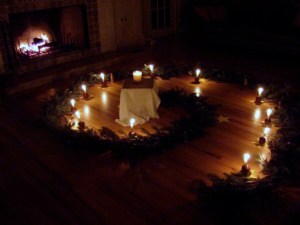
Advent Spiral 2008

Advent Spiral 2008

Advent Spiral

– this is a peaceful, meditative time for young children.  We hold an Advent Spiral every year within our local Waldorf homeschooling group, and this is how we have done it.  The Advent Spiral is typically held inside where a large evergreen spiral is laid out on the floor.  The spiral is adorned with    The room is dark except for candlelight – the candle at the middle of the spiral. The children come in and receive a candle inside a hollowed-out apple.  One by one each child walks the evergreen spiral , which is typically adorned with representations of the mineral, plant, animal and human kingdoms) to the center where they light their candle from a central candle. On their way out of the spiral, there are gold stars on the floor and the child chooses a star and places their candle on it.  All the children walk the spiral one by one until the spiral is lit up with all of the candles.  The children look at it for a moment and then file silently outside to go home.

Saint Nicholas Day – This day is celebrated on December 6th.  Children leave out their wooden clogs, shoes, a boot or even a sack on the Eve  of Saint Nicholas.  Saint Nicholas comes to earth on his snowy white steed, and leaves behind apples, tangerines, clementines, walnuts, hazelnuts and sometimes a little toy or book.   In many stories, Saint Nicholas is the forerunner that reminds children the Child of Light is coming.  Saint Nicholas, the patron saint of children, is loved in many countries, including Russia, where there are many churches dedicated to Saint Nicholas.   It is a major day for my friends in the Netherlands.  Saint Nicholas music, crafts, cookie cutters and recipes and more can be found at the wonderful website www.stnicholascenter.org.  There are also some wonderful handouts regarding the relationship between St. Nicholas and Santa Claus. 

A good source of St. Nicholas stores can be found in the Winter Wynstones book and also the little book I cited “An Overview of the Waldorf Kindergarten.”  One of the most famous stories of St. Nicholas is about his rescue of the three maidens who had no dowry to marry.

Tonight, (December 5th) my littlest child was looking wistfully out the window into the darkness tonight, softly singing under her breath a Saint Nicholas song.  That sweet knowledge of everything’s right with the world and the wonderful anticipation of good things to come.  My children left out hay and carrots for Saint Nicholas and his horse (oh, and a cookie as well :)) and polished up their wooden clogs.  Tomorrow they will wake up to one piece of candy each, a clementine each, a book each and small game to share together.  We have Saint Nicholas napkins for breakfast and Saint Nicholas cookie cutters to try our hand at decorating.  However, the best thing to do in the spirit of Saint Nicholas would be to do something wonderful for someone else, and not have them catch you whilst doing it! 

Santa Lucia Day– is another day some Waldorf school and homeschools celebrate.  This holiday is typically celebrate throughout the Scandinavian countries, especially Sweden.  You can google her and read quite a bit about her, but she is honored in Scandinavia as the bringer of boats filled with food when the people of Sweden were in a time of great famine.  The oldest girl in the family rises early in order to make sweet yellow buns for the family breakfast.  While serving, the oldest girl wears a white dress with a red sash and on her head a wreath of greens with four small candles lit – (yes, in this day and age you could use electric candles!)

Solstice – Unlike the very meditative inward experience of the Advent Spiral, the Solstice is parties and fun!  Round, yellow foods prevail with hopefully lots of friends and music!  Some families have a big bonfire, a Solstice tree, and some families “count up” to Solstice by starting with a set of 21 candles and lighting one each night until all 21 are lit on Solstice!

Look for a separate post regarding the 12 Days of Christmas and Epiphany soon.  Hope you have a wonderful holiday season celebrating with your close family and friends.

Peace, love, and joy.

Just a few thoughts from my little corner of the world.