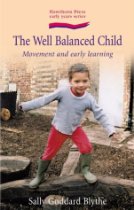
“The Well Balanced Child” – Chapter Three: “Brain and Body–Developing The Mind”

Yay, we are up to Chapter Three!  I hope you all are enjoying this book as much as I am.

This chapter points out that the brain of a new-born baby incredibly contains nearly all the brain cells it will need throughout the rest of life even though the newborn baby’s brain is only about a third of the size of the adult brain.  The main period of brain growth occurs in the first year of life, although between age 15 months and age 6 the cerebral cortex appears to double in size.  (The cerebral cortex play a role in memory, attention, language and other areas; you can see more about it here on Wiki:  http://en.wikipedia.org/wiki/Cerebral_cortex).   Continue reading

“The Well-Balanced Child”–Chapter Two: Balance


I am determined to make a great deal of headway in this book for you all during the next several weeks.  You can find the back posts regarding the foreword, introduction and Chapter One here: https://theparentingpassageway.com/2011/08/14/the-well-balanced-childintroduction-and-chapter-one/  and here:  https://theparentingpassageway.com/2011/07/28/the-foreword-of-the-well-balanced-child-movement-and-early-learning/


This chapter starts with two  case report of a little twelve year old girl who did everything “late” in life and a woman in her mid-forties who suffered from agoraphobia.  The common connection between the two cases was one of balance. 


From page 11:  “It was the late Paul Schilder’s belief, that many of the symptoms of neurosis and psychosis could be traced back to a fault in the functioning of the balance mechanism.  Why is balance so important that dysfunction can result in such a wide variety of symptoms, many of them masquerading as cognitive or emotional disorders?”


I have done some extra work in the area of vestibular rehabilitation, and I have seen the above quote to be true, particularly in my work with children.  Children who do not move well, who are unsure of their own bodies, are understandably more unsure of themselves in social situations, and often seem to hold more anxiety than children who are not suffering from movement issues.  Just an observation, no blind study research here.  Smile  Children with vestibular disorders are not nearly as clearly recognized as adults.  Some pediatric specialists believe the vestibular system being “off” has much to do with ADHD, and I remember in one pediatric vestibular course I took the presenter stated she felt children with symptoms of developmental delay, low vision, hearing loss, motor developmental delay, tinnitus, motion sickness or sensitivity, abnormal movements, clumsiness, decreased hand/foot/eye coordination, ataxia or falls, nystagmus of the eye,  problems planning or executing movement, loss of consciousness, seizures or vertigo/dizziness should all be evaluated for vestibular system function.  Children who seek movement or fear movement should also be evaluated.  Those children who have had chronic ear infections or a history of infant torticollis should also be seen.  


At any rate, this chapter goes on to discuss balance as the system to “facilitate orientation and postural behavior – the ability of the body to function within the force of gravity, or “to know your place in space.”  The knowledge of place in space provides the primary reference point from which  all other spatial judgments and adaptations  become possible.”  The vestibular system is different than other systems in the body though, because we often are aware of balance only through the other systems.  This chapter gives several examples of that:  rides at the fair that leave butterflies in the stomach, sea-sickness, vertigo when standing on the edge of a high cliff.


The next part of the chapter traces the origins of the balance system – the plaques that eventually become the inner ear start developing at 21 days gestation.   From my notes, at eight weeks the embryonic inner ear resembles the adult inner ear.  I don’t know as this chapter was really clear for layman in terms of the parts of the ear, so I wanted to add a few things here.  There is an outer ear, the part you see, a middle ear that is air-filled that a physician can look at with an otoscope in the doctor’s office, and there is an inner ear that is fluid-filled located in the temporal bone, which is part of your skull.    There are two vestibular organs called the saccule and the utricule, you can see a picture here: http://en.wikipedia.org/wiki/Utricle_(ear) , which are covered with hair cells and contain otoliths, which are calcium carbonate coverings that detect linear acceleration and respond to gravity.  There are also three semicircular canals, just as the chapter here describes, which detect angular motion.  You can see a further description of this on page 14.


This chapter points out that balance is not something we “have”, it is something we do!   Balance and vision work together, balance requires muscle tone development and the development of postural control; hearing and touch also work with balance.  This is a lovely quote:  “The vestibular system may be the expert in movement, but it receives its training through movement.”


On page 17, the author notes, “Secure balance is inseparable from the development of postural control, which in turn is supported by information from the visual, proprioceptive, and motor systems.  Training of these systems is a gradual process during which maturation of the vestibular pathways involved will take until at least 7 years of age, and continue through puberty and beyond.  Immature vestibular functioning is frequently found amongst children who have specific learning difficulties such as Dyslexia and Dyspraxia, problems of attention, language impairment, emotional problems, and adults who suffer from anxiety, Agoraphobia and Panic Disorder.”  And, on page 18, “Children who continue to reverse letters, numbers, and words after the age of 8 years are also found to have immature balance.” 


The last few pages of the book are devoted to a list of how to train balance: up and down movements like jumping and jumping on a trampoline or going down a slide; to and fro – running, stopping, starting, swinging; centrifrugal force such as carousels; turning movements of the body such as spinning, dancing, rolling, somersaults and depth such as riding on a scooter board. 


The chapter ends with a list of signs and symptoms that may indicate problems with the vestibular system and mentions developmental delay, poor muscle tone, frequent falls, fear of movement, clumsiness, no fear of heights or excessive hear of heights, excessive spinning or rocking, poor sense of body in space in relations to others, cannot figure out how to push or pull or imitate movement, motion sickness over eight years of age, difficulty learning to ride a bike, etc.


A chapter with a lot of food for thought.  Look for Chapter Three in the next post!

“The Well-Balanced Child”–Introduction and Chapter One


We are up to the Introduction and Chapter One of our new book study. Is everyone reading along?  This is interesting stuff!


The author writes that when her children were growing up, she was searching for information on not just child development and the practical advice for parenting that stemmed from child development, but HOW nature and nurture work together to produce skills that are unique to each human being. Continue reading

Three Books of Import–Christian Book Reviews


I am back doing less work and projects right now, and more reading.  I recently finished “Making God Real in the Orthodox Christian Home” by Fr. Anthony Coniaris, which was lent to me by a dear local friend.    Thank you, dear friend.


There is something so peaceful and soothing about this book.  When I get bogged down in “what is this all about – parenting, homeschooling, juggling all these balls in the air” – this book reminds me:  “the primary lesson for children is to know the eternal God, the One Who gives everlasting life” (St. Clement).  A balm for the mothering soul, and such a great simplifying thought. Continue reading

The Foreword of “The Well Balanced Child: Movement and Early Learning”

Our new book study is here!  We will be going through Sally Goddard Blythe’s “The Well Balanced Child: Movement and Early Learning”

The foreword to the book begins by stating this book is written by a therapist (Goddard Blythe is a physiological psychologist), and is an exploration of the “age-old truth “Sound body, sound mind”, and explains why early movement is vital for developing sound balance as well as the interrelated and dependent foundations for normal or sound language, learning, cognition, and affect.”

Harold Levinson, the MD who wrote this foreword, states that his research in 1973 was the first to understand “that the many and diverse symptoms characterizing dyslexia and related learning, sensory-motor, attention deficit, and anxiety or phobic disorders were caused by medically diagnosable and treatable  signal –scrambling dysfunction within the inner ear and its “super-computer”, the cerebellum…” and states that this book will be helpful to parents and professionals interested in children.

The guest introduction by Ewout Van-Manen talks about how difficult parenting is these days due to a lack of community, the lack of practical task for children to participate in, and how mothers today are divided between working and motherhood..and not to mention those conflicting books, articles and media reports of “how-to” parent.

How do we sort through, and make sense of, this information in order to be in a position to make informed decisions as to what is best for our children?  Clearly, the best way to begin is to look at these issues is by looking at general child development.  It is only by understanding child development and by observing the children in our care that we can begin to be in a position to make appropriate, informed judgements and decisions”  .


On page xv:  “A society that does not promote the sensory development of its younger generation is at the same time diminishing its overall intellectual capacity.”

On to the author’s introduction to the book and Chapter One in our next book post!  Is everyone excited?

Many blessings,
Carrie

Parenting Just For Today

One of my dear local friends  just sent me the most beautiful prayer from the book “Making God Real In The Orthodox Home” by Fr. Anthony Coniaris  (here is the Amazon link:  http://www.amazon.com/gp/product/0937032077/ref=ox_sc_act_title_1?ie=UTF8&m=A6MHEJ10672MS) .  Here is the beautiful prayer she shared with me:

Continue reading

Sunday Inspiration From “Beginning to Pray”


“Beginning to Pray” by His Eminence Metropolitan Anthony Bloom is a classic that I think really  should be read by anyone on a journey to draw closer to Our Creator.  Here is a link to read a brief description about the really interesting life of Metropolitan Anthony:  http://orthodoxwiki.org/Anthony_%28Bloom%29_of_Sourozh


Here is an inspiring quote from this book:


“What we must do is to collect all knowledge of God which we possess in order to come into His presence, but then remember that all we know about God is our past, as it were, behind our back, and  we are standing face to face with God in all His complexity, all His simplicity, so close and yet so unknown.  Only if we can stand completely open before the unknown, can the unknown reveal itself, Himself, as He chooses to reveal Himself to us as we are today.  So, with this open-heartedness and open-mindedness, we must stand before God without trying to give Him a shape or imprison Him in concepts and images, and we must knock at the door.

Where?  The Gospel tells us that the kingdom of God is within us first of all.  If we cannot find the kingdom of God within us, if we cannot meet God within, in the very depth of ourselves, our chances of meeting Him outside ourselves is very remote.”


Metropolitan Anthony has many wonderful things to say about prayer, living up to prayer, taking up one’s crosses, going inward and how to do this, and so much more.  Here is the link to this book on Amazon: http://www.amazon.com/Beginning-Pray-Anthony-Bloom/dp/0809115093/ref=sr_1_1?ie=UTF8&qid=1310776866&sr=8-1


A lovely beginning to a day of rest —

Many blessings,

Carrie

The Christopherus Early Years Book

is out!  Here is the link to the blog post announcing its arrival, and there is a link at the bottom of the post to order the book. The book is available only in eBook version, and costs twenty dollars.  It is over 430 pages long, and  has responses from so many wise mothers regarding  many of the most commonly asked questions and dilemmas of parenting in the early years.

http://christopherushomeschool.typepad.com/blog/2011/07/creating-our-new-early-years-book.html

Many blessings to you all,

Carrie

A Special New Series And Our New Book To Read

So far, the books we have read chapter-by-chapter on this blog have included “Tapestries” by Betty Staley, “Discipline Without Distress” by Judy Arnall, “Love and Anger: The Parental Dilemma” by Nancy Samalin with Catherine Whitney.  You can find the posts regarding each chapter under the “Book Studies” tab along the top.

I am pleased to announce our next book will be “The Well Balanced Child: Movement and Early Learning”, by Sally Goddard Blythe.  This is such an important topic, and one that is near and dear to my heart given my background as a neonatal/pediatric physical therapist.

As far as a new special series…

I have a dear friend who was talking to me about a situation where I didn’t really want to weigh- in my opinion on a matter.  I was keeping so silent, and finally my friend said, “Carrie, you know, we like road maps!  Give us a road map!  We can modify the map, but at least it is a starting point.”  Her words startled me out of my reticence to comment to the group we were addressing, and it also led to a thought for this blog.

How would you like a starting point toward creating the family and homeschooling life you have always wanted?  How would you like a place to exchange ideas to help each other and where you could take what resonated with you for your family and your situation?

I guess the closest I ever got to this idea of a road map in the past was “Twenty Days Toward Becoming A More Mindful Mother” – were any of my current readers around then and followed that series?

I have been speaking with many mothers locally regarding what challenges they are facing in their families and how they are trying to build a scaffolding to support homeschooling, so I thought perhaps this summer would be an excellent time to pave the way toward a happy, healthy family for fall.

I am planning to post one to two concrete,  small, “do-able” things to make your real family life more in line with the family life you envision during this time.

I hope you will  enjoy this and plan to join me!

Many blessings,

Carrie

The Last Chapter In “Love And Anger: The Parental Dilemma”

“The Loving Breakthrough” is the last chapter in this book.  I love this opening quote:  “Parenting is serious business, but often we take it too seriously.  We can get so wrapped up in the weight of our responsibilities that we leave no room for the fun, the playfulness, the joy of being with our children.  We may lose the ability to delight in their qualities of wonder, spontaneity, and silliness.”

Finding The Good – this section talks about how parents are the ones who must set limits, the ones who have to say no, to cut short parties, to set curfew, and then we are sad when we are not appreciated.  Our children go through phases where there is tension as a child pushes against the limits we set and we fail to see the wonderful things in our children, all the things they really are doing right.  The authors suggest we make a list of the qualities we appreciate in our children, that we look for the things our children do really well, and make a continued, renewed effort to see all that is good.

Give Yourself A Break – this section talks about also finding the things we do well as parents, that many times the only thing parents think about is where they fail and where they don’t measure up.  Finding our own strengths, our own positive qualities is important, just as important as when we do that for our children.

Lightening Up – Using laughter, humor and kindness in the moment when your child least expects it can be such a powerful tool for connection and discipline.  Being able to slow down and appreciate the unhurried pace of a child also helps immensely.  Do you have time for fun with your children?  They are only small once.

Time For Love –   Do you have the time to love your child?  Delight in your child is important, and it is even more important in those moments when things are starting to heat up.  Pull back, look at your small child, and find the love and delight there.

Many blessings, thank you for taking a trip through this book with me!  Stay tuned for the announcement of our next book and a very special series of posts to come.

Carrie