The Value of Being A Stay At Home Mother

I started a few thoughts on this subject at Donna Simmons’ paid subscription discussion forum,  the Waldorf At Home forum.  Donna posed the question of what the true, real or hidden value of being a mother is and it really got me thinking. (To join in on the discussion please see  http://www.waldorf-at-home.com/forums/ ).

To me,  the utmost value that a stay at home mother can provide is first of all the ability to create peace within herself, her spouse and her children and then to bring that peace into all the areas in which the mother and family  impacts society.  Stay at home mothers provide a bulk of the volunteer force for schools, religious organizations, and other service organizations, so hopefully we become a model for peace within our own homes and within our own communities.  So many people live their lives and in their homes without ever thinking about the soul of that home – how does your home feel when you are in it?  How does your family feel? Is it a warm, relaxed, pleasant place where the respect and the dignity of all are honored or is it a place of strife, tension, and yelling?

Mothers ask me all the time how they can attain this invisible positive aura within their homes, and I always say the same thing:  It starts within you.  You cannot change your children or your spouse.  All you can do is be consistent and go inward and start with yourself.  (Assuming your spouse is not  physically or verbally abusive; in these cases I cannot presume to say that only modeling will help!)……..However, if your spouse  is unsure of how to  become a de-escalator of situations and attain peace, it may take time to see changes, but the home will become a more peaceful place as you model and create this magic within your own space.  The other two things I can highly suggest is to work on everyone in the family finding a sense of humor about things and I can advocate you contact the local NonViolent Communication Group in your area – see www.cnvc.org for further details regarding better communication skills between you and your partner.

I think the second thing that we show society, hopefully, is how to live in harmony with daily, weekly and yearly rhythms; how to really have a rhythmical manner within the flow of time.  The art of daily work, of being able to be productive with our hands, for really having and showing gratitude, for being able to live simply, for being able to slow down to really prepare for holidays and festivals in a meaningful way is becoming a lost art in our society.  Hopefully we can be a model for demonstrating ways to celebrate the beauty and reverence in daily life, in ordinary tasks,  besides the more celebratory occasions.

The third important thing I think we do is to show mothers that childhood can have a slower pace than what our society is currently making it and pushing it to be and that this is of benefit to the child and to society.  Many mothers I speak to today lament the early push on academics, they lament the lack of outside time their children are participating in due to their children getting home from school and having to do homework, they lament the lack of imaginative play within their children, but yet they shrug their shoulders and continue on.  “What are you going to do?” they say, as if this progress toward the rapidity of childhood and the speeding up of childhood is something that is normal and cannot be avoided.  Perhaps we can be the light that shows others how a slower childhood has benefits for the health of our children for the long run.

To all my stay at home mothers out there, I applaud the light you are shining into the darkness of the world in this season and in this time.  Blessings to you all for  your work.

Just a few thoughts from my little corner of the world.

A Great Blog to Read


(Sorry everyone; as of 1/2011 this link may not be working — If you know of an Islamic Waldorf Homeschooling blog, please leave in the comments below!  Thank you).

My cyberfriend Shireen Pashdadi has a wonderful series of articles on an Islamic blog.  If you ever wondered about Waldorf from an Islamic perspective, please do check out my friend Shireen’s lucid, thought-provoking writing when you have a chance to sit down with a cup of tea.  The whole blog is entitled, “See! Hear!  Speak!” and you can can get to Shireen’s articles through this link:  http://www.seehearspeak.com/?cat=10

Just a few thoughts from my little corner of the world.

What Do You Deserve?

This came across a list I am on this morning and it is such a valuable perspective to offer that I wanted to share it with everyone.  This work has been credited to Louise L. Hayes.

Deservability Treatment

I am deserving.  I deserve all good.  Not some, not a little, but all good.

I now move past all negative, restricting thoughts.

I release and let go of the limitations of my family, friends, and co-workers.

I love them, and I go beyond them. I am not their negative opinions, nor their limiting beliefs.

I am not bound by any of the fears or prejudices of the current society I live in.

I no longer identify with limitation of any kind.

In my mind, I have total Freedom.  I now move into a new space of consciousness,

where I am willing to see myself differently.

I am willing to create new thoughts about myself and about my life.

My new thinking becomes new experiences.

I now know and affirm that I am at one with the prospering power of the universe. 

As such, I now prosper in a number of was.  The totality of possibilities lies before me.

I deserve a good life. I deserve love, an abundance of love.

I deserve good health.  I deserve to live comfortably and prosper.

I deserve joy and happiness. I deserve freedom to be all that I can be.

I deserve more than that. I deserve all good.

I accept this abundant life with joy, pleasures and gratitude.  For I am deserving.

I accept it; I know it to be true.


Hope this provides you some encouragement in this season of the year and in this season of your life.

Just a few thoughts from my little corner of the world.

A Letter to All Those Dads Undecided About Homeschooling

This letter was written by my wonderful husband for all the dads who are feeling rather undecided about the whole homeschooling thing.  Maybe it will help provide some thoughts for your family.

Dear Undecided Dad,

Carrie asked me to talk about this since I had many of the same concerns you have about when talking to colleagues about homeschooling.   Having worked as a Director of IT and now working as a Senior Consultant at ABC Company (a large, global company),  I understand the hidden pressure when talking with colleagues and clients and the subject of kids and school.  At first, I was very hesitant about the conversation, but as time went on, I found that people were very interested in the subject.  I never felt judged.  Usually, the conversation went like this

Friend: My kids are at XYZ academy, how about you?

Me: Actually, my wife and I homeschool our two girls.

Friend: Really? How does that work?

Me:  It actually works very well.  My wife deserves all the credit, though.  She has spent hours researching and preparing curriculum and teaching class.   One of the things we realized was that in a “typical” school, the teachers are spending time with those who are at the bottom of the class educationally and expect the others to just follow along with workbooks.   We found that by homeschooling, we can tailor the environment and get great results.  Heck, my daughter  is  reading well along with working on both German and Spanish languages and has lots of time to play outside.  Her childhood is still there while she is learning a lot!

Friend:  What about the social aspect?  Don’t you worry about your kids socially (or some variation on “is your child going to be socially stunted by homeschooling”)

Me: Interestingly enough, my wife gets out with the kids quite a bit.  Because with homeschooling, you have a lot of flexibility, my wife meets with other homeschooling mothers.  Of course, it helps that Carrie also assists a homeschooling support group in our area, but there are quite a lot of interactions.

Basically, people begin to understand that we’re not “weird” and with the noticeable wins by homeschooled kids in things like the National Spelling bees, it’s becoming more common.  I always stress how much work my wife does, and how well she does it.  I also stress that my wife and I felt that having a parent at home with the kids is important for both of us.   That can give some people a “hidden guilt” because they’ve given that up and both parents work.  We, who have chosen to have a parent stay home,  have smaller houses, older cars etc, but in the end, hopefully we have kids who enjoy learning and who are strongly connected to their siblings and to the family.. ..That’s the legacy I want!

I think, Undecided Dad, you would be surprised how many people homeschool that you don’t know about, and how interested people are when you do.

Sincerely,

Carrie’s Husband

Carrie Here:  Thanks to my husband for putting this together for the Undecided Dad! 

Just a few thoughts from our little corner of the world.

Resources for “After Schooling” Waldorf First Grade

Julie recently wrote in a comment on one of my First Grade posts regarding her first grader who is in public school.  Her oldest had been in a Waldorf school, and the public school experience was going fairly well for her first grader, but as a parent she was missing some of the beauty and depth that Waldorf brings to the educational process.  She wondered what resources were available without buying an entire curriculum to bring some of the Waldorf magic into her home. This is a great question, Julie, and I am happy to be able to give some suggestions to you and everyone else out there wondering the same thing!

First of all, I think a place to start would actually be your physical space.  To me, if my child was in public school, I would want to make a big effort to have a very special Nature Table to celebrate the seasonal changes.  A little book that may give you some wonderful ideas is “The Nature Corner” by M v Leeuwen and J Moeskops.  The other thing I would consider is to have open-ended toys available for play.  Since a school environment is fairy directed, it will be important for your child to have time to just play.  Play is the work of every young child.  A good source of ideas and how-to’s for making some open ended toys is the classic, “Toymaking with Children”, by Freya Jaffke.

Secondly, I think festival preparation would be very important for your child’s soul life, so just figuring out what festivals you would want to celebrate, gathering ideas, and then sitting down with a calendar and counting two weeks or so before the festival and writing down what you would like to do each day to prepare to celebrate is something wonderful.  A good festival book such as “All Year Round”  or “Festivals, Families and Food”.    The Wynstones series of Autumn, Winter, Spring and Summer have great verses, poems and songs to learn.  They are available through www.wynstonespress.com or other Waldorf booksellers.  The book “Earthways” by Carol Petrash could also give you some excellent ideas for seasonal craft ideas that may fit into any festival celebration.

The heart and soul of Waldorf first grade is fairy tales, so a good book with all of the wonderful Grimm’s fairy tales may make for wonderful storytelling time.   I personally enjoy the Pantheon edition of Grimm’s fairy tales as my own resource for teaching.   You could also look for fairy tales from other cultures around the world at your local library.  Please see my blog post entitled,  Great Fairy Tales for Waldorf First Grade,  for suggestions of what fairy tales may be appropriate for a first grader.  Making up your own little stories and nature tales is also so important.

Some other typical Waldorf first grade experiences would be wet on wet watercolor painting, modeling, knitting and playing the recorder, pentatonic flute or pennywhistle.  Please be on the lookout for future posts of these subjects.   They are very important tasks for soul development and also for future academic success.

Last but not least, however, I would imagine with being in a school setting all day long, your child may just need time to be when she comes home so planning lots of free play in natural areas may be a very important thing to provide for her.  Please do see the posts entitled “Fostering Creative Play”, “More About Fostering Creative Play” and “Connecting Your Children to Nature” available on this blog.

Please do look for some future posts on wet on wet watercolor painting, modeling, knitting and music in the home.  These are the wonderful things that make the world go round.

If you have questions or topics you would like me to address, please do leave a comment in the comment section.  I am open to helping and encouraging you in any area you have doubts about!

Just a few thoughts from my little corner of the world.

One of the 12 Senses: Warmth

This is an excellent article regarding one of Steiner’s 12 senses that is important developmentally for young children: warmth.

Please check out this link to read a great article on Warmth, Strength and Freedom:  http://tidewaterschool.blogspot.com/2008/12/warmth-strength-and-freedom-by-m.html

Happy, happy reading!!

Just a few thoughts from my little corner of the world.

Advent and Other Winter Celebrations Within The Waldorf Home

I had a friend over today who requested I write a post regarding the celebration of Advent and other Winter festivals within the Waldorf Home.  She told me, very astutely, that this time of year was difficult for not just  herself but for so many people she knew who did not have a true religious leaning – it was hard to know what to celebrate and why, and not only that,  the consumerism and materialism of this time of the year really dampened her enthusiasm and excitement.  She summed it up by saying like, “What can I show my children about this time of the year when I don’t even have it all figured out?”

This is a hard time of year for the very reasons my friend stated.  I have a number of friends who encompass different faiths, spiritual leanings, denominations – atheism, agnosticism, Catholicism, Judaism, Islamic, Mormon, Presbyterianism, Reformed, Lutheran, Paganism, or just friends with leanings toward one place or another but no true “spiritual home” yet.  And this December, we all come together to celebrate different things; whether it be Saint Nicholas Day, Bodhi Day (when Buddhists celebrate the Enlightenment of Buddha), Eid al Adha (Islamic Feast of Sacrifice, the most important holiday of the Muslim calendar from my understanding), Santa Lucia Day, Las Posadas in Mexico, Winter Solstice, Hanukkah, Christmas, Kwanzaa. But yet we are all in the darkness of Winter searching for Light.

It is my fervent hope this holiday season that no matter what our spiritual leanings are, that we are all working toward and being the most loving, compassionate people we can be.  Our children need that, and our country need that. 

I hope this holiday season and throughout the year we can all treat each other with respect and dignity.  We are one in humanity.  I had a beautiful family I worked with recently from Bangladesh and the father looked at me at one point and told me in broken English how he and his wife had just bought a house and how he did not especially want to hang around with the Bengali community in our town.

“My neighbor, he American and say he help me with whatever I need, “ he shrugged.   “I cut my finger, I bleed, you cut your finger, you bleed.”  He and I solemnly looked at one another over the head of  his little baby and nodded at each other.  One humanity, one world.  That is what we should be about this time of year and all times of the year.

We are not the only ones with difficulties this season. Consider the plight of the Waldorf school teacher.  In the book , “An Overview of the Waldorf Kindergarten,” edited by Joan Almon, she writes, “December brings special challenges to the Waldorf Kindergarten teacher, for Christmas is a vital part of our culture and a festival that brings joy to children.  However, there is sometimes a tendency to be so overt in one’s celebration of Christmas that the kindergarten comes to feel more like a Christian Sunday School than like a Waldorf school.  This brings great pain to our non-Christian families, but it is problematic even for the children of Christian background. Within the Waldorf Kindergarten the festivals are  not meant to be “taught” but are offered in a light manner, much like telling a fairy tale, which allows the children great freedom to come to the festival as they will.  When offered in a spirit of gratitude and with a sense of wonder and awe, something of the essence of the festival can speak to the children.”

In this same book, an article by Freya Jaffke, says this of the festivals, “DOING-DOING-DOING.  Never reasoning why something is done in a certain way, although sometimes children have their own philosophy about certain things.  Our task as kindergarten teachers is to try to transform everything we do, to transform our knowledge into activities: to make visible that about which we have been thinking.”

The joy of a Waldorf homeschooling experience, I think is that you can choose the festivals that resonate within you and your family in this season and little by little, year after year, bring them to light.  Just as you would not bring a fairy tale to your child that does not resonate with you, you would not try to bring a festival to your child that does not resonate with you.  So choose your festival carefully, and also the traditions that you start with these festivals as the children will expect the same things year after year.

So, let’s go through some of the Winter Festivals that are common to Waldorf Tradition and some of the typical ways they are celebrated. If the Winter festival you most enjoy or celebrate as part of your religious faith is not on this list, please do not be offended.  It just means I could not find information regarding this festival/holiday in the Waldorf books and resources I had on hand.  And I do hope people will post their holiday traditions in the comment section!  Let’s share the beauty of our traditions!

Advent – Advent means that which is coming, so this is the time of preparation for Christmas.  This year Advent began on November 30.  Advent can be celebrated with an Advent calendar, needle felted figures of Mary and Joseph that start somewhere in the room and make their way closer and closer to the stable for Christmas Eve, an Advent wreath, an expectant Nature Table covered with a simple cloth.  Some Christian families make a Jesse Tree.

It is popular in Waldorf to mark  stones, plants, animals and human beings each week within the Advent wreath or on the Nature Table each week.  So for example, the first week of Advent would include adding stones, crystals, shells to the Advent Wreath or Nature Table.  The second week one would add representations of the plants – mosses, ferns.  And so forth.  Examples of what a nature table for Advent would look like can be found in the book, “The Nature Table.”  There is a wonderful book that has seven stories in it for each week leading up to Christmas and the first week all the stories involves stones in some way, the second week the stories involve plants in some way, etc.  This book is called, “The Light in the Lantern.”

My German friends have told me in Germany, Advent is a time of peacefulness, a time of cookie making and craft making.  Paper window stars, making ornaments, paper snowflakes and straw stars are  typical crafts for the season.  Contrast to the hustle and bustle and materialism you see here, and think about how you can bring peace to your home during this time.
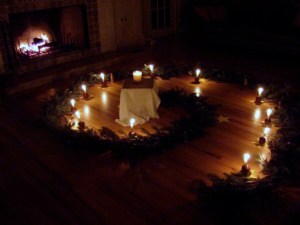
Advent Spiral 2008

Advent Spiral 2008

Advent Spiral

– this is a peaceful, meditative time for young children.  We hold an Advent Spiral every year within our local Waldorf homeschooling group, and this is how we have done it.  The Advent Spiral is typically held inside where a large evergreen spiral is laid out on the floor.  The spiral is adorned with    The room is dark except for candlelight – the candle at the middle of the spiral. The children come in and receive a candle inside a hollowed-out apple.  One by one each child walks the evergreen spiral , which is typically adorned with representations of the mineral, plant, animal and human kingdoms) to the center where they light their candle from a central candle. On their way out of the spiral, there are gold stars on the floor and the child chooses a star and places their candle on it.  All the children walk the spiral one by one until the spiral is lit up with all of the candles.  The children look at it for a moment and then file silently outside to go home.

Saint Nicholas Day – This day is celebrated on December 6th.  Children leave out their wooden clogs, shoes, a boot or even a sack on the Eve  of Saint Nicholas.  Saint Nicholas comes to earth on his snowy white steed, and leaves behind apples, tangerines, clementines, walnuts, hazelnuts and sometimes a little toy or book.   In many stories, Saint Nicholas is the forerunner that reminds children the Child of Light is coming.  Saint Nicholas, the patron saint of children, is loved in many countries, including Russia, where there are many churches dedicated to Saint Nicholas.   It is a major day for my friends in the Netherlands.  Saint Nicholas music, crafts, cookie cutters and recipes and more can be found at the wonderful website www.stnicholascenter.org.  There are also some wonderful handouts regarding the relationship between St. Nicholas and Santa Claus. 

A good source of St. Nicholas stores can be found in the Winter Wynstones book and also the little book I cited “An Overview of the Waldorf Kindergarten.”  One of the most famous stories of St. Nicholas is about his rescue of the three maidens who had no dowry to marry.

Tonight, (December 5th) my littlest child was looking wistfully out the window into the darkness tonight, softly singing under her breath a Saint Nicholas song.  That sweet knowledge of everything’s right with the world and the wonderful anticipation of good things to come.  My children left out hay and carrots for Saint Nicholas and his horse (oh, and a cookie as well :)) and polished up their wooden clogs.  Tomorrow they will wake up to one piece of candy each, a clementine each, a book each and small game to share together.  We have Saint Nicholas napkins for breakfast and Saint Nicholas cookie cutters to try our hand at decorating.  However, the best thing to do in the spirit of Saint Nicholas would be to do something wonderful for someone else, and not have them catch you whilst doing it! 

Santa Lucia Day– is another day some Waldorf school and homeschools celebrate.  This holiday is typically celebrate throughout the Scandinavian countries, especially Sweden.  You can google her and read quite a bit about her, but she is honored in Scandinavia as the bringer of boats filled with food when the people of Sweden were in a time of great famine.  The oldest girl in the family rises early in order to make sweet yellow buns for the family breakfast.  While serving, the oldest girl wears a white dress with a red sash and on her head a wreath of greens with four small candles lit – (yes, in this day and age you could use electric candles!)

Solstice – Unlike the very meditative inward experience of the Advent Spiral, the Solstice is parties and fun!  Round, yellow foods prevail with hopefully lots of friends and music!  Some families have a big bonfire, a Solstice tree, and some families “count up” to Solstice by starting with a set of 21 candles and lighting one each night until all 21 are lit on Solstice!

Look for a separate post regarding the 12 Days of Christmas and Epiphany soon.  Hope you have a wonderful holiday season celebrating with your close family and friends.

Peace, love, and joy.

Just a few thoughts from my little corner of the world.

Top 10 Essentials of the Waldorf Kindergarten at Home

Whew, almost every day people ask me where to start with Waldorf homeschooling with their young children under the age of 7.  My recommendation is to take a deep breath, get yourself a cup of tea with honey and come and sit back down at this screen.

Okay, have that cup of tea?  Are you ready?

Let’s start with a quote by Rudolf Steiner himself, to get us in the mood.  This is from page103 of the lectures compiled into the book, “Soul Economy” :  “Anyone in charge of young children – especially those who work in children’s homes- who is aware of the activity of destiny, must ask, Have I been specifically chosen for the important task of guiding and educating these children?  And other questions follow:  What must I do to eliminate as far as possible my personal self, so I can leave those in my care unburdened by my subjective nature? How do I act so I do not interfere with a child’s destiny? And, above all, How can I best educate a child toward human freedom?”

This quote gives one a clue as to the framework and tools Steiner sees as appropriate with young children.  It is not that it is only destiny, but that as a caregiver or parent one must act in the right way with the right thoughts as we are the utmost model for our children to imitate.   It is a great quote to ponder and meditate on what this means to you and your work with small children. 

[This is from the comment section below, maybe it will help explain this quote a bit:  Steiner’s point was not just  “hands off” for the early years; he had a strong notion that we are parents and teachers ARE the leaders within home and school.  However, he also felt strongly that teachers and parents do the WRONG thing doing these early years by intellectualizing the child, by providing the child with toys that do not require imagination…I think the quote above was more the call to get out of our own way, to disregard what we think we know about childhood development from a traditional perspective and to look at the child from a spiritual perspective and what we can do in these early years to lay the best foundation for adulthood].

Here is my Top 10 List of the Essentials of Waldorf Kindergarten at home:

1. Understand what Waldorf kindergarten is – -> NO ACADEMICS.  Yup, that is right, and there is a reason for this.  If you are new to anthroposophic thought, a brief and probably unsatisfying summary would be to say that Steiner based Waldorf education upon his thoughts of the knowledge of the human being.  The years from birth to seven are for forming the physical organism of the child, the memory is not seen as freed for academic work until the seventh year.  The young child should be surrounded by joy and happiness, toys that encourage the imagination,  but only the physical body is ready for influence by the outside world.  Hence, no academics because the child is not yet ready.

2.  So if there are NO ACADEMICS, what should I be doing?  Preparing yourself in two areas is  the first thing.

Inner work:  Inner work is the hallmark of Waldorf education.  How you do it is up to you.  Many people use Steiner’s exercises.  Other people use prayer, meditation, yoga, tai chi, walking meditation.  Identify your strengths and your challenges for this homeschooling journey.  Meditate on the quote from Steiner above and how to put that forth in your care of your small children.

Preparation of skills you will need to be able to show your child:  oral storytelling, choosing fairy tales, knowing your local fauna and flora, singing, playing a blowing instrument (pennywhistle, pentatonic flute or recorder), washing and carding wool, spinning wool, dyeing wool and silks, toymaking, gardening, woodworking, knitting, other forms of handwork, drawing with block crayons, wet on wet watercolor painting, modeling, seasonal arts and crafts.  Pick something and practice at night after your children go to bed.

3.  The second thing to do is to prepare your ENVIRONMENT.

Screens:  How much time are you spending in front of a screen?  TV, computer, other?  How much time is your child spending in front of a screen?  Please see my blog post entitled, “Children and Media.”

Clutter:   Is your house organized so you can find things?  Do you have 10 of everything?  Do you have too much furniture for your house? 

Simplicity:  What can you get rid of and be free of?  What toys do your children actually play with and how many books and toys do you have out at one time?

4. The third thing to do is to start to establish a rhythm.

Awake times/naptimes/bedtimes:  A wonderful place to start your rhythm is around awake times, naptimes and bedtimes.  A wonderful cozy bedtime routine at an early hour sends your children off to peaceable sleep and starts your day off on the right foot the next day.  Then start work on times of outbreath – outside time- and times of inbreath-storytelling, art.  You can tell the same story for two weeks to a month!  Repetition is the foundation of childhood!

Weekly:  What practical work are you going to do when?  Baking, laundry, housekeeping, gardening, handwork?

Yearly:  What festivals will you celebrate and in what physical way will you show your small child?  We do not explain the holidays, the festivals, only show these are the things we DO at this time.

5.  Now that you have that in place, start reading about child development.  Steiner said that this was essential, and the anthroposophic view of childhood development is much different than the traditional view of development.  I highly recommend The Education of the Child, Soul Economy and The Study of Man.

6.  Work on how you ARE with your children – are you a warm presence?  can you just BE with your child?   Are you completely running around after your child, is every day a frenzied day or are you setting the tone of your home by getting up at a consistent time with a plan and a rhythm for the day?  Are you there for your child but letting your child see your work, your interests?

7.   Protect your child’s 12 Senses.  Steiner felt there were 12 senses instead of the traditional five senses we think about. 

8.  Work on getting your child into his or her body.  This is the most important thing you can do for your young child under the age of 7 – games, circle time, free outside time, play and movement – are all critically important.  Donna Simmons has some great suggestions in her book, “Joyful Movement.”  Another book I really like from my pediatric physical therapist work is the book, “Activities Unlimited”, which was written by a group of Neurodevelopmentally- trained pediatric therapists. (This book is available through Amazon, and for more i nformation regarding Neurodevelopmental Treatment please see www.ndta.org).   “Activities Unlimited” is not Waldorf by any means, but it would be fairly easy to put these activities into some sort of game or fantasy play. 

Another great source of movement and getting children into their bodies is through all the circle time kind of games and fingerplays that go on in a Waldorf classroom. Please see the Rudolf Steiner College Bookstore or Bob and Nancy’s bookshop for books that have pre-planned circle times, or get adventurous and make up your own!

9.  Watch how you frame discipline – are you using imitation, movement and fantasy to re-direct your child?  Are you a chatter box and explainer with your child? Please see my blog post entitled, “Take My Three Day Challenge”.

10.  Okay, now is the time to start slowly bringing in the skills you are learning – start with storytelling and puppetry, bring in baking once a week, needle felt something  for your nature table…Bringing it all in and to your child  is the last step.

You have the years of birth through age 6 to work on this…it is a process, it is an evolution, it is a learning.  It will not happen in one day.  But begin with your end in mind and work toward it.  Hope that  this will provide you with some inspiration and encouragement.

Just a few thoughts from my little corner of the world.

The Adjunct to “Did You See This” ?

I have gotten some private emails and such, apparently this post has hit a lot of raw nerves.  First of all, I would like to give all of you struggling with these issues empathy.  Some of you have grown children and you are worried that perhaps people judge your parenting skills by the state your adult children are now living in.  Some of you worry for your child’s safety. Some of you have taken over care and responsibility for your grandchildren.  I too, was raised by grandparents with involvement from my father and uncle.  I probably understand more than you think about this.

Please give yourself a break and be easy with yourself.  There are no guarantees for how children “turn out”.  It is a fallacy in our society, especially that for mothers, that if we provide our child undivided material goods, unlimited opportunities, that if we are the “perfect” mother our children will turn out just fine.  This is a fallacy, but it should also not be an excuse to bow out of parenting in the best way we know how.

I believe the skyrocketing rates of  childhood ADHD, depression, alcohol and drug abuse are definitely related to not only parenting but also the position we assign children in our society.  Many people have told me out right there is no way there would have more than one or two children with the often unspoken message that children are a liability in this society- a cause of worry, a cause of stress and doubting yourself as a human being and who would want that?  Motherhood is the invisible job that no one seems to value anymore, yet it is the most important one to be able to provide peace and stability in your home to the best of your ability.  The work of motherhood should be well supported and encouraged for the future of our children and our country.

Children are a joy and a blessing.  I strongly feel the work and education of attachment parenting and Waldorf for the early years is at least the best hope we have at this time to stem the tide of all the problems we are seeing now in teenagers and young adults.

Thanks for all your comments and thoughts, keep ‘em coming.

Just a few thoughts from my little corner of the world.

Did You See This?

According to an article detailed on msn.com this morning,  1 in 5 young people (college-aged) in the United States have a personality disorder, including obsessive-compulsive disorder, depression, phobias and bipolar disorder.  This was the findings of a study where 5,000 people aged 19-25 were interviewed face to face and asked about a variety of personality disorders.  Researchers also found the rates of substance  of abuse by young people was higher than the rates of personality disorders.

Obviously, personality disorders have always been around. Hopefully this study will highlight the prevalence of these diseases and encourage those affected to seek help.  Hopefully this study will encourage discussion amongst families as to family history.  Hopefully this study will encourage more research to be done into the genetic and environmental factors that contribute to personality disorders.

Some children seem to you with their own biology, circumstances and destiny.  The best parenting techniques may not be able to change the reality some children, step children or foster or adoptive children, enter into your home with.  This post is not intended to be directed toward those children per se, unless you think there is something here that will help your circumstance. 

Here is just a thought for what may compose the best stability and the most security for our children so they can grow up into healthy, stable adults.

1.  Marriage before having children is an excellent place to start.

2.  If you work outside the home and are happy with this and your family is thriving, please skip this paragraph and go on!  If you are not perfectly happy, read this.  I feel having a parent that stays home with the children when they are young, and is home daily  throughout the child’s years, even the teen-aged years, is essential. I personally  have had a variety of work situations including working 12 hours a week with on=site daycare when my oldest was little and now working one weekend day a month when my husband can be home with my children.  I have stressed and agonized and felt torn like so many of you.  So please know I am not saying these things lightly or without feeling or compassion. However, if you have thought about staying home and have the possibility of doing so, I am here to encourage you.

I have two thoughts on the subject of working, and I am sure  you all can add more perspectives and comments.  My first thought is actually for the mother.  If you are caught up in work, chances are you are not present at home, even if you are physically there.   I have seen mothers tearing themselves into little pieces in order to be the perfect  mother, the perfect wife, the perfect worker, the perfect everything, only to be stressed out, worried, disappointed and feeling like they are not doing the best job at either place. If this is you, change it.  Your children need your warm, loving and caring presence.

My second thought on this subject is  for the children. Some children seem to do “well” (whatever that means)  in daycare of any kind – group daycare, in-home daycare, nanny etc. – but some children just do not do well, even if it is care provided in their own home.  I do wish there were more studies regarding the number of hours a child is in daycare and future health ramifications for the school-aged child and the adult – studies that look at  mental health and physical health outcomes.   The difficult thing about this  is sometimes you just cannot tell until your children have grown and matured who seemed to survive in an alternative care situation and who really did not. 

All that being said, if you are going to work, please be happy about it and confident about it and carry that to your children in your energy. Please do not use your worry about working as an excuse to jellyfish parent or to shower your child with material things to make up for what you believe is lacking.  Have a rhythm for when you get home from work, and work hard to be with your child outside of work.  Seek out support from other caring, working parents through your local La Leche League and Attachment Parenting support groups.

If you wish your work situation was something else, and many of us do in this economy, know from the bottom of your heart you are a caring parent for even worrying about it, and that you are doing everything you can do,  the best you can do,  right now.  My heart goes out to yours.  Support is vital in this situation, please do find a community to hook into about this important subject.

Onward and upwards.

3. Get your own stability in check – do what you need to do, but get therapy, help, advice, do your  own inner work through prayer, meditation, tai chi, yoga, energy work.  Align yourselves with mothers whose parenting you admire.  Look deeply into what you feel the role of a homemaker should be, could be, is now for you.  Think about how you set the tone for your home, the peace in your home, the tone and model for your spouse and your children.   Think about your relationship with the other adults in your extended family, and what you are modeling for your children.  Do not assign your adult baggage a role in your child’s life.

Also, mothers please take care of your bodies.  It is the only one you have for your life here on Earth, and how you feel in your body affects your mind and your attitude and your ability to create peace in your home.  Please show your children how to care for their own bodies by  limiting your own screen time, by being active, by eating healthy and by receiving whatever preventative  health care you need to keep yourself in balance.

4.  Start things right by breastfeeding and practicing other measures of attachment parenting. If you need more advice or thoughts regarding this, please see www.attachmentparenting.org and www.lalecheleague.org.

5.   Learn about protecting your child’s senses (all 12 of them!  Yes, there are 12 senses according to Rudolf Steiner).  Warmth is a very important sense, and start working on this early to provide your children not just with physical warmth by keeping their heads covered, but also work on being emotionally warm with your children.  They need this to thrive!

6.  Establish a rhythm in your home that benefits your whole family.  This includes gently guiding yourself and your child toward better, healthier sleeping patterns, and adequate time in movement and outside time.  Repetition is a healthy cornerstone for the early years.   Work toward providing healthy boundaries that protect everyone in the family’s dignity and respect.

7.  Understand normal childhood development and the best ways to guide behavior in a loving way during different stages of development.  For the early years, this includes  respecting that young children live in their bodies, distraction, having a strong rhythm, limited choices, using fantasy and movement as our friends to encourage the behavior we do want to see, keeping ourselves calm and grounded, and yes,  even use of the word “no”.  You can still set limits and be a loving parent. You can still be a warm, loving parent and not explain away the mysteries of life and chatter away to your child. Practice your singing and humming instead for some really beautiful energy in your home that words and explanations cannot touch.

8. Enjoy, protect and nurture childhood.  I feel so sad when parents say to me, “Yes, my little one is six and in school and all grown up.”  I feel sad when I see the little girl  third graders at the bus stop experimenting with make-up.  I feel sad when all the wonder of childhood is gone before it even starts in our rush to sign our little ones up for organized sports, teach them reading and writing, and force their independence too early.  What is our hurriedness doing to our children?

Let them have the wonder of childhood. Protect them from media for awhile.  They will not be behind if they do not use a computer when they are five, and they will not be behind if they haven’t seen all the Hannah Montana TV shows by the time they are nine.  Childhood should be a time of imagination, fantasy and wonder. 

The world our children will inherit will be even more fast-paced than it is now.  We are going to need good, solid leaders who can make difficult decisions, innovative out of the box creative thinkers, inventors, and people who can help other people.  Protecting their childhood and letting your child have a childhood will contribute to this in a most important way.

9.  Look into Waldorf education for your child.  It is the most healing educational system I can find, the only one that seems to correlate the educational process with the possible health of the future adult, the one where the entire curriculum is set up to feed a child’s soul based on the child’s developmental level.    Please see our own personal  reasons for choosing Waldorf for home education on my blog post entitled, “Wonderful Waldorf”.

10.  Create opportunity and moments of wonder and reverence in your home for your child through nature observation and being outside, the wonder of stories, the wonder of beautiful art and music, the wonder of the mysteries of life.  Wonder, joy, reverence is really what it is all about.

Take  what resonates with you from here. I would be interested to hear your thoughts.

Just a few of my thoughts from my little corner of the world.