Sleep and Rest: Eight Facets Of A Healthy Family Culture

Have you ever felt weary?  Maybe it is the rainy weather and the lack of sunshine.  Maybe it is weariness from being emotionally fatigued.  I think we can all look back on these times and think about how inviting rest was for us.

Small children take in sense impressions all day long, without any kind of filter on those impressions.  They also tend to go “full force” in their work and play without a good ability to balance these inward and outward forces.  And lastly, small children under the age of 9 really have a difficult time balancing their excesses of emotion, of bringing their emotional and feeling life being into balance.  Rhythm is strength for them, and for the brief reasons mentioned above,  sleep and rest are vitally important for small children.

One thing that forms the basis of health is stillness.  Stillness is the basis for nearly all spiritual traditions around the world.  In my own tradition of Christianity, the Early Church Fathers discussed stillness, prayer, love, and self-control.  Stillness is also the basis for wonder and awe which leads to a sense of goodness in the small child, this idea that the world is a good place, which is a foundation of health.  When we have consistent sleep and rest times for the whole family, I think we convey to children that being still is valued.  That resting is okay.  That having an unhurried pace is okay.

In this age of information overload and the “need” to respond to things “right now, hurry, hurry and respond and don’t think first” I think  through rest and sleep we are giving our children the foundation to be able to say as adults, “That is interesting.  Please let me think about it and I will respond to you in a bit.”  We are giving our children the ability to find the stillness to connect with themselves, with the natural world and with the spiritual world.  We are giving them the tools for health. Continue reading

Rhythm–Part Four: The Eight Facets Of A Healthy Family Culture

Well, here we get down into the nitty-gritty:  how we craft a rhythm to take care of the THINGS in our home.  All things require care, require cleaning, require maintenance.  And here is my top secret thought:

This is often what can make or break homeschooling. It can also make or break how peaceful a mother feels…(not that one cannot have a wonderfully clean home and still have a whole bunch of sadness or tension in it!)  However,  I think in general, if mama is completely stressed and overwhelmed by her environment, and has to homeschool on top of total care of the home with no one helping in the form of the family working together, then mama may burn out.  If life cannot be brought under some bit of control in order to not have the Mount Rushmore of Laundry, things clean, the environment uncluttered to the point where mama does not feel nuts….then homeschool is that much harder to get done.

At least that’s how it is in my home.  And I think this is how many women function.  We all know people before things, but at the same time, if one is home all day long and every flat surface is piled high with things, every drawer and closet is bursting, the laundry and dishes are piled up…..

It just doesn’t feel good.

So, my thoughts are these: Continue reading

Rhythm – Part Three: Eight Facets Of A Healthy Family Culture

So, if you have been following this series you all know I think the foundation of parenting and homeschooling consists of three things:   inner work and personal development, a religious and spiritual life, and a healthy family culture. ( In Waldorf Education in the grades we lay eight artistic pillars through which we teach academics along with practical work on top of these three foundational things).

We have looked at the beginnings of establishing a rhythm by starting with ourselves.  The other pieces of rhythm include a rhythm for the people and pets/livestock in your family, and then a rhythm of the care of the things in your home and environment.

I think the major piece of looking at rhythm for your family means pondering two important things:

1.  Discerning the essential – does your rhythm reflect the values you hold for your family?  And, if your rhythm does not reflect this for whatever reason right now but those values are still what you hold dear, how will you get there?

and –

2. Balance.  If  you craft a rhythm based on your day and week and find, for example, that everything is geared toward your oldest child, then having your rhythm written down becomes a system of checks and balances; a starting point for change.  Remember, there are all the children’s needs, the needs of the single adult or the need of the adult couple as well or the need of the extended family members in the home as well, along with pets, etc.  All have needs.

Throughout the years, I have chosen different ways to keep track of rhythm.  Sometimes Continue reading

Rhythm–Part Two: Eight Facets Of A Healthy Family Culture

The three parts to rhythm include rhythm for yourself (so hard to set it for your family if you don’t have any rhythm to what you do in your day, your week, your month, your year!), rhythm for the family members and pets and/or livestock, and rhythm for the things in your home (a plan of care for things because all things take maintenance!)

Today we are looking at YOU.  Many mothers tell me they have a really hard time with rhythm, starting with sleep and what time they get up.

In order to get up and set the tone for your family, you must go to bed.  That, of course, is not nearly as simple as it seems sometimes.  Sometimes at night we are just thrilled to garner some time alone, or some time with a spouse if we are married and then we are up rather late on top of being up all night with:  the child who had a nightmare and can’t go back to sleep/the toddler who is restless/the baby who still wakes up.  Then, we find it hard to get up, we get up and jump into everything since the children are awake and running around, but then we do not get to take a shower or put ourselves “ together”  first. Continue reading

Lovely Weekend Reading


A list of encouraging things to say to your children:  http://parentingfromscratch.wordpress.com/2012/01/12/encouraging-things-to-say-to-kids/


Lessons about parenting from Nancy Mohrbacher on her son’s 30th birthday:  http://www.nancymohrbacher.com/blog/2010/10/15/process-product-and-personal-growth.html


…and I thank Lisa Boisvert-Mackenzie for choosing to interview me for her Wonder of Childhood magazine…http://thewonderofchildhood.com/2012/01/carrie-dendtler-of-the-parenting-passageway/


Many blessings for your weekend,

Carrie

Eight Facets Of A Healthy Family Culture: Rhythm (Part One)

There are many reasons to have a rhythm to your days: small children under seven crave stability and knowing what is going to happen; rhythm helps regulate such physiological processes as sleepiness and appetite; rhythm teaches children that home life is reliable and that parents are dependable; rhythm provides a balance so the needs of all in the household is addressed; and rhythm addresses the place of us as humans within the larger context of time and seasons.

Also,to me, an most important part of having a family rhythm is that it is an outward way of expressing your family’s values.  A family that values gardening, for example is going to have a rhythm that looks different than a family whose life includes lots of music.  Rhythm is another way that forces us, as parents, to be mindful as to what we are creating as family life, what is essential, what our mission is as a family in raising our children.  The beginning of a new year is always a wonderful time to go back and review your family mission statement. If you do not have a family mission statement, it might be an interesting process for you to ponder and go through.

I talk to so many women who state that garnering a rhythm is just plain hard.  Their main complaints and challenges about rhythm center around several things: Continue reading

Eight Facets Of A Healthy Family Culture

I was thinking more about the three components I see underlying parenting and homeschooling:  inner work and personal development on the part of the parent, a religious and spiritual life, and a healthy family culture.  Obviously each one of these influences the others, but I want to spend some time over the next eight days to elucidate eight components that I feel make up a healthy family culture.  You can take what components resonate with you, and take away or add others of your own.  At any rate, I think this is a good topic to get thinking about as we head into the New Year with a Christmas mood, a mood of kindness, courtesy, and (in the spirit of the Epiphany Season of the church),  of being a visionary for our family life.

These are the eight components that I have chosen to make up family culture: Continue reading

Homeschooling Fourth Grade: Norse Myths

I have enjoyed this block of Norse myths; I remember doing Greek myths in the fifth grade in my public school education but I never  formally did Norse myths so these stories are fairly new to me.  It is always very exciting as a homeschooling parent to delve into uncharted lands!

I also think Norse myths fit and match the moral ambiguity the post-nine year change child is discovering in the world.  The Norse myths, as they head along toward Ragnarok, also bring forth new depths of emotions in the complexities.  Many children are outraged, saddened, in disbelief of the ending.

One other thing that has been interesting to me and my own development as a teacher has been drawing on the blackboard for this block.  I wanted to share some of my drawings with you…

I drew this recently……Here is Odin on Sleipner, his eight-legged stallion:

WP_000050

Here is another one of Odin I drew at the beginning of this block; I feel my drawing abilities have improved a lot through this block: Continue reading

Operation Shiny Toy

Ever feel like a cat with a shiny object in your own home and within your own homeschooling rhythms? Look, a shiny toy!  Oh, look over here, another shiny toy!  I do!  It can be especially hard to get back into the swing of things after the holidays.  I know some families in the U.S. are starting back to homeschooling this week and some are starting back next week.  We ourselves started on Monday, so I wanted to offer a word of encouragement and a plea for Operation Shiny Toy.

Turn off your computer.

Turn off the phone.

Do not schedule things during the time when you are homeschooling.

Do not say yes to events during the time when you are homeschooling.

Plan what you are doing; work at night to make sure you know what you are presenting the next day.

Commit yourself that the housework, emails and phone calls to make, the housekeeping and cooking (unless you are doing practical work in school!) can wait and you must finish your homeschooling time first.

Write down an outline to the flow of your day and homeschooling time.

Jump in and do it!

On Monday we woke up and started school with Continue reading

More Virtual Tea: The Twelve Senses In Homeschooling

WP_000170

Happy New Year’s to you all!  Many best and bright wishes to my readers in this lovely New Year!

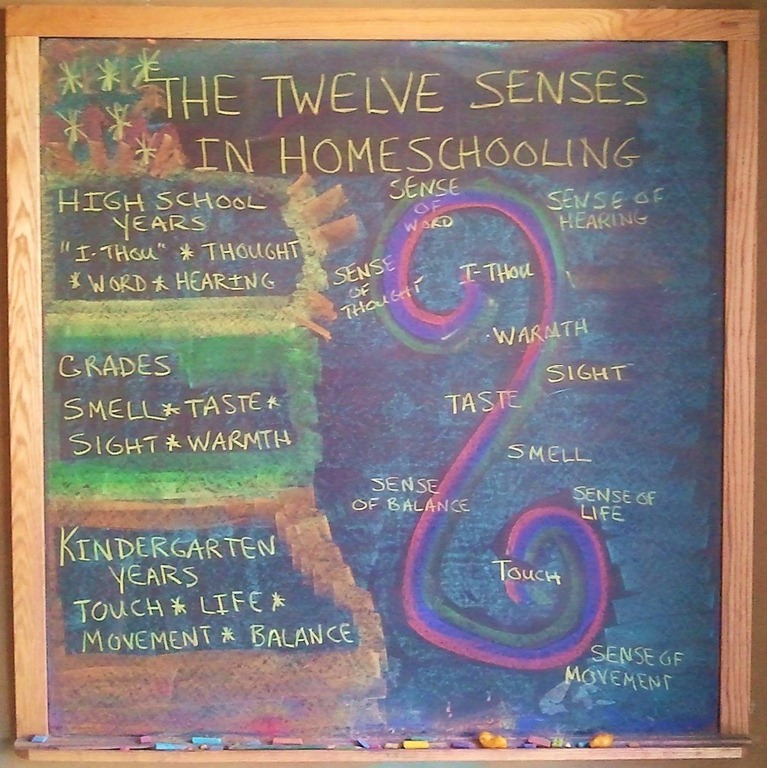
Many of you know that given my background as a physical therapist and homeschooling parent, work revolving around the twelve senses as set forth by Rudolf Steiner has been fascinating to me.    Some of the therapists and neuroscientists I have spoken to feel there are anywhere from 75 to over a hundred senses, but I feel these twelve are a fine place to start.  They are well-organized and clear, and I think it is a piece that is accessible for all educators, not just Waldorf/Steiner educators and should be of particular importance to us as homeschool educators and as parents.

Lisa Boisvert-Mackensie was kind enough to continue a virtual tea with me regarding some of the fundamental pillars of Waldorf Education.  You can see those posts here:  https://theparentingpassageway.com/2011/12/20/the-three-artistic-pillars-of-waldorf-homeschooling/ and here:  http://www.celebratetherhythmoflife.com/2011/12/as-person-who-has-straddled-worlds-of.html  and here: https://theparentingpassageway.com/2011/12/21/more-about-the-artistic-pillars-of-waldorf-education-a-virtual-tea/

Lisa’s last virtual tea post on the twelve senses ( here is the link:  http://www.celebratetherhythmoflife.com/2011/12/lemniscate-and-senses.html)  inspired me to draw the image above.  It was originally presented in horizontal form in a lecture I heard in the fall  by Douglas Gerwin, but after I really sat with this information, slept on it, let it lie fallow for a bit,  I drew this vertical figure. This vertical figure reminds me of the upright human being; it reminds me that we all have these twelve senses, and that having all of these senses fully developed leads to the freedom to give and receive love. One can have all the knowledge and training and facts in a field, and if one cannot rule over oneself, if one cannot see another’s view, if one can relate to another person, if one cannot use their knowledge and training for the love of humanity, what good does it really do?

This figure also reminds me that Continue reading