Interesting Links This Week

I found some interesting links to share with you all this week.

First, I found this free 58 paged document that describes all the how’s and why’s of chalkboard drawing in Waldorf Education and provides samples of chalkboard drawings for grades one through eight here:  http://www.antiochne.edu/ed/waldorf/projectJohnsonCatie.pdf Continue reading

Late To Waldorf? Overwhelmed?

If you are coming in late to Waldorf homeschooling or feel overwhelmed and overrun by dogma, I have a solution for you!  Please read the lectures given by Rudolf Steiner compiled in “The Renewal of Education.”  This set of lectures, given to a group of Swiss public educators only eight months after the first Waldorf school formed, is so accessible. The foreword is written by a favorite Waldorf educator of mine, Eugene Schwartz, in which he compares and contrasts Waldorf Education to John Dewey and Maria Montessori’s work and sheds light on the hallmarks of Waldorf Education:  the self –renewal and self-development of the teacher, the balance that feeling provides in education, and the approach of Waldorf education to the holistic child.

Waldorf education approaches the child from four different avenues. Continue reading

Waldorf Perfect Re-visited


I wrote a post awhile back about this whole notion of  Waldorf guilt,  and the dangers and impracticality of striving for perfection here :  https://theparentingpassageway.com/2011/05/16/waldorf-perfect/


I find this is the time of year we need to  re-visit this topic.  Curriculum fairs are popping up all over,  and mothers are starting to look toward planning for fall again whilst trying to finish up this school year.


I want to reiterate here that homeschooling is about family.  It is about love, warmth, laughter and joy, and spending time together.  If you find that your homeschool rhythm, or the things you are trying to learn or do with your homeschooling are consistently draining to you in your quest to be “Waldorf Perfect”, warning signs should be going off.


Waldorf Perfect is a perfect recipe for burn-out and for leaving Waldorf homeschooling altogether. 


Yes, Waldorf homeschooling is about inner development balanced with doing.  I see a lot of imbalance out there – mothers who are doing, doing, doing, doing and then that turns to drudgery, or mothers who are involved with inner work but no doing, or mothers who are just researching and not putting anything into action.


Please know that just as every class teacher has different strengths and weaknesses, so does each and every individual homeschool.  We have to try and learn and expand in the areas where we are not strong, but I also don’t think we should abandon the things that make us feel joyous and nourished.  I love to draw, paint, model, and make needle felted creations.  I don’t love to knit; I do it when I need to in order to work alongside my daughters, but I don’t spend a lot of my free time on it.  I like to try to garden, but my garden has its share of successes and failures.  I love movement and being outside, and I love movement games with music.  My homeschool reflects me, my joys, my strengths. Your homeschool will look different. 


There is no perfect recipe for Waldorf homeschooling; but there are essential truths of childhood development to work with.  Goodness, Beauty and Truth.  Head, Hearts and Hands.  Willing, Feeling and Thinking.  There are skills to be worked with and learned.  Most of all, there is an opportunity to know yourself, to know and observe your child and know what special things you can bring to your child to help them, guide them and teach them. 


But there must be warmth, laughter, love and enjoyment.  We are not creating a Waldorf school in our homes but our own family life with a homeschooling experience.  Your religion, your culture, all of that should be reflected within your homeschool.


Don’t try to be perfect.  Try to love.  Try to learn.  Try to strive and do better each and every day.  Be faithful in the small things. 


Have fun exploring each new seven year cycle and knowing that in respecting the child’s development, you will know what will come in when. 


In Joy,

Carrie

First Grade Wet On Wet Painting For Saint David’s Day

Today is one of my favorite feast days:  The Feast of St. David of Wales!  There are many wonderful stories about Saint David.  I decided today to use an element from one of the many stories about St. David to bring wet on wet watercolor painting to our first grade daughter.

There seems to be a lot of confusion and mystery regarding wet on wet painting for those families new to Waldorf.  Watercolor painting, in and of itself, has been around for quite some time – think of brush painting from Asia, and the watercolors of the German Renaissance Master Albrecht Durer.   Waldorf Education has a beautiful of approaching watercolor painting for children in the kindergarten and the grades.

In first grade, we go through each color one at time by itself  (which is very beautiful and reverent….I mean, in this day of visual bombardment how often do we get to experience the pure beauty and joy of one color?), then two colors and then some first grade teachers will move into three colors.  Eric Fairman , Master Waldorf grades teacher, discusses the approach he took in his first grade Path of Discovery guide if you are looking for more information.  If you are looking for other resources to help you discover wet on wet painting, please do have a look at this back post:  https://theparentingpassageway.com/2009/02/02/resources-for-wet-on-wet-watercolor-painting/

So, today I had heavy watercolor paper soaking in a tray of water whilst I told some brief stories about St. David, including how he went into Wales to spread the message of the Gospel, how the monastery he founded was very simple where the monks pulled the ploughs for sowing the fields, how he and his monks ate no meat, and how St. David was called the “waterman” not only because he would only drink water but because he would often pray submerged up to his neck in cold water in those Welsh lakes.  I also talked about the miracle of the ground lifting him up so people could hear his message.

Then, to lead up to our painting, we ended with the story of  the battle between the Welsh and the invading Saxons. Legend has it that the Welsh were losing until St. David pointed out that the dress of the two sides was so similar they could not be told apart in battle. He suggested each of the Welsh put a leek in their hat or dress, and the Welsh went on to win the battle.  When a Welsh leek flowers, it looks like a daffodil, so we worked together to create the beautiful colors of the daffodil in our painting.

First we painted our whole page yellow.

(There was once a beautiful daffodil standing as bright as the sun itself.  The daffodil was so lovely that everything in God’s creation wanted to be close to this sunny, lovely daffodil.)

Even the sky moved closer in to see the daffodil, but dared not to get too close to touch the daffodil.  The sky did not want to mar the daffodil’s radiant springtime beauty!

(Paint blue creeping in at the edges, round and round on the page, circling in, until a patch of yellow daffodil is still present).

And all the sky, and all the meadow, rejoiced in the daffodil’s beautiful light.

(If you look carefully at this painting, you can see the darker blue on the outer border, green like meadow as the blue and yellow mixed, with a yellow center as a daffodil).

The main thing to wet on wet painting is to just get the supplies and paint! Paint yourself first and then bring it to your children!  They will thank you!

If you need more help, here are two free resources I suggest:

http://thewonderofchildhood.com/2011/06/wet-on-wet-watercolor-painting-set-up-2/  (multiple parts)

and this resource by Sarah Baldwin, with multiple parts:

Many blessings and joy!

Carrie

A Mother’s Checklist For A Day Of Homeschooling


Did I  get up `early enough to feel steady, calm and unhurried?


Did I put on my apron or other attire to not only protect my own vital life forces whilst I am teaching, but also to set the stage that now we are in school?


Did I set the space of my work area where I will be with the children?


Did I center myself with a verse, a prayer, lighting a candle?


Did I cheerfully and lovingly greet the children for school?


Did we clean up at the end of school what could be cleaned up and close with a verse?


At the end of the day, did I review the day and meet my child again in prayer as to what that child needs from me in their  schooling, in their character development, in their life?  Was I prepared, and what could I do differently to be even more prepared?


Am I going to bed early enough to get up and do this again tomorrow?


Many blessings and much love,

Carrie

Lesson Planning: A Sample Form

In one post I shared my personal form for the rhythm of one of our days of the week, but I was recently thinking about a sample form or list that could help mothers plan their Grades One through Eight  homeschooling according to the eight pillars of artistic work of Waldorf Education that we have talked about in the past on this blog.  Academic subjects are taught through artistic work in Waldorf Education; this is an enlivening form of education for the child.

Please take this as a “I thought of this in quickly and you might be able to tweak it or use parts of  it or come up with something even better” kind of way, not as a definitive end product.  Smile

Anyway, this is what I was thinking: Continue reading

Homespun Waldorf Winter Carnival


Today I am kicking off a week of posts regarding the topic of “Pondering” over at the Homespun Waldorf Winter Carnival.  Here is the link so you can check out my post and the forum:  http://homespunwaldorf.com/wordpress/2012/02/ponder-a-vision-for-your-family/


I like the Homespun Waldorf forum; it is run by mothers who are veteran Waldorf homeschoolers.  I enjoy that this forum is not connected to any particular curriculum, so mothers write very honest reviews of books and curricula and how it worked for their family.  There are also great threads on homemaking, and how mothers combine Waldorf with other methods.


Come join us to brighten up your winter days!

Many blessings,
Carrie

Homeschooling Fourth Grade: Norse Myths

I have enjoyed this block of Norse myths; I remember doing Greek myths in the fifth grade in my public school education but I never  formally did Norse myths so these stories are fairly new to me.  It is always very exciting as a homeschooling parent to delve into uncharted lands!

I also think Norse myths fit and match the moral ambiguity the post-nine year change child is discovering in the world.  The Norse myths, as they head along toward Ragnarok, also bring forth new depths of emotions in the complexities.  Many children are outraged, saddened, in disbelief of the ending.

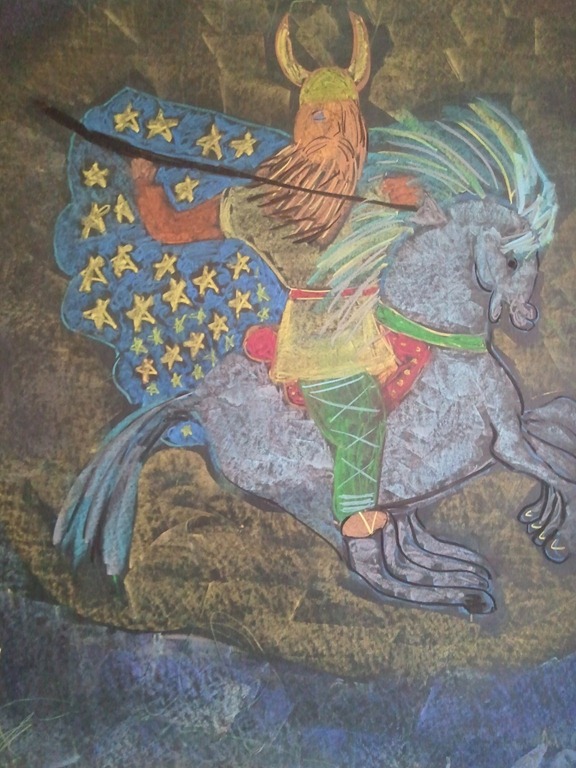
One other thing that has been interesting to me and my own development as a teacher has been drawing on the blackboard for this block.  I wanted to share some of my drawings with you…

I drew this recently……Here is Odin on Sleipner, his eight-legged stallion:

WP_000050

Here is another one of Odin I drew at the beginning of this block; I feel my drawing abilities have improved a lot through this block: Continue reading

Operation Shiny Toy

Ever feel like a cat with a shiny object in your own home and within your own homeschooling rhythms? Look, a shiny toy!  Oh, look over here, another shiny toy!  I do!  It can be especially hard to get back into the swing of things after the holidays.  I know some families in the U.S. are starting back to homeschooling this week and some are starting back next week.  We ourselves started on Monday, so I wanted to offer a word of encouragement and a plea for Operation Shiny Toy.

Turn off your computer.

Turn off the phone.

Do not schedule things during the time when you are homeschooling.

Do not say yes to events during the time when you are homeschooling.

Plan what you are doing; work at night to make sure you know what you are presenting the next day.

Commit yourself that the housework, emails and phone calls to make, the housekeeping and cooking (unless you are doing practical work in school!) can wait and you must finish your homeschooling time first.

Write down an outline to the flow of your day and homeschooling time.

Jump in and do it!

On Monday we woke up and started school with Continue reading

More Virtual Tea: The Twelve Senses In Homeschooling

WP_000170

Happy New Year’s to you all!  Many best and bright wishes to my readers in this lovely New Year!

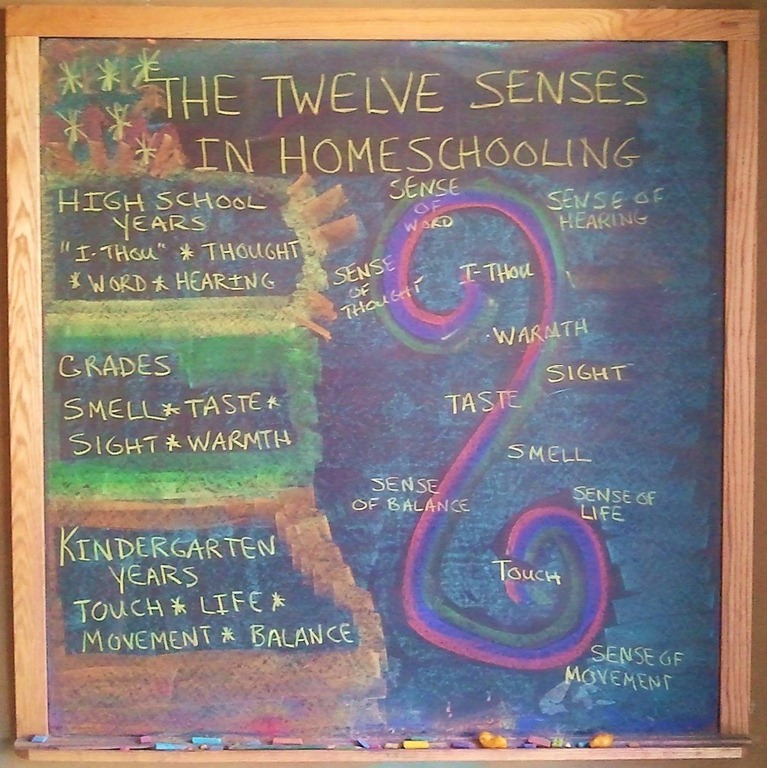
Many of you know that given my background as a physical therapist and homeschooling parent, work revolving around the twelve senses as set forth by Rudolf Steiner has been fascinating to me.    Some of the therapists and neuroscientists I have spoken to feel there are anywhere from 75 to over a hundred senses, but I feel these twelve are a fine place to start.  They are well-organized and clear, and I think it is a piece that is accessible for all educators, not just Waldorf/Steiner educators and should be of particular importance to us as homeschool educators and as parents.

Lisa Boisvert-Mackensie was kind enough to continue a virtual tea with me regarding some of the fundamental pillars of Waldorf Education.  You can see those posts here:  https://theparentingpassageway.com/2011/12/20/the-three-artistic-pillars-of-waldorf-homeschooling/ and here:  http://www.celebratetherhythmoflife.com/2011/12/as-person-who-has-straddled-worlds-of.html  and here: https://theparentingpassageway.com/2011/12/21/more-about-the-artistic-pillars-of-waldorf-education-a-virtual-tea/

Lisa’s last virtual tea post on the twelve senses ( here is the link:  http://www.celebratetherhythmoflife.com/2011/12/lemniscate-and-senses.html)  inspired me to draw the image above.  It was originally presented in horizontal form in a lecture I heard in the fall  by Douglas Gerwin, but after I really sat with this information, slept on it, let it lie fallow for a bit,  I drew this vertical figure. This vertical figure reminds me of the upright human being; it reminds me that we all have these twelve senses, and that having all of these senses fully developed leads to the freedom to give and receive love. One can have all the knowledge and training and facts in a field, and if one cannot rule over oneself, if one cannot see another’s view, if one can relate to another person, if one cannot use their knowledge and training for the love of humanity, what good does it really do?

This figure also reminds me that Continue reading