Advent and Other Winter Celebrations Within The Waldorf Home

I had a friend over today who requested I write a post regarding the celebration of Advent and other Winter festivals within the Waldorf Home.  She told me, very astutely, that this time of year was difficult for not just  herself but for so many people she knew who did not have a true religious leaning – it was hard to know what to celebrate and why, and not only that,  the consumerism and materialism of this time of the year really dampened her enthusiasm and excitement.  She summed it up by saying like, “What can I show my children about this time of the year when I don’t even have it all figured out?”

This is a hard time of year for the very reasons my friend stated.  I have a number of friends who encompass different faiths, spiritual leanings, denominations – atheism, agnosticism, Catholicism, Judaism, Islamic, Mormon, Presbyterianism, Reformed, Lutheran, Paganism, or just friends with leanings toward one place or another but no true “spiritual home” yet.  And this December, we all come together to celebrate different things; whether it be Saint Nicholas Day, Bodhi Day (when Buddhists celebrate the Enlightenment of Buddha), Eid al Adha (Islamic Feast of Sacrifice, the most important holiday of the Muslim calendar from my understanding), Santa Lucia Day, Las Posadas in Mexico, Winter Solstice, Hanukkah, Christmas, Kwanzaa. But yet we are all in the darkness of Winter searching for Light.

It is my fervent hope this holiday season that no matter what our spiritual leanings are, that we are all working toward and being the most loving, compassionate people we can be.  Our children need that, and our country need that. 

I hope this holiday season and throughout the year we can all treat each other with respect and dignity.  We are one in humanity.  I had a beautiful family I worked with recently from Bangladesh and the father looked at me at one point and told me in broken English how he and his wife had just bought a house and how he did not especially want to hang around with the Bengali community in our town.

“My neighbor, he American and say he help me with whatever I need, “ he shrugged.   “I cut my finger, I bleed, you cut your finger, you bleed.”  He and I solemnly looked at one another over the head of  his little baby and nodded at each other.  One humanity, one world.  That is what we should be about this time of year and all times of the year.

We are not the only ones with difficulties this season. Consider the plight of the Waldorf school teacher.  In the book , “An Overview of the Waldorf Kindergarten,” edited by Joan Almon, she writes, “December brings special challenges to the Waldorf Kindergarten teacher, for Christmas is a vital part of our culture and a festival that brings joy to children.  However, there is sometimes a tendency to be so overt in one’s celebration of Christmas that the kindergarten comes to feel more like a Christian Sunday School than like a Waldorf school.  This brings great pain to our non-Christian families, but it is problematic even for the children of Christian background. Within the Waldorf Kindergarten the festivals are  not meant to be “taught” but are offered in a light manner, much like telling a fairy tale, which allows the children great freedom to come to the festival as they will.  When offered in a spirit of gratitude and with a sense of wonder and awe, something of the essence of the festival can speak to the children.”

In this same book, an article by Freya Jaffke, says this of the festivals, “DOING-DOING-DOING.  Never reasoning why something is done in a certain way, although sometimes children have their own philosophy about certain things.  Our task as kindergarten teachers is to try to transform everything we do, to transform our knowledge into activities: to make visible that about which we have been thinking.”

The joy of a Waldorf homeschooling experience, I think is that you can choose the festivals that resonate within you and your family in this season and little by little, year after year, bring them to light.  Just as you would not bring a fairy tale to your child that does not resonate with you, you would not try to bring a festival to your child that does not resonate with you.  So choose your festival carefully, and also the traditions that you start with these festivals as the children will expect the same things year after year.

So, let’s go through some of the Winter Festivals that are common to Waldorf Tradition and some of the typical ways they are celebrated. If the Winter festival you most enjoy or celebrate as part of your religious faith is not on this list, please do not be offended.  It just means I could not find information regarding this festival/holiday in the Waldorf books and resources I had on hand.  And I do hope people will post their holiday traditions in the comment section!  Let’s share the beauty of our traditions!

Advent – Advent means that which is coming, so this is the time of preparation for Christmas.  This year Advent began on November 30.  Advent can be celebrated with an Advent calendar, needle felted figures of Mary and Joseph that start somewhere in the room and make their way closer and closer to the stable for Christmas Eve, an Advent wreath, an expectant Nature Table covered with a simple cloth.  Some Christian families make a Jesse Tree.

It is popular in Waldorf to mark  stones, plants, animals and human beings each week within the Advent wreath or on the Nature Table each week.  So for example, the first week of Advent would include adding stones, crystals, shells to the Advent Wreath or Nature Table.  The second week one would add representations of the plants – mosses, ferns.  And so forth.  Examples of what a nature table for Advent would look like can be found in the book, “The Nature Table.”  There is a wonderful book that has seven stories in it for each week leading up to Christmas and the first week all the stories involves stones in some way, the second week the stories involve plants in some way, etc.  This book is called, “The Light in the Lantern.”

My German friends have told me in Germany, Advent is a time of peacefulness, a time of cookie making and craft making.  Paper window stars, making ornaments, paper snowflakes and straw stars are  typical crafts for the season.  Contrast to the hustle and bustle and materialism you see here, and think about how you can bring peace to your home during this time.
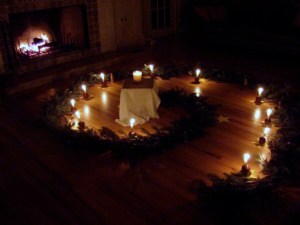
Advent Spiral 2008

Advent Spiral 2008

Advent Spiral

– this is a peaceful, meditative time for young children.  We hold an Advent Spiral every year within our local Waldorf homeschooling group, and this is how we have done it.  The Advent Spiral is typically held inside where a large evergreen spiral is laid out on the floor.  The spiral is adorned with    The room is dark except for candlelight – the candle at the middle of the spiral. The children come in and receive a candle inside a hollowed-out apple.  One by one each child walks the evergreen spiral , which is typically adorned with representations of the mineral, plant, animal and human kingdoms) to the center where they light their candle from a central candle. On their way out of the spiral, there are gold stars on the floor and the child chooses a star and places their candle on it.  All the children walk the spiral one by one until the spiral is lit up with all of the candles.  The children look at it for a moment and then file silently outside to go home.

Saint Nicholas Day – This day is celebrated on December 6th.  Children leave out their wooden clogs, shoes, a boot or even a sack on the Eve  of Saint Nicholas.  Saint Nicholas comes to earth on his snowy white steed, and leaves behind apples, tangerines, clementines, walnuts, hazelnuts and sometimes a little toy or book.   In many stories, Saint Nicholas is the forerunner that reminds children the Child of Light is coming.  Saint Nicholas, the patron saint of children, is loved in many countries, including Russia, where there are many churches dedicated to Saint Nicholas.   It is a major day for my friends in the Netherlands.  Saint Nicholas music, crafts, cookie cutters and recipes and more can be found at the wonderful website www.stnicholascenter.org.  There are also some wonderful handouts regarding the relationship between St. Nicholas and Santa Claus. 

A good source of St. Nicholas stores can be found in the Winter Wynstones book and also the little book I cited “An Overview of the Waldorf Kindergarten.”  One of the most famous stories of St. Nicholas is about his rescue of the three maidens who had no dowry to marry.

Tonight, (December 5th) my littlest child was looking wistfully out the window into the darkness tonight, softly singing under her breath a Saint Nicholas song.  That sweet knowledge of everything’s right with the world and the wonderful anticipation of good things to come.  My children left out hay and carrots for Saint Nicholas and his horse (oh, and a cookie as well :)) and polished up their wooden clogs.  Tomorrow they will wake up to one piece of candy each, a clementine each, a book each and small game to share together.  We have Saint Nicholas napkins for breakfast and Saint Nicholas cookie cutters to try our hand at decorating.  However, the best thing to do in the spirit of Saint Nicholas would be to do something wonderful for someone else, and not have them catch you whilst doing it! 

Santa Lucia Day– is another day some Waldorf school and homeschools celebrate.  This holiday is typically celebrate throughout the Scandinavian countries, especially Sweden.  You can google her and read quite a bit about her, but she is honored in Scandinavia as the bringer of boats filled with food when the people of Sweden were in a time of great famine.  The oldest girl in the family rises early in order to make sweet yellow buns for the family breakfast.  While serving, the oldest girl wears a white dress with a red sash and on her head a wreath of greens with four small candles lit – (yes, in this day and age you could use electric candles!)

Solstice – Unlike the very meditative inward experience of the Advent Spiral, the Solstice is parties and fun!  Round, yellow foods prevail with hopefully lots of friends and music!  Some families have a big bonfire, a Solstice tree, and some families “count up” to Solstice by starting with a set of 21 candles and lighting one each night until all 21 are lit on Solstice!

Look for a separate post regarding the 12 Days of Christmas and Epiphany soon.  Hope you have a wonderful holiday season celebrating with your close family and friends.

Peace, love, and joy.

Just a few thoughts from my little corner of the world.

The Adjunct to “Did You See This” ?

I have gotten some private emails and such, apparently this post has hit a lot of raw nerves.  First of all, I would like to give all of you struggling with these issues empathy.  Some of you have grown children and you are worried that perhaps people judge your parenting skills by the state your adult children are now living in.  Some of you worry for your child’s safety. Some of you have taken over care and responsibility for your grandchildren.  I too, was raised by grandparents with involvement from my father and uncle.  I probably understand more than you think about this.

Please give yourself a break and be easy with yourself.  There are no guarantees for how children “turn out”.  It is a fallacy in our society, especially that for mothers, that if we provide our child undivided material goods, unlimited opportunities, that if we are the “perfect” mother our children will turn out just fine.  This is a fallacy, but it should also not be an excuse to bow out of parenting in the best way we know how.

I believe the skyrocketing rates of  childhood ADHD, depression, alcohol and drug abuse are definitely related to not only parenting but also the position we assign children in our society.  Many people have told me out right there is no way there would have more than one or two children with the often unspoken message that children are a liability in this society- a cause of worry, a cause of stress and doubting yourself as a human being and who would want that?  Motherhood is the invisible job that no one seems to value anymore, yet it is the most important one to be able to provide peace and stability in your home to the best of your ability.  The work of motherhood should be well supported and encouraged for the future of our children and our country.

Children are a joy and a blessing.  I strongly feel the work and education of attachment parenting and Waldorf for the early years is at least the best hope we have at this time to stem the tide of all the problems we are seeing now in teenagers and young adults.

Thanks for all your comments and thoughts, keep ‘em coming.

Just a few thoughts from my little corner of the world.

Did You See This?

According to an article detailed on msn.com this morning,  1 in 5 young people (college-aged) in the United States have a personality disorder, including obsessive-compulsive disorder, depression, phobias and bipolar disorder.  This was the findings of a study where 5,000 people aged 19-25 were interviewed face to face and asked about a variety of personality disorders.  Researchers also found the rates of substance  of abuse by young people was higher than the rates of personality disorders.

Obviously, personality disorders have always been around. Hopefully this study will highlight the prevalence of these diseases and encourage those affected to seek help.  Hopefully this study will encourage discussion amongst families as to family history.  Hopefully this study will encourage more research to be done into the genetic and environmental factors that contribute to personality disorders.

Some children seem to you with their own biology, circumstances and destiny.  The best parenting techniques may not be able to change the reality some children, step children or foster or adoptive children, enter into your home with.  This post is not intended to be directed toward those children per se, unless you think there is something here that will help your circumstance. 

Here is just a thought for what may compose the best stability and the most security for our children so they can grow up into healthy, stable adults.

1.  Marriage before having children is an excellent place to start.

2.  If you work outside the home and are happy with this and your family is thriving, please skip this paragraph and go on!  If you are not perfectly happy, read this.  I feel having a parent that stays home with the children when they are young, and is home daily  throughout the child’s years, even the teen-aged years, is essential. I personally  have had a variety of work situations including working 12 hours a week with on=site daycare when my oldest was little and now working one weekend day a month when my husband can be home with my children.  I have stressed and agonized and felt torn like so many of you.  So please know I am not saying these things lightly or without feeling or compassion. However, if you have thought about staying home and have the possibility of doing so, I am here to encourage you.

I have two thoughts on the subject of working, and I am sure  you all can add more perspectives and comments.  My first thought is actually for the mother.  If you are caught up in work, chances are you are not present at home, even if you are physically there.   I have seen mothers tearing themselves into little pieces in order to be the perfect  mother, the perfect wife, the perfect worker, the perfect everything, only to be stressed out, worried, disappointed and feeling like they are not doing the best job at either place. If this is you, change it.  Your children need your warm, loving and caring presence.

My second thought on this subject is  for the children. Some children seem to do “well” (whatever that means)  in daycare of any kind – group daycare, in-home daycare, nanny etc. – but some children just do not do well, even if it is care provided in their own home.  I do wish there were more studies regarding the number of hours a child is in daycare and future health ramifications for the school-aged child and the adult – studies that look at  mental health and physical health outcomes.   The difficult thing about this  is sometimes you just cannot tell until your children have grown and matured who seemed to survive in an alternative care situation and who really did not. 

All that being said, if you are going to work, please be happy about it and confident about it and carry that to your children in your energy. Please do not use your worry about working as an excuse to jellyfish parent or to shower your child with material things to make up for what you believe is lacking.  Have a rhythm for when you get home from work, and work hard to be with your child outside of work.  Seek out support from other caring, working parents through your local La Leche League and Attachment Parenting support groups.

If you wish your work situation was something else, and many of us do in this economy, know from the bottom of your heart you are a caring parent for even worrying about it, and that you are doing everything you can do,  the best you can do,  right now.  My heart goes out to yours.  Support is vital in this situation, please do find a community to hook into about this important subject.

Onward and upwards.

3. Get your own stability in check – do what you need to do, but get therapy, help, advice, do your  own inner work through prayer, meditation, tai chi, yoga, energy work.  Align yourselves with mothers whose parenting you admire.  Look deeply into what you feel the role of a homemaker should be, could be, is now for you.  Think about how you set the tone for your home, the peace in your home, the tone and model for your spouse and your children.   Think about your relationship with the other adults in your extended family, and what you are modeling for your children.  Do not assign your adult baggage a role in your child’s life.

Also, mothers please take care of your bodies.  It is the only one you have for your life here on Earth, and how you feel in your body affects your mind and your attitude and your ability to create peace in your home.  Please show your children how to care for their own bodies by  limiting your own screen time, by being active, by eating healthy and by receiving whatever preventative  health care you need to keep yourself in balance.

4.  Start things right by breastfeeding and practicing other measures of attachment parenting. If you need more advice or thoughts regarding this, please see www.attachmentparenting.org and www.lalecheleague.org.

5.   Learn about protecting your child’s senses (all 12 of them!  Yes, there are 12 senses according to Rudolf Steiner).  Warmth is a very important sense, and start working on this early to provide your children not just with physical warmth by keeping their heads covered, but also work on being emotionally warm with your children.  They need this to thrive!

6.  Establish a rhythm in your home that benefits your whole family.  This includes gently guiding yourself and your child toward better, healthier sleeping patterns, and adequate time in movement and outside time.  Repetition is a healthy cornerstone for the early years.   Work toward providing healthy boundaries that protect everyone in the family’s dignity and respect.

7.  Understand normal childhood development and the best ways to guide behavior in a loving way during different stages of development.  For the early years, this includes  respecting that young children live in their bodies, distraction, having a strong rhythm, limited choices, using fantasy and movement as our friends to encourage the behavior we do want to see, keeping ourselves calm and grounded, and yes,  even use of the word “no”.  You can still set limits and be a loving parent. You can still be a warm, loving parent and not explain away the mysteries of life and chatter away to your child. Practice your singing and humming instead for some really beautiful energy in your home that words and explanations cannot touch.

8. Enjoy, protect and nurture childhood.  I feel so sad when parents say to me, “Yes, my little one is six and in school and all grown up.”  I feel sad when I see the little girl  third graders at the bus stop experimenting with make-up.  I feel sad when all the wonder of childhood is gone before it even starts in our rush to sign our little ones up for organized sports, teach them reading and writing, and force their independence too early.  What is our hurriedness doing to our children?

Let them have the wonder of childhood. Protect them from media for awhile.  They will not be behind if they do not use a computer when they are five, and they will not be behind if they haven’t seen all the Hannah Montana TV shows by the time they are nine.  Childhood should be a time of imagination, fantasy and wonder. 

The world our children will inherit will be even more fast-paced than it is now.  We are going to need good, solid leaders who can make difficult decisions, innovative out of the box creative thinkers, inventors, and people who can help other people.  Protecting their childhood and letting your child have a childhood will contribute to this in a most important way.

9.  Look into Waldorf education for your child.  It is the most healing educational system I can find, the only one that seems to correlate the educational process with the possible health of the future adult, the one where the entire curriculum is set up to feed a child’s soul based on the child’s developmental level.    Please see our own personal  reasons for choosing Waldorf for home education on my blog post entitled, “Wonderful Waldorf”.

10.  Create opportunity and moments of wonder and reverence in your home for your child through nature observation and being outside, the wonder of stories, the wonder of beautiful art and music, the wonder of the mysteries of life.  Wonder, joy, reverence is really what it is all about.

Take  what resonates with you from here. I would be interested to hear your thoughts.

Just a few of my thoughts from my little corner of the world.

Children and Media

Waldorf education strongly encourages the limitation of media for children.   Many parents I know have a difficult time with this, and even question why they should limit media for children when “everything my child watches is educational.”  This is a topic that deserves a closer look.

Joan Almon writes in the forward to Martin Large’s book, “Set Free Childhood”, the following:  “My primary concern about children’s exposure to media has to do with the issue of how children grow and develop their full human capacities, and the many ways in which our culture interferes with this.  For children to develop well, they need caring adults with whom they have much contact and who inspire them to develop their full range of human abilities – mental, social, emotional, and physical.  Even the best of media programs cannot begin to inspire children in the way that a loving adult can.  Yet far too often, adults are calling upon the media to baby-sit their children. They feel guilty about about this, for they know that media is no substitute for their own attention and care; but the pressure in their lives leads them to do it anyway.”  She goes on to talk about the lack of imagination and aggression she has seen as a Waldorf nursery/kindergarten teacher in the children who watch TV.

Marie McClendon in her book “Alternatives to TV Handbook” explains how television works. “A television image is seen because the images are normally re-drawn – or scanned- about 60 times a second.  Imagine how much this is for the eye and brain to process.  Regardless of program content or pace, TV overstimulates and taxed the developing neurological systems and may result in shorter attention spans and hyperactivity.  It is simply how the television works”  She goes on to say, “It may sound funny, but the worst thing about your children watching hours of TV is that they are not climbing trees.”  She has a summary of the “Top Ten Research Findings on Children Viewing TV” and mentions that TV-induced alpha brain waves place the brain in a non-learning mode and are addictive.  The alpha brain waves with TV watching are less than sleep or dream waves; the brain actually atrophies.

Martin Large, in his book “Set Free Childhood” has the following criteria available to evaluate the TV your child is watching:

1. News – he concludes is unsuitable for children under the age of 12.

2. Language – he suggests turning off e picture of your child’s television show and listening to the language in it – How do you rate the richness of language expression?

3. Advertising – enough said.

4,  Social skills – How do people solve problems?  What values are offered?

5. Comprehension level – does your child actually  understand the plot lines or what happened, even if they enjoy it? 

Even just the background noise of TV affects how babies sleep.  A newborn baby is sensitive to noise, bright lights, cold and warmth.  I cannot tell you  how many times I have gone into a newborn infant’s room to examine an infant and had to ask the family to turn a blaring TV off.  It always amazes me that there is this precious newborn infant in the room, and the family members are glued to some sort of incredibly loud show on the television! If you are pregnant or have a newborn in the house, please do think seriously about the sounds and screens that are in front of your babies!  The American Academy of Pediatrics also has position statements regarding the hazards of television viewing for children, you can access these policy statements on their website.

Potential health hazards of your child watching TV includes visual processing problems, childhood obesity and lack of exercise, nature deficit disorder, social isolation, the undermining of play and aggressive or anti-social behavior.  Attention deficits and inability to concentrate has also been tied to television viewing in children.  If you are concerned about your child’s developmental progress or behavior in any way, shape or form I strongly encourage you to cut off the television.

Some Waldorf families have no television in their homes at all; some have a TV but hide it away and it does not come on until the children are asleep.   Some families never watch TV, some ban TV during the week, some ban TV during the weekends.  Some allow one show a week, some families allow a certain number of hours per month.  Some families do not really watch TV, but are not adverse to putting in a half hour of Barney is the entire world and all the children are just simply falling apart. 

Eliminating TV does require some advance planning – have some simple activities ready that  you can pull out. One time of day many parents find challenging is the before dinner hour, when it seems almost all small children are tired, hungry and whiny. Marie McClendon proposes some ideas on page 40 of her little book.  She mentions that you can make up a story while you cook, sing while you cook, give the children a snack, make a little fort for your children to hide away in while you cook, or let your child call grandma or someone while you cook.  My personal favorite is to let the children have a snack and either play with homemade salt dough while I cook or enlist them to help me scrub vegetables, tear lettuce for a salad or set the table.  Filling up one half of the sink with soapy water is also usually a  hit for my younger child.

The other area that mothers often find challenging without TV is that famous question of how to keep the older child entertained in order to get a few moments to put the baby to sleep.  There are several things that come to mind.  You may consider trying to lay down with both of them while you read to the older one and hopefully the little one will drift off to sleep. You could also set up play scenarios with little figures and silks and see if the older child cannot engage himself in some play for a few moments.  If you don’t worry about the mess you could set up a big tub of dried beans and cups for pouring, build a big fort and let your oldest have a snack in it while you get the little one off to sleep.  Another thought is to set up lacing cards or wooden beads and strings for your older child to play with.  One thing that always worked well for me personally was to wear the baby in a sling and let the baby nap there till the baby was old enough for only one nap a day and  then I only had to think of something for my oldest to do alone once a day instead of twice a day!  In any case, also take a look at your rhythm again and make sure your oldest has a lot of outside time before the baby needs a nap, so then he or she will want to do something quieter at that point.

Marie McClendon’s book has many suggestions for what to do instead of TV, divided by age group.  It is a small book of about 56 pages, but packs a lot of information in it. I highly recommend you look over the suggestions of activities she presents and see if that doesn’t help stimulate your own ideas!

Just a few thoughts from my little corner of the world.

Forgiving Ourselves

How do you work within the  context of parenting with the concept of forgiving yourself?  Some mothers have very carefree, sunny personalities and don’t dwell on things so much, but I know many mothers who are trying to be “the perfect mother”; feeling  overwhelmed and then are mad at themselves when they don’t live up to their own self-imposed standards.  When they are being authentic and real, they admit to me they find it hard to forgive themselves and their behavior.  I especially see this as mothers try to change some parenting skill that was inherited from they way they were parented and they “slip-up”.  I also see this quite a bit in homeschooling mothers; mothers who want to do more “of a Waldorf-inpsired homeschool” and are currently more unschooling  than doing Waldorf or using some kind of a homeschooling “curriculum package” instead of creating their own lesson plans, or in mothers where life has derailed their current homeschooling plans.  The opportunities to feel bad about oneself abounds!

For the past two years, I have made my inner work and parenting focus this simple phrase:   “I will be easy with myself.”  The Thanksgiving holidays heading into Advent into the 12 days of Christmas are always a meditative, contemplative drawing-in time for me, and this year I am also starting to work with the idea of “letting go” (more about that in a separate post), in addition to being easy with myself.

If you are feeling guilty about the way you have parented in the past, a situation that involved you not handling things they way you wanted to, if you are feeling guilty about the state of your homeschooling adventure at this point because other things in life are  taking center stage at this moment; please take a deep breath.

Feeling guilty is not always undesirable – it can point out ways to change for the better at times.  However, what I see in so many mothers is just feeling too guilty, all the time, over everything and anything.  Please stop modeling this for your children, especially your daughters!  Trust yourself, your intuition and trust in your authenticity. No, we cannot use this as an excuse for not  doing what is right in our lives,our families and our homeschool, but we can decide that instead of dwelling on the negative things, instead of dwelling on the things in reality that did not meet our expectations or ideas, we can move forward and come up with positive solutions that will help everyone involved.  We can look at enlisting  help and changing what is going on within the family.  We can look at using our own inner work to work with these feelings instead of unleashing them on our children and spouses.  We can look and find the support of other mothers.   We can also look at acceptance.  My husband sometimes will say, “It just is what it is.”  And sometimes that is just enough.

Take the time to examine your own beliefs – do you believe you should never say “no” to anyone, do you think a mother should be able to give of herself continuously and endlessly without any help from anyone else, do you feel everything must be done “perfectly” or it is not worth doing, do you feel your best is never good enough? Do you think you should be working within your home seven days a week without a break?  Do you feel you are so busy with your family you have no time or place to connect to your own children, your own spouse and encouraging friends?

You live in your home with your family; you do not live FOR your home and your family.  Think about what you need and how to get there!  And be easy with yourself while you do it!  Is your home a place of peace, and joy?  (At least most of the time??!!)  Or is it a place of stress and upset?

There is a wonderful book called, “The Hidden Feelings of Motherhood :  Coping with Stress, Depression and Burn-out,” by Kathleen Kendall-Tackett.  In the epilogue of this book, she points out several things you can do to make things better for yourself and your family.  The number one thing on her list is to focus on the things that are actually going well, and that if you can identify even just one strength, one thing that is going right,  you can  use that and build on that.  She also talks about the need for self-care, the importance of eating well, getting to exercise and yes, even getting to relax.  Are you doing this for yourself at all?   She also talks about the need for mothers to laugh, and I so agree with this!  So many of the mothers I  meet just seem unhappy, sad, overwhelmed, depressed, and joy-less.  Make a promise to yourself to start trying to bring humor and joy back into your life.  Kendall-Tackett has lots of other things to suggest, such as ways to re-vitalize your sense of humor, and  her important recommendation of finding support through a mothering mentor. 

From a Waldorf perspective, I think working within your own inner work on your feelings, needs and expectation is vital.  It is the most important part of your homeschooling experience with your children.  If  your homeschooling experience is joyless and not alive, your children will have difficulty not only in absorbing the material and learning, but also in seeing the joy within your homeschool!   Barbara Dewey wrote a great article about this in her most recent newsletter, entitled, “Are Your Child’s Eyes Shining? Are Yours?”  You can find it here: http://www.waldorfwithoutwalls.com/newsletter/44/

Vimala McClure writes in the neat little book, “The Tao of Motherhood,” the following:  “A wise parent recognizes her failings and accepts what is.  There is room in life for remorse, and for forgiveness.  There is room in our heart for ourselves, and for one another.”  Lovely words.

Mothers have been mothering since time began.  What we do is the most important thing on earth, but more important than even doing everything right and trying to meet the impossible standard of providing “the perfect childhood” where there can be no such thing is to provide your children the  model of what to do when the pieces don’t fit together or fall apart.  Show them how one can focus on the strengths and be optimistic.  Show them how one can say, “So glad that is over now!”  Show them how to move on, make things right.  Show them that parents can take care of themselves and be partners together and still have enough love and energy for everyone in the household because that is how families work.

Meditation, meditative rhythmical activity such as Tai Chi or yoga or even walking, prayer, taking a day of rest each week can all go a long way toward helping us to forgive ourselves for just being human.  Be the best mother you can be, but accept and love yourself where you are in your journey and in your path.

Just a few thoughts from my little corner of the world.

Happy Thanksgiving!

I wanted to thank those of you who read my blog; I hope it provides you some inspiration and encouragement.

Blessings and peace to you on this holiday.

Just a few thoughts from my little corner of the world,

Carrie

Holiday Gifts for Children: How Much Is Too Much?

The holidays are upon us, along with the rampant materialism that seems to consume our culture.  If we are not careful and vigilant, the holidays become more about fulfilling what is on someone’s  wish list than any meditative, contemplative act regarding truths and light in the darkness of winter.

I invite you this holiday season to slow down.  In many of the countries that celebrate Christmas, the season of Advent is a time to slow down, be at home and enjoy making crafts and decorations for the home and baking.  It is not a time to run out and spend 500 dollars on one person at Christmas.

Unfortunately, in our society, the person(s) many families are most likely to spend the most money on are their children.  Whew.  I invite you to make yourself a cup of tea, and have your husband take your kids to the park for a few hours.  Now go into their rooms and the playroom and look at the amount of stuff that is there.  Seriously.  Count the number of puzzles they have, the number of pairs of shoes, how many bags and boxes of craft supplies there are. How many board games do they have?  How many dress up clothes?

The first step is always the hardest.  I invite you to think about purging at least a third or more of your toys this holiday season.  If you cannot purge them all, or you do purge all the junky made in China plastic toys and have some nice open ended toys to keep, here is a thought for you.  Some families pack up toys and  put them away somewhere.  Then they rotate the toys so only a few things are down at a time.  The toys can be changed out either monthly or seasonally.

If you are stumped as to how many toys a child really needs to have or how many clothes/outfits a child needs, I can offer these guidelines that I have read from other sources.  Marsha Johnson, Master Waldorf teacher and moderator of the wonderful Yahoo!Group waldorfhomeeducators has this great article in her FILES section of that group entitled, “The Issue of Toys, Children and Materialism.”  She wrote it in December of 2004 and I think it should be required reading for parents when a baby is born!  Seriously!

She writes on the matter of clothes, “Examine wardrobes and put together fourteen outfits for your children, enough for two weeks without laundry, for each season, and donate the rest.  Buy good quality wool, cotton and natural fiber clothes that will last through several children, practice the fine art of hand me downs, and gather a group of other families to have a twice a year “share” time where you all bring extra clothes and parcel them out.  You will be shocked at how this is so very freeing although you will spend a bit more time doing laundry on your new schedule.”

Yup, fourteen outfits.  And probably not nearly as many shoes as your child currently has in his or her closet either!

For the matter of what toys a child really needs, I turned to the pages of a Waldorf classic entitled, “Toymaking With Children” by Freya Jaffke.  I so love this little book.

At any rate, for the child’s  first year of life, Freya suggests a small soft cloth to play with, a cradle doll and a wooden doll. (There are instructions on how to make these dolls in her book).  She also gives an honorable mention to a felt ball, an embroidered ball, a wooden spoon, blocks of wood that are sanded until they are very smooth with no bark on them, a strong basket, an empty box with a lid and small cloths.   Again, there are instructions on how to make nearly all of these things in her little book.

For other toys for the one to three year old, Freya suggests  knotted dolls, carts, a simple basket “pram” (stroller), a basket of building bricks, a carved wooden spoon, a basket of chestnuts and a rocking horse.

For the three to five year old, Freya suggests toys be grouped into categories such as building toys for a large scale, building on the floor or on tables, the Doll’s Corner and the Play Store.  There are pictures of these play areas throughout this book and they are magnificent in their simplicity and imaginative value.

For example, in the building on a large scale section, Freya has wooden playstands (if you do not know what these are, they are wooden stands you can drape a cloth over  and can be many different things – google for a picture), playstand cloths, dress-up cloths (dyed silks), sandbags, wooden clothespins, little wool rugs, wooden building logs and finger-knitted or crocheted headbands.  This all sounds like a lot, but it can tuck away neatly in baskets, it is all open ended, and all of it you can make yourself.

Everything is very open-ended in the other play scenarios as well. A basket in the doll corner, for example, could be a baby’s bathtub or if flipped over, could be a stove.

Freya recommends baskets full of natural items such as shells, stones, bark, feathers, pine cones and unspun sheep’s wool, a bunting bed for a doll, a doll’s spoon, a hammock for the dolls, play pillows, a footstool, wool carpets and fleece, outdoor toys and a wheelbarrow.  She also mentions for quiet time a tumbling man (instructions are in the book), a Russian doll (the kind you open up and there is a smaller doll inside and you open that doll and there is an even smaller doll inside), a few good picture books.

Marsha Johnson has slightly different suggestions for each age group, but similar in imaginative value and open ended play.  For the one year old, she says infants under one year really need no toys at all, but if you must, consider one rattle, a soft ball, 2 or 3 silks to play peek a boo with, an animal or shape to chew on, a special blanket for naptimes and a nature table to look at.

For the 1 to three year old, the list is a bit longer but adds such things as a wooden stacking toy, a small truck or car and 6 small board books.

For the four to seven year old, Marsha adds  such items as dress up capes and crowns, simple musical instruments, outdoor riding toys, no more than two dozen small books on a shelf at a time.  She also has suggestions for the eight to 12 year old child.  This article is really invaluable, and she has many other wonderful articles in that FILES section.  I suggest if you have any interest in Waldorf at all, join her group and read through all of her fantastic articles.  The things she says really resonate with me personally and I am glad the Waldorf homeschooling community has her!

If you feel as if your child does not need one more toy, see if you can encourage family members to provide gardening tools, a membership to the nature center where you could go one afternoon a month or a homemade gift certificate for tea time with mom or a park date with dad.

Less really is more.  Think about what you could make for your child this holiday, what your child could give and what you could make for your home together. If we keep on giving our children the large number of gifts, the big parties, the closet full of clothes before they are even five years old what are they going to have to have to top all this when they are 15 or 16 years old?

Just a few thoughts from my little corner of the world.

Steiner’s Grain of the Day

A different grain for each day is part of the Waldorf Kindergarten and connected to the cosmic origins of the days of the week.   A different grain a day fits in with the nourishing weekly rhythm the kindergarten thrives on.   The most common listing of grains I have seen is the following, taken from The Waldorf Kindergarten Snack Book:

Sunday (Sun): Wheat

Monday (Moon):  Rice

Tuesday (Mars):  Barley

Wednesday (Mercury);  Millet

Thursday (Jupiter):  Rye

Friday (Venus):  Oats

Saturday (Saturn):  Corn

Waldorf teachers and those who cook with whole grains attribute different properties to different grains.  According to The Waldorf Kindergarten Snack Book, wheat is often seen as a harmonizer of the organ systems, rice is seen as acting on the digestive system, barley is seen as strengthening to the connective ligements due to a high silica content and also seen to be soothing to the mucous membranes of the stomach and intestines, millet is seen to have warming properties, rye nourishes the head and bones, oats loosens stiffness and increases stamina and resistance to disease, and corn stimulates the metabolism in muscles.

People often ask me what grains we work with in our homes, and how we work with them.  We do not work with wheat much at all.  Rice I tend to cook as either cream of rice for breakfast, coconut cinnamon rice with raisins for snack or just plain old rice with dinner.  Barley I enjoy most in a soup or cooked in place of any recipe that calls for rice.  Typically I cook millet as a breakfast porridge in the crockpot overnight with almond milk.  Millet is rather low in calcium and almond milk just seems to go fairly well with the millet to balance it all out.  I have tried rye in bread, but have found it difficult to work with this grain much.  There is a recipe in one of my raw food “un” cookbooks for a long tailed rye salad, so maybe i will try that next.  Oats I tend toward scottish oatmeal, steel-cut oats or making something with oat flour.

Grains can be a touchy thing for many people.  Many of these grains (wheat, barley, rye, cross-contaminated oats) have gluten in them.  There was just an interesting article in the December/January 2009 issue of the  magazine “Living Without: the magazine for people with allergies and food sensitivities”  (see www.LivingWithout.com for further information about this wonderful magazine!).  The magazine interviewed Peter HR Green, MD and director of the Celiac Disease Center at Columbia University and author of Celiac Disease, A Hidden Epidemic.  Dr. Green states in the article, “Wheat has only been domesticated in the last 10, 000 years. Our digestive systems can’t fully chop up gluten, the protein in wheat.  We’re left with large molecules of up to 30 amino acids that can be absorbed into the intestinal lining (probably during gastrointestinal infections) and that interact with the immune system, causing celiac disease in genetically predisposed individuals.  We evolved to eat meat.  Our enzymes digest meat protein fully into single amino acids or molecules of 2 to 3 amino acids that are readily absorbed.” (I am so sorry to my vegan friends, these are his words, not mine!)

They asked Dr. Green if he thought everyone should limit gluten consumption and he answered, “No, not necessarily.  But many people who don’t have celiac disease feel better not eating wheat and it may be because it’s poorly digested.”  He adds in answer to a different question, “Some people may feel better on a gluten-free diet.  If they don’t test positive for celiac disease, they may still be gluten sensitive.  They may feel better avoiding gluten, or just wheat.  They may not need as strict a gluten-free diet, just limited.”

But at any rate, I thought it was interesting.  Steiner was so into agriculture and the creation of biodynamic cultivation methods, and I wonder what he would say about today’s surge of folks who are gluten-sensitive and/or celiac disease positive.  I have often joked that The Standard American Diet for many people is Wheat, Soy, Cow and Chicken.  Behind that not so good joke, however, is my wonder at what we are doing to our health by eating such a limited diet.

So, I guess this is the long way of saying I think Steiner’s idea of rotating grains through our diet was a good one.  I seem to have gluten sensitivity and can only eat about a half cup portion or less of a grain each day and still feel good, but I do try and follow Steiner’s rotations.  I love the warming properties of my millet.  The other grain that intrigues me, not one of Steiner’s, is the little Ethiopian grain called teff.  Teff is high in calcium, protein and fiber.  I will let you all know as I experiment with it.

Proponents of Nourishing Traditions will point out that most of these grains, except rice, need to be soaked overnight in order to inactivate the enzyme inhibitors present in grains and inhibit the presence of phytic acid, present in grains and causes the decreased absorption of important minerals.  You can do the soaking of grains just by simply covering the grains with warm water and adding a tablespoon of lemon juice, yogurt, kefir or whey and then rinsing the grains before cooking the next day.

Maybe this will inspire you to try some different whole grains, and to think about the diversity of the things you do eat.

Just a few thoughts from my little corner of the world.

Another Poetic Interlude

Thanks

Thanks for the bees so good,

Thanks for you and me,

Thanks for the golden corn,

Thank you God for everything!

Amen

Another little poem by my first grader.

The Pumpkin Pie Song

Just in time to help your children learn this song for Thanksgiving, here is my dear friend Jodie playing guitar, along with her 7 year old playing the pennywhistle, and singing all the words for your listening pleasure:

http://homemusicmaking.blogspot.com/

You can find the words and music to this song on page  89 of the book, “Festivals, Family and Food:  Guide to Seasonal Celebration” by Diana Carey and Judy Large.

Have fun with it!!

Just a few thoughts from my little corner of the world.