Are You Raising A Potted Plant?


There should be warning signs for parents on every child in America:  “Warning!  This is not a potted plant!  This is a human being that needs sunshine, free play in nature and lots of movement throughout the entire lifespan!  Warning!”


Too often our children today are treated like potted plants. Sterile, not moving, in a pot, watching only one view because the inherent nature of the human being to move is essentially ignored by our predominate educational system, our medical system, and our society at large. 


Children of all ages, birth through twenty-one, need to MOVE.  Children birth through age seven should be developing their will, their doing.  Movement also is learning.  I have read research estimates that 80 percent of the brain is devoted to taking in sensory information and deciding what to do with that information.    Almost any long-time teacher will tell you that most children are kinesthetic learners. 


We know from current research that school aged children need at least three to four hours a day of true rough and tumble outside play. Heavy work benefits ALL children and ALL adults.  We are wired for it!


In a classroom setting, just having ten minute breaks to really move every two hours can completely increase learning.  According to a 2006 study in the journal of Medicine and Science in Sports and Exercise, children with ADHD who take movement breaks for ten minutes every two hours show a 20 percent improvement in “on-task behavior.”


In Waldorf Education, we look at movement to be about a third of our learning time if possible.  We play movement games for math, we walk our forms before we draw them, we have eurythmy and Bothmer gymnastics in the Waldorf School setting, we include folk dancing in the curriculum for certain grades, we have drama and gardening.


You CAN do this at home and it will not complicate your homeschool, but enhance it!


Simple ways to start:


Finally, are you moving in your free time?  Are you cleaning, gardening, working? Hiking and biking and swimming and skating?  Or are you sitting down on your computer?  Just sayin’.  Smile


Happy Moving!

Carrie

The Rant: Get Out Of Your Own Way!


Okay, today I am less in encouraging mode and more in rant-y mode, so if you are not in the mood for a kick in the pants kind of post, do feel absolutely free to check back in tomorrow.  That’s the disclaimer.  And here it is, bluntly:


Folks, I want you all to stop researching, and start making some decisions and DOING.  If what you decide doesn’t work out the way you want, you can tweak things.  You can change your mind, if it is something to do with parenting or discipline.  If it is something to do with curriculum choices for homeschooling, you can jump off the pages and make it more your own, if it is a curriculum you bought –  bring it alive for your child (or re-sell the darn thing!)  Make a decision, stick to it and give it some time, and then tweak or change.  You can do this!  Get out of your own way!  Do what your heart is calling you to do, without fear!  I am less interested in why something WON’T work then how to MAKE it work.  Try it!


I am meeting more and more mothers lately who are so lovely and sweet but they seem so driven by pure and utter fear.  Fear of being judged of others.  Fear of “since I can’t do it 150 percent “right” –whatever that is- I won’t do it at all!”  Fear of failure.  Fear of making a commitment, even though they keep circling back around to the same things over and over.


If fear, negativity and anxiety are fueling you, no wonder you feel paralyzed in making decisions!!  The more you get used to doing a REASONABLE amount of looking at the issues and making a decision and moving forward, the more you will get used to ACTION.


Action takes practice.  It doesn’t always feel “safe”.  But everything in life has pros and cons, polarities.  There is no 100 percent failsafe.  Have courage, have joy, take action and move forward!  It only takes baby steps and dipping a toe in, not this headlong dive into perfection and dogmatic thinking – and that is whether it is homeschooling, positive discipline or attachment parenting.  Be proud of the small successes and keep moving forward.


Create an action plan for whatever challenge you are facing.  And part of your action plan should be to do something small for yourself everyday.  Some of the mothers I meet I think are partially paralyzed because there is nothing for them at all,  they are pouring everything into their children, and they are harried, hurried and worn-out. 


Help yourself out by taking on only what you can handle!  Are you rushing around every morning and afternoon and squishing homeschooling in around all that?  Where is your time for your action plan if you are not home?  I had a dear, dear friend say to me several weekends ago, ‘You know, Carrie, I cannot hear that still small voice of God, I cannot find and listen to my own intuition, if I am just rushing around.”


YES, dear sweet friend, YES. 


Take care of business first; discern what is essential, create an action plan, and each day do something small to help you reach your goal.  Start somewhere.  No one will fault you for being where you are, but now is the time to move forward!  Make decisions, take time to see how things work out, and then tweak or change.  But move forward, and quit swimming in circles over fear, judgment, negativity, semantics, or pressure. 


It is spring, there is new growth and change in the air, and  a perfect time to start getting ready for fall school!


There, was that so bad?

Love,

Carrie

The Six/Seven Change and Community

There was a very wise post this morning on the waldorfhomeeducators@yahoogroups.com list by list owner and veteran Waldorf teacher Marsha Johnson.  You will the entire post for your reading pleasure below, but I wanted to add a few comments.

I agree and feel the same way as Marsha Johnson:  I think community is so important.  How homeschoolers get this community may look different from homeschooling family to homeschooling family.  Some homeschooling families get this through a place of worship and that is their community that they see numerous times a week.  Some get it through a homeschooling group.  Some get it through a large extended family with many brothers and sisters and cousins, and some get it though a neighborhood setting.  I too, feel sad to hear of homeschooling children who are all alone or older homeschooling children who never have contact with children their own age.  It is one thing to say that homeschooled children do wonderful with people of all ages – they typically do, and that is wonderful!- but they also, as they get older need time with other ten year olds and other twelve year olds and as much as they love their brothers and sisters, they will welcome some time to be with children their own age without smaller ones about.

As you plan for fall, please be sure to put in community.  Time for you to have community and time for your children to have community.  We are not fully human until we can look each other in the eyes and be together.   It is so important, and should be an important part of your homeschooling plan:  movement, art, the academic pieces, practical work and community.  Together, this makes a wonderful homeschooling experience and also eases many of the pangs of the ages of development change.

Here is Marsha Johnson’s post: Continue reading

Rhythm: Part Five

Today we are going to talk about two very important things:  the foundation of all rhythm in parenting and homeschooling, and then the biggest, fattest detractor and destroyer of rhythm. Continue reading

Rhythm: Part Three

Once you have the basics of going to bed, waking up, naps and food happening around the same time each day, you can now look at planning perhaps the most important part of the day:  how you will spend time with your children if you are the parent of small children, or how you will set up your homeschooling day if you have children in the grades (or a combination of children in the grades and small children not yet in the grades! Smile)  This post is mainly about the Early Years, with food for thought for the grades. Continue reading
Preferred Parent Of The Week

This is the term my husband and I used frequently when our older children were smaller:  preferred parent of the week.  You are probably familiar with this phenomenon if you too  have small children whose temperaments are not so laid back…”no, no, MAMA DO!”  or “I don’t want you!! I waaaaannnnntttt Daaaaddddyyy!!”

I honestly wonder, in those of you with big families, does this occur much past the third child?  It seems to me, by necessity, that the youngest members of the family often get used to older brothers and sisters helping out, and the flexibility that develops from that precludes the “Preferred Parent Of The Week” syndrome.  I would love to hear from you if you have a comment on that!

Parents always want to know how to handle this.  In our family, we didn’t argue about this for the sake of arguing (“No, you must have Daddy put your fork on the table!”) for small things, but there were certainly times when a child’s desires could not be accommodated.  Mama had the wailing baby, so yes, little four year old, Daddy will have to give the bath.  And yes, there would be wailing.  But Daddy is a parent too.

It can be hard for parents going through this for the first time to  not feel baffled and hurt, especially fathers.  One has to carry on in good humor, this is a small child!  They say all kinds of things and have all kinds of feelings!  Once fathers realize this can be a very normal phase, I think many of them can sort of shore themselves up and not take it so personally.  Whenever our children would go through that, we would just look at it other and shrug, “Guess you’re PPW this week!”

It is important to have a good sense of humor about the whole thing and also a very matter-of-fact, less words, less explaining kind of manner when things are not going the way the child wants.

I have a very astute friend who pointed out that if Dad is never on the “preferred list” for baths, ouchies, bedtime, etc that she wondered if the father and child were doing anything positive through play at all first.  It is hard to expect the child to want Dad during those tired, hungry, hurt and whiny kind of times if the child and father have no positive bond together during happy times.  There should always be time in the family schedule for FUN, with BOTH parents. Build on a happy platform of play as a foundation!

I would love to hear your experiences with “PPW”.

Blessings,
Carrie

More Virtual Tea: The Twelve Senses In Homeschooling

WP_000170

Happy New Year’s to you all!  Many best and bright wishes to my readers in this lovely New Year!

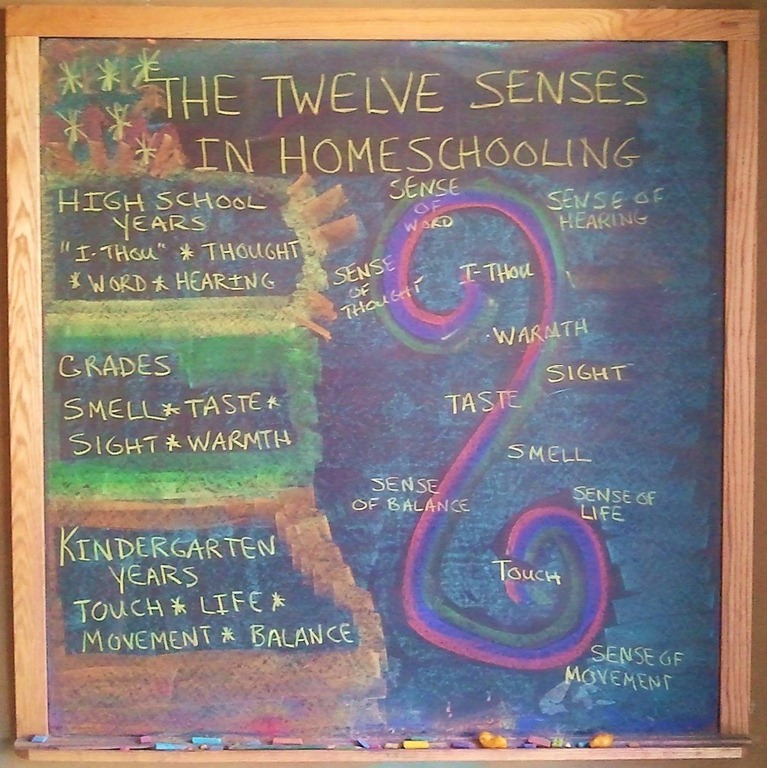
Many of you know that given my background as a physical therapist and homeschooling parent, work revolving around the twelve senses as set forth by Rudolf Steiner has been fascinating to me.    Some of the therapists and neuroscientists I have spoken to feel there are anywhere from 75 to over a hundred senses, but I feel these twelve are a fine place to start.  They are well-organized and clear, and I think it is a piece that is accessible for all educators, not just Waldorf/Steiner educators and should be of particular importance to us as homeschool educators and as parents.

Lisa Boisvert-Mackensie was kind enough to continue a virtual tea with me regarding some of the fundamental pillars of Waldorf Education.  You can see those posts here:  https://theparentingpassageway.com/2011/12/20/the-three-artistic-pillars-of-waldorf-homeschooling/ and here:  http://www.celebratetherhythmoflife.com/2011/12/as-person-who-has-straddled-worlds-of.html  and here: https://theparentingpassageway.com/2011/12/21/more-about-the-artistic-pillars-of-waldorf-education-a-virtual-tea/

Lisa’s last virtual tea post on the twelve senses ( here is the link:  http://www.celebratetherhythmoflife.com/2011/12/lemniscate-and-senses.html)  inspired me to draw the image above.  It was originally presented in horizontal form in a lecture I heard in the fall  by Douglas Gerwin, but after I really sat with this information, slept on it, let it lie fallow for a bit,  I drew this vertical figure. This vertical figure reminds me of the upright human being; it reminds me that we all have these twelve senses, and that having all of these senses fully developed leads to the freedom to give and receive love. One can have all the knowledge and training and facts in a field, and if one cannot rule over oneself, if one cannot see another’s view, if one can relate to another person, if one cannot use their knowledge and training for the love of humanity, what good does it really do?

This figure also reminds me that Continue reading

Simple Is Enough

I had two great conversations the other day, one with a dear friend about the challenges this particular generation of children is facing.  Her theory as to why children have more sensory challenges, obesity, attention deficit – in other words, why are these children so darn unhealthy – is, in her mind, a mixture of things:  environment, too much stimulation, schedules that are like an adult, too much of making the child a miniature adult, diet, lack of physical work and movement.

Then I had another conversation, this time with a dear friend and physical therapy colleague.  She is in geriatrics, but specifically wondered why she is seeing more and more dementia and Alzheimer’s-type symptoms in patients of even younger ages than before.  “The people I am seeing, HAD those kinds of childhoods that you wish for – eating local, farm-raised food before agribusiness became huge, collecting eggs and walking to school, playing outside for hours on end in rivers and creeks and the mountainside.  So why are these folks getting dementia at such a relatively young age?”

Of course, no one knows for sure; these are the kind of rhetorical things physical therapists and I am sure other health care professionals sit around and ponder.  We all wonder.

I am sure it is all the things of childhood, but also mixed with all the things of adulthood:  taking adults who were used to moving a lot to moving them into jobs that were more sitting than usual, more modern conveniences than ever that also cause decreased movement, a more toxic environment, an increasingly over-stimulating environment ( the friend from my first conversation was remarking that now when you go into a grocery store, there may be TV’s in the shopping cart, cows mooing in the diary section, dancing vegetables with loud thunder that mists over the veggies!  How true!)

But I think it is also community – or lack thereof.  The church or synagogue may not be the same hub of the neighborhood it once was, which is a shame for many reasons and on many levels but also on a health level:  one six year study showed Continue reading

Clothes For Children Who Have Challenges With Sensory Processing

I just went to a course this past week (yes, another one! ‘Tis the time of year!) regarding autism and sensory processing disorders.

For those of you who missed the posts I have done in the past regarding children with challenges in sensory modulation, indicators of sensory modulation typically include extreme inflexibility, resistance to activities, difficulty in transitioning in activities, poor behavior, over or under reaction to the environment, perseverating behaviors, a lack of inner drive or motivation, avoidance behaviors and difficulty focusing attention.

One thing that many children who have difficulty with sensory modulation find challenging is finding clothes they can feel good in.  Dressing can be the most difficult point of the day for a child challenged by sensory issues and their parents.  Continue reading

Children Who Dislike Everything

I was going through some papers this weekend and came across an article by Michael Howard that I had printed out called, “Educating the Feeling-will in the Kindergarten” and this quote just popped out at me:

“The defining characteristic of feeling will is the capacity to live deeply into the inner quality of something outside us, knowing and feeling it as if we are within it or it is within us. In the early childhood years a healthy child is naturally inclined to drink in the inner mood and qualities of places and persons.  It is one of the tragedies of our times that the ways of the world, including the life of the family and school, can dull rather than foster this natural soul attachment.  Tragically, many young children come to kindergarten with a sense-nerve disposition already strongly developed.  Their thinking has become prematurely intellectual and abstract, and their feeling life inclines toward strong personal like or dislike.”

I have been seeing so many tiny children yet with so many big opinions.  Have you been seeing this as well?  Continue reading